
Collector's Corner
MONEY, MONEY, MONEY: Currency as an Artistic Medium in the Work of Tamara Bell
Nov
For me, one of the great joys of attending the Santa Fe Indian Market is coming upon the work of an artist that is totally unknown to me. Every year, in addition to the output of the artists whose work is familiar to me, I always stumble upon an artist’s work that is a complete surprise and I always wonder at how I could have missed it in previous years. If truth be told, Indian Market can be overwhelming not only for newcomers, but for veterans as well. Usually, I am running from booth to booth visiting with old friends so it is easy to miss things. With over 1,000 Native artists represented from over 200 Tribal Nations, one cannot see everything and everyone even in the market’s two days.
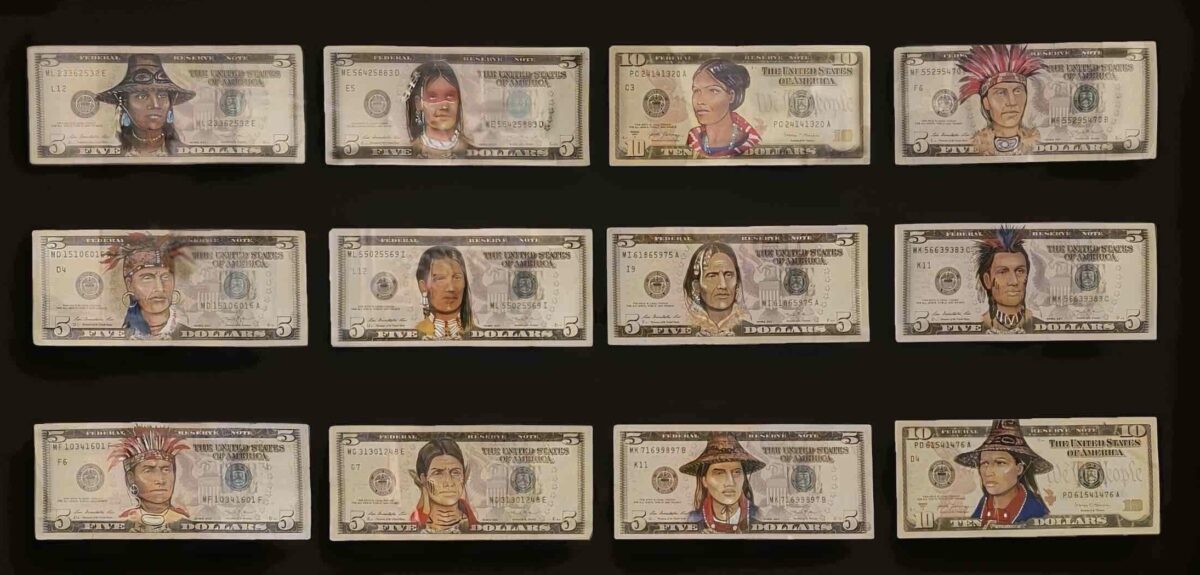
This year on the second day of the Santa Fe Indian Market I was mostly wandering about, saying my goodbyes when I happened upon the booth of Haida artist Tamara Bell. I was immediately fascinated and struck up a conversation with her and her son. The work that this artist was showing was daring in a subtle fashion but, technically, it was illegal. Was I really seeing what I thought I was seeing? Sure enough there were five, ten, twenty, and even fifty dollar U.S. bills as well as Canadian paper currency with images of Native Americans painted on them. This was something I had never seen before. I was somewhat shocked and definitely intrigued and I absolutely wanted to learn more. Firstly, I was curious as to why of all the currencies in the world the artist had focused on the U.S. and Canada. The answer was tied to the Ms. Bell’s Native heritage and the sad record of how Native Peoples have been treated by the U.S. and Canadian Governments for centuries. Through these artistic expressions Tamara Bell is making personal and political statements.
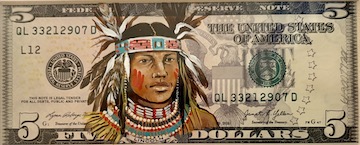
Founding Fathers by Tamara Rain Bell (aka 6690077201), Haida, acrylic paint on U.S. $5.00 bill, 2.5” x 6” (2025). Collection of E. J. Guarino.
A nation’s currency presents its identity not only to its citizens, but also to the rest of the world by visually displaying its history, culture, and beliefs. By using national currencies as her canvas, Tamara Bell is redirecting the narrative, something she frequently does. In her work she alters U.S. and Canadian dollar bills, imposing portraits of Indigenous people over U.S. and Canadian national figures. On U.S. bills where one would expect to see an image of Andrew Jackson, Abraham Lincoln, or Ulysses S. Grant, Bell instead paints an image of a Native person, frequently a female, thus making a political statement about the relationship these Presidents and the U.S. Government had with Indigenous populations. On a certain level, Bell’s work is bold since it is technically illegal to “deface” U.S. currency.
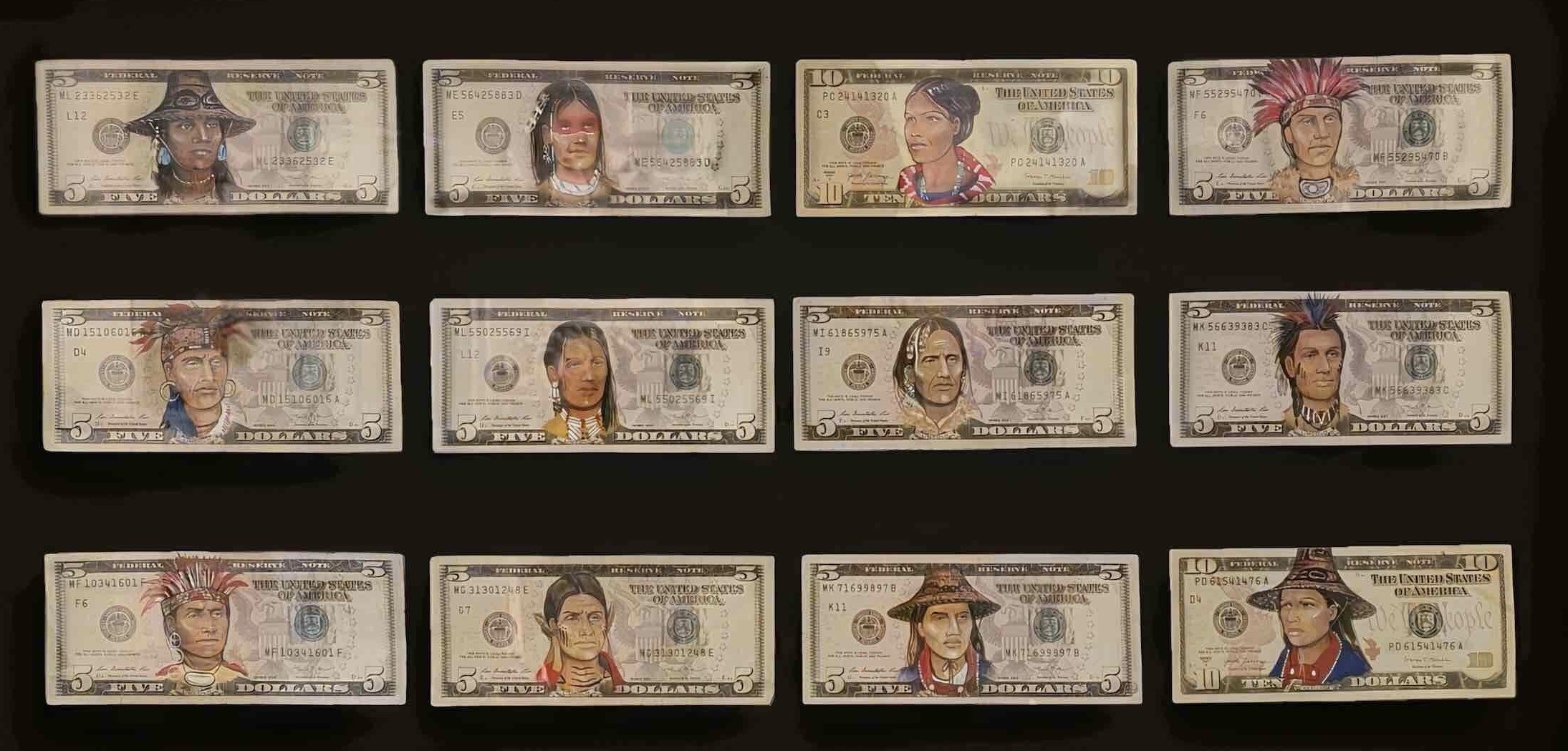
Image courtesy of the artist.
Through her art, Tamara Bell creates a curiosity in the viewer. One wonders why she has painted over the faces of U.S. Presidents and what exactly were their policies regarding Native Americans.
Although these men are venerated for various accomplishments, their policies regarding Indians is not well-known by the public:
In 1830 President Andrew Jackson (U.S. $20.00 bill) signed the Indian Removal Act. More than 60,000 Native Americans from some eighteen tribal nations were forced to move west of the Mississippi River, some to what was termed Indian Territory (Oklahoma) and others to Kansas. The Cherokee unsuccessfully challenged their relocation in the courts and were forcibly removed from their ancestral lands. This became known as the Trail of Tears.
Although Abraham Lincoln (U.S. $5.00 bill) signed the Emancipation Proclamation freeing enslaved African Americans, he fell far short in applying the same ideals to Native Americans. Lincoln was uninformed at best and fell into following the same policies as his predecessors: treaties were broken, territories confiscated, tribes were forcibly removed from ancestral lands, and genocidal acts by the U.S. military were generally ignored.
President Ulysses S. Grant (U.S. $50.00 bill) was sympathetic to the plight of Native Americans, but his attitude regarding the “Indian Problem” was that they needed to be civilized and assimilated into the larger American society. To achieve this end he established what was to become the Bureau of Indian Affairs (BIA) and had missionaries, particularly Quakers, manage reservations and provide education. In his inaugural address referred to Indians as the “original occupants of the land” and promised that he would follow any course of action that would eventually lead to their citizenship. As President, Grant appointed Ely S. Parker, a Seneca, as his Commissioner of Indian Affairs. Although Grant’s strategy with regard to Native Americans was rooted in his 1869 Peace Policy, his efforts ultimately failed. During the Grant Administration a number of wars were waged against Native Americans, including the Modoc War, the Red River War, and the Great Sioux War whose most infamous battle was the Battle of the Little Big Horn.
George Washington (U.S. $1.00 bill) and Thomas Jefferson (U.S. $2.00 bill) also had complex and complicated attitudes regarding Tribal Peoples usually seeing them as objects of curiosity, sometimes as enemies, at other times allies, and mostly as uncivilized. Although Jefferson referred to Indians as “merciless savages” in the Declaration of Independence, he later wrote, “I beleive [sic] the Indian then to be in body and mind equal to the whiteman,” in a 1785 letter.
Painting Native portraits over U.S. and Canadian historical figures on currency is a form of “poetic justice,” as Tamara Bell sees it. These images are painted with great attention to detail by the artist who uses a magnifying glass as well as cosmetic brushes, particularly eyeshadow brushes as well as nail brushes for the finer details and hair.
Another unconventional aspect of Bell’s work is that, rather than sign her work in the traditional way with her name, she, instead, uses 6690077201, her identifying number from her status card. Such cards determine who is Native American. This system monitors what is termed blood quantum – the number of ones ancestors who were documented as being full-blooded Native Americans. However, this governmental policy has no basis in Native American traditions, which has always relied on kinship and lineage to establish tribal membership.
Although I simply stumbled upon Tamara Bell’s booth, I am very excited that I did. I find her work fascinating and because she has painted over figures on currency, it forces the viewer to think and consider just who was represented on the bill. I would venture to guess that most of us don’t know who is on what denomination. Using currency as her artistic medium, Tamara Bell has encouraged discussions and explorations about history and the often adversarial attitudes the American and Canadian Governments held regarding Native Peoples. It is a conversation long overdue.