
Collector's Corner
DISTURBING: Arnaqu Ashevak’s Composition (Cancer)
As a collector, I have not shied away from acquiring works dealing with a diverse range of controversial themes. Inuit works dealing with physical abuse, sexual exploitation, violence, autoeroticism, and even cannibalism are part of my collection. I first became aware of Inuit art that dealt with controversial subject matter in 1999 when I saw Three Women, Three Generations: Drawings by Pitseolak Ashoona, Napachie Pootoogook and Shuvinai Ashoona at the McMichael Canadian Art Collection in Kleinburg, Ontario. The exhibit was a revelation since it included works dealing with themes I had never seen addressed in Inuit art. I quickly realized that in order for my collection to show the depth and scope of Inuit graphic art it needed to contain such material. However, when I recently saw Composition (Cancer) by Arnaqu Ashevak I hesitated because it hit too close to home. This work made me uncomfortable and there was a simple reason it did so: In 2016 I was diagnosed with multiple myeloma, a type of blood cancer. Arnaqu Ashevak had taken a nightmare we all fear, and some have experienced, and had given it a disturbing visual presence.
When I was growing up, cancer was so feared the the word was spoken in whispers. Even today, some people will not speak the word, instead referring to it as the “Big C” or some other euphemism. For quite some time, try as I might, I could not find out what type of cancer afflicted Arnaqu Ashevak, which might reflect the fact that, even today, despite vast advances, people still fear the disease so much that they hesitate to name it, or even speak of it.
Arnaqu Ashevak, the adopted son of famed Inuit artist Kenojuak Ashevak and Johnniebo Ashevak, was predominantly known as a sculptor, but he also produced drawings and prints and was also a printmaker for other Kinngait (Cape Dorset) artists. Ashevak’s work is unique, particularly his sculptures, which were not straightforward carvings; they were constructions composed of diverse materials, which were often unusual. Many of the artist’s works on paper also have a visceral, ofttimes surreal quality and sometimes deal with controversial and troubling subject matter. However, as harrowing as some of Ashevak’s works may be, for many, Composition (Cancer) is the artist’s most disquieting creation.
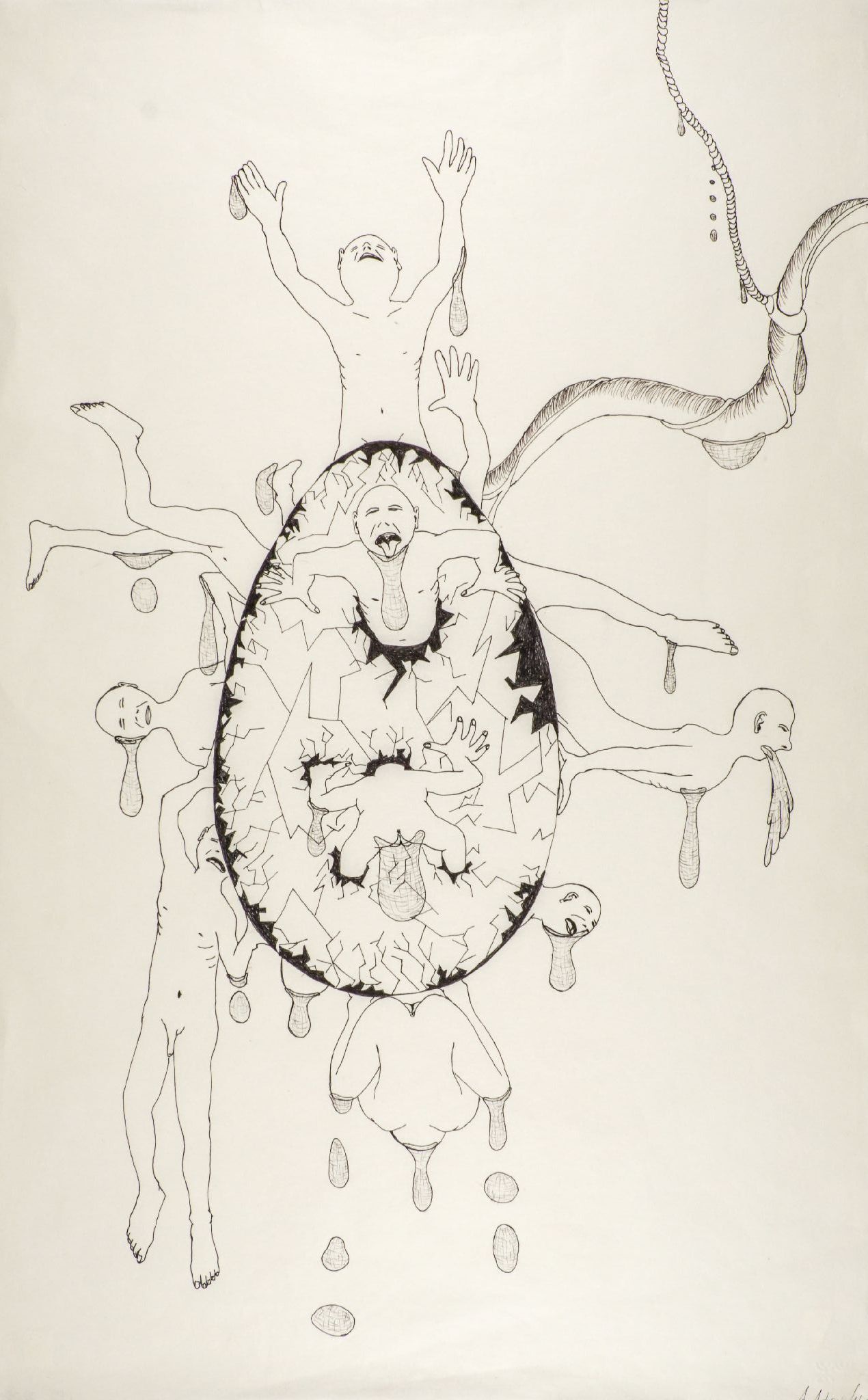
Composition (Cancer) by Arnaqu Ashevak, Kinngait (Cape Dorset), ink on paper, 39” x 24 3/8” (2006). Collection of E. J. Guarino. Image courtesy of Feheley Fine Arts, Toronto, and Dorset Fine Arts, Toronto.
There is no denying that Composition (Cancer) is a troubling, surreal work. It is definitely not to everyone’s taste since it forces the viewer to confront something he or she would prefer to ignore. Most people still perceive cancer as silent, invisible – and deadly. Arnaqu Ashevak has taken the dreaded disease and given it a graphic representation, though a horrifying one. The central image looks very much like an egg. Within it are two figures – one appears to be screaming as he breaks through what might be ice or shards of glass while the other seems to bury his head. This image may very well suggest what a person goes through when first diagnosed with cancer – both terrible fear as well as denial, thinking This isn’t true. The “egg” has an organic looking tube coming out of it, but the viewer does not see where it leads or to what it is connected, leading one to consider the possibility that the oval actually represents the human stomach rather than an egg. (In a discussion on March 19, 2026 with Pat Feheley, owner of the Feheley Fine Arts Gallery, she said that as far as she remembers Arnaqu Ashevak suffered from stomach cancer, or possibly intestinal cancer.) Emerging from the oval are various tormented-looking figures, which appear to represent the sufferings of cancer patients. One is vomiting, another suggests diarrhea, while others have their arms raised, wearing expressions of anguish while some liquid (blood?) drips out of their limbs.
Composition (Cancer) is unsettling and nightmarish, but it remains in the viewer’s memory. In it Arnaqu Ashevak has confronted his and our worst fear – the dreaded disease, its effects, as well as what might be the results of treatment. Through his art Ashevak has forced us to acknowledge his suffering and mortality and through it what we would prefer not to recognize – our own.
Many collectors believe that controversial subject matter has no place in Inuit art and some of the harshest criticism Inuit artists have faced has come from members of their own communities who feel that personal and communal problems should not be aired publicly. In spite of this, Arnaqu Ashevak created works that explore deeply personal, often painful themes, refusing to remain safely within the expected norm. In 1998 Ashevak produced Daymare, a drawing, and Untitled (Study for Daymare), a monoprint, both of which referenced the Holocaust as well as a sculpture in 2008 titled Suicide Altar.
Arnaqu Ashevak’s influences were many and varied – art magazines, a book about Celtic designs, a TV documentary about the Holocaust as well as the Lupa Capitolina (the Capitoline Wolf), the famous sculpture of a she-wolf nursing Romulus and Remus, the founders of Rome. Perhaps surprisingly, two of Ashevak’s favorite artists were Alexander Calder and M.C. Escher who, like him, continually surprised and intrigued their audience.
Despite living in an Arctic hamlet with a population of under 1,500 and being geographically isolated from most of the rest of the planet, Arnaqu Ashevak defied the assumptions of gallerists, collectors, and curators, many of whom expected charming images of Arctic wildlife, or a romanticized version of life as it was once lived on the land. Instead, Arnaqu Ashevak gave them the unexpected – a look into his own suffering and, by extension that of so many others. Rather than reinforce outmoded concepts, Ashevak’s work reflects the concerns and interests of a contemporary artist. It is true that Composition (Cancer) is a painful, unsettling, and distressing work. However, art has many purposes; it can uplift us, delight us, amuse us, and awe us, but it can have other meanings as well, including allowing us in some small way to empathize with the suffering of our fellow humans. In this respect Arnaqu Ashevak has succeeded admirably.