
Scott, Rain – 13″ Tall “Flying High” Origami Water Jar with Lid
$ 5,800.00
Rain Scott is the son of jeweler Raynard Scott (Navajo) and a descendant of Marie Z. Chino of Acoma. He says that growing up in Arizona, he wanted to learn to make pottery but didn’t have anyone to teach him. In 2011, he began working with origami, the art of creating objects with folded paper. From 2013 to 2018, he experimented with the art form and, in 2018, made his first vessel, an Acoma jar. He calls his style “contemporary Indigenous origami.” Each piece is made from thick paper and creates a corrugated texture.
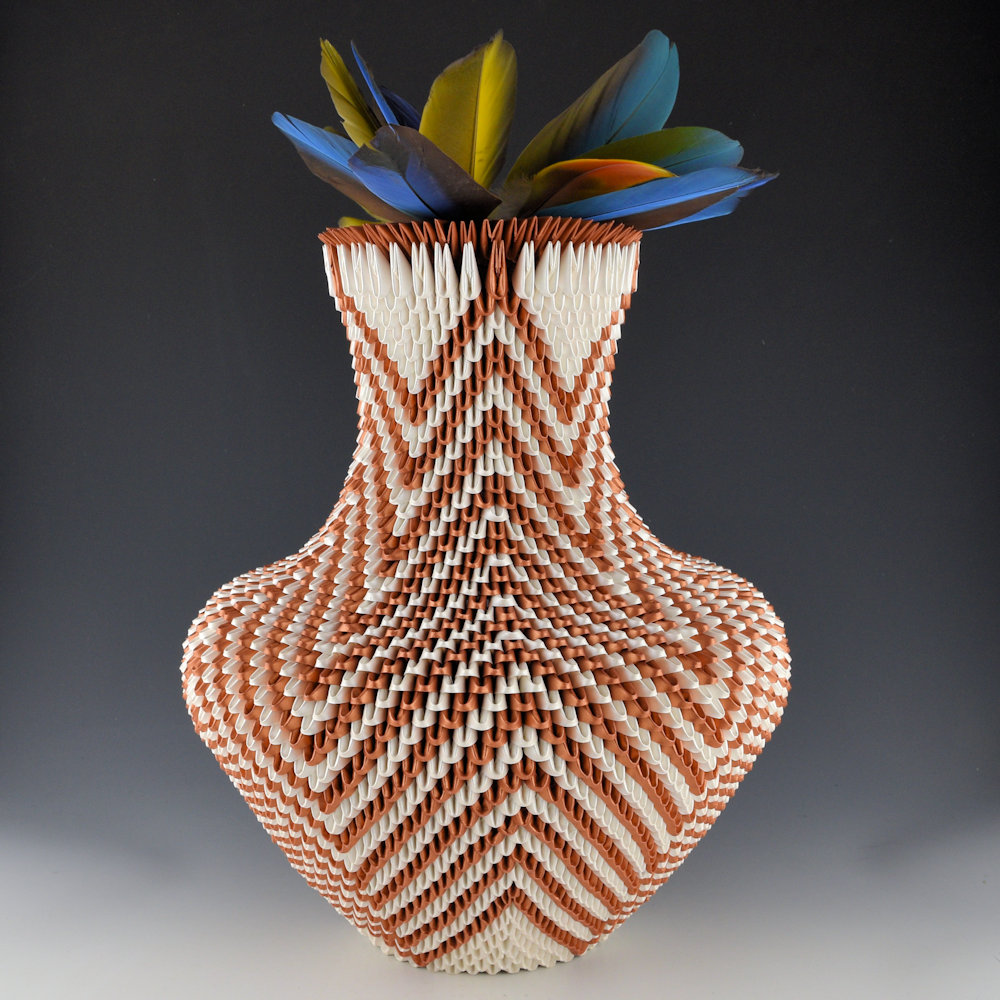
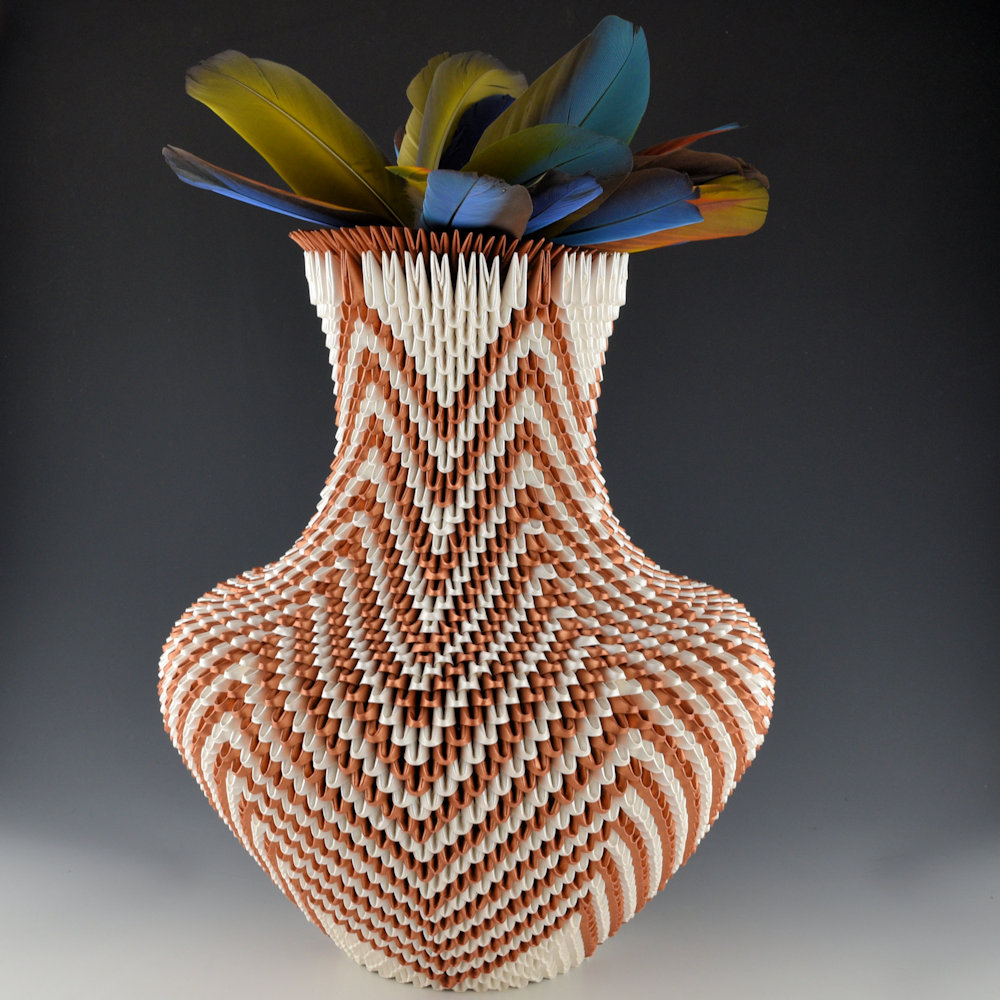
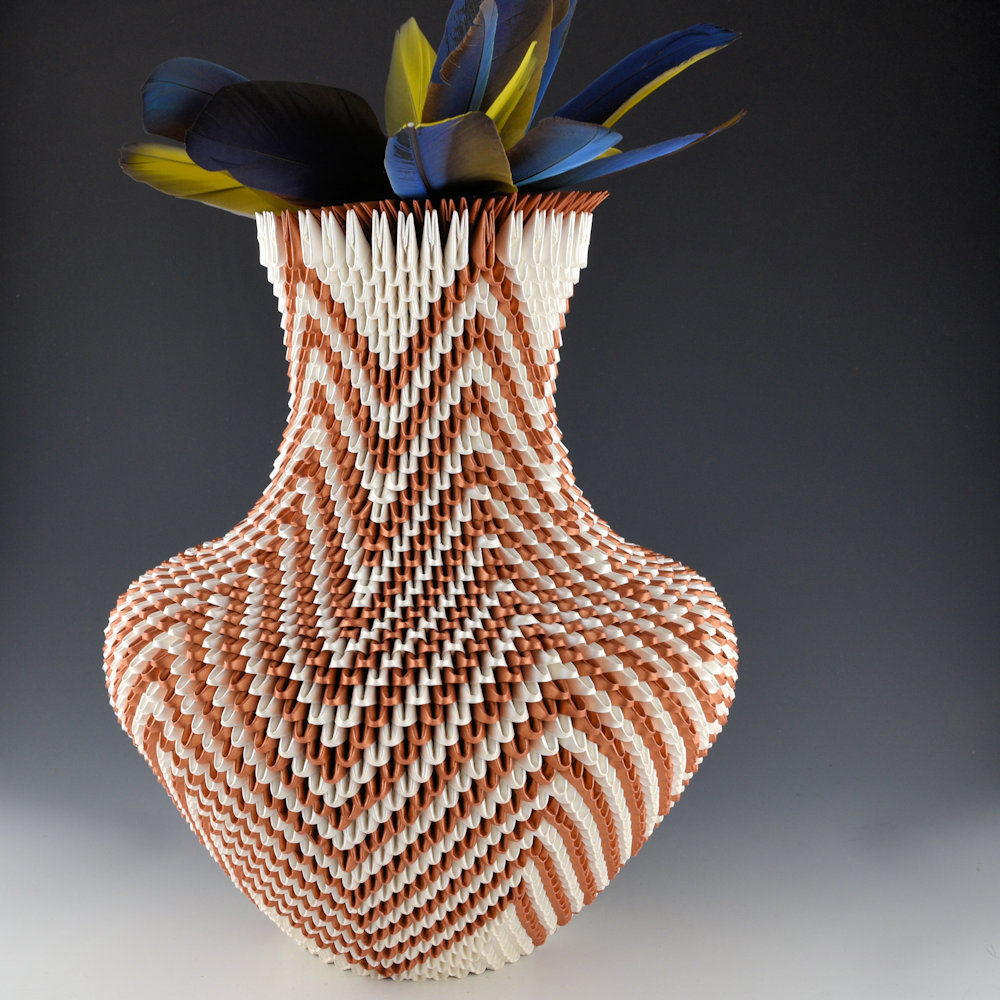
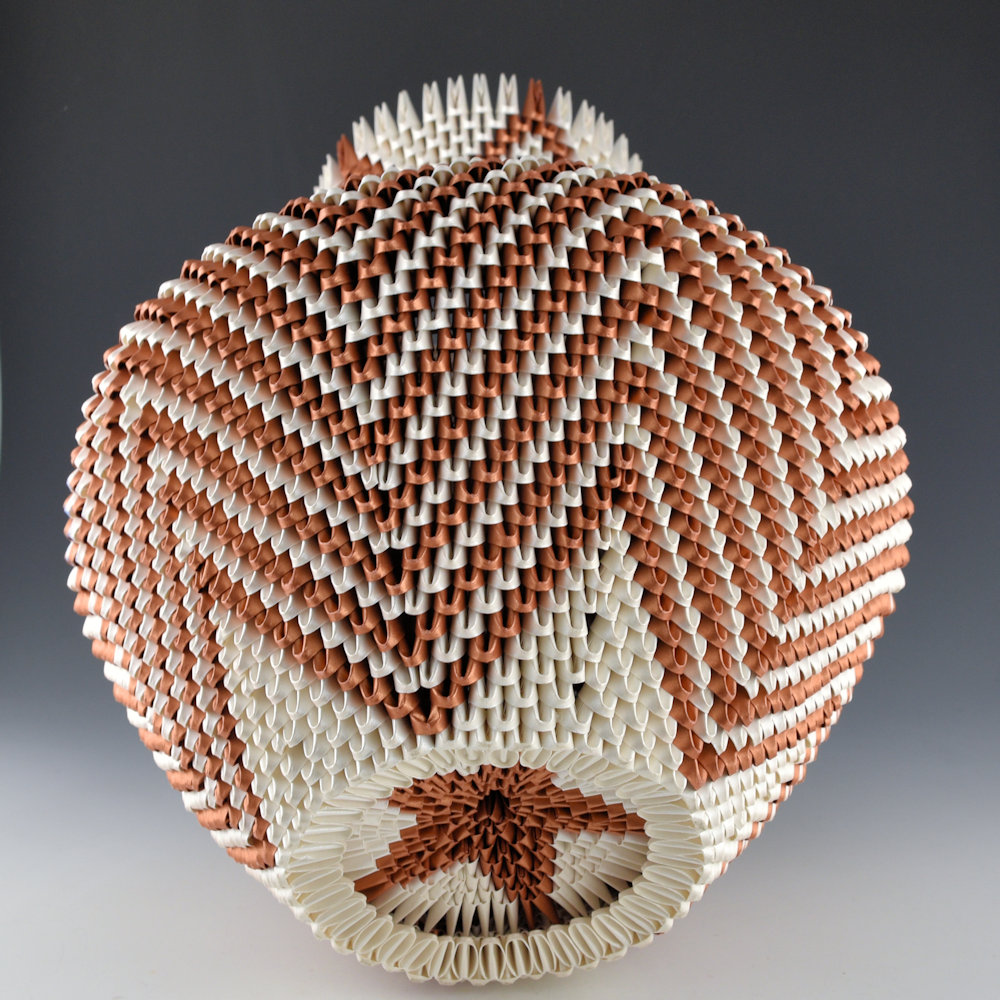
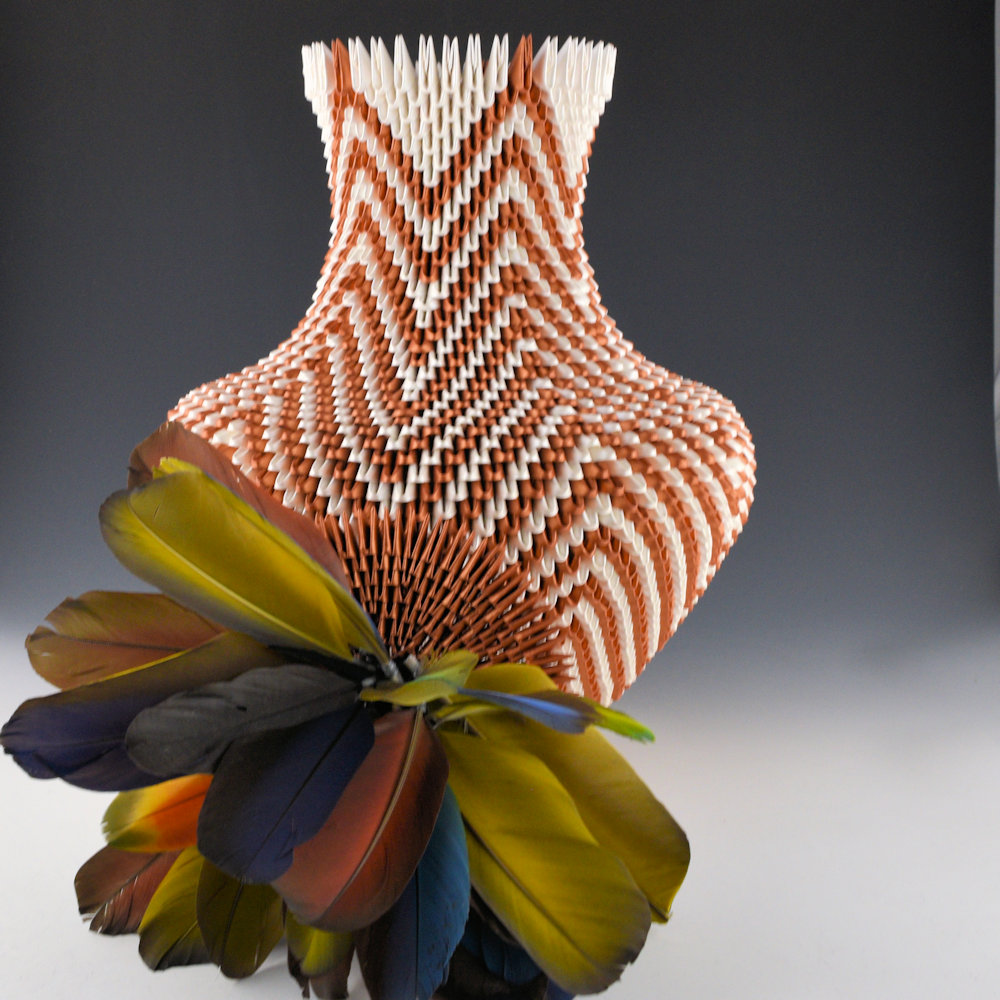
This is one of the larger pieces of his work we have had in the gallery. The starburst design works perfectly for this shape, as it captures the shoulder and the length of the neck. It is entitled, “Flying High”. Rain says of this piece:
There are over 7,000 individually cut and folded metallic copper and white modules. The lid is a combination of scarlet, blue, and gold, green wing, and hyacinth macaw feathers. The jar too a little over two and a half months from start to finish. An olla is a semi-functional storage vessel with a lid that detaches and feathers that are ready to use for a dance at a moment’s notice. I got the idea to make the feathers detachable by observing people from Acoma who take part in traditional dances. They usually store their feathers in drawers, hang them on walls, or suspend them from the ceiling. My vessel is a decorative way to display your feathers and have them ready to be used when called upon at any moment.
Rain used white 8 1/2 x 11 sheets of paper to make the design. Each full sheet is folded to make each section! The jar has an elegant form with a high shoulder and elongated neck. The jar has an elegant form with a round shoulder and elongated neck. The jar has a lid with a piece of coral attached as the finial. Rain keeps on innovating his art form with each new piece! Believe it or not, thousands of pieces of paper were used to make this jar! The piece is signed on the bottom, “Rain Scott”. There is a Third Place ribbon from the 2024 Eiteljorg Museum Show. It’s exciting to have such innovative work in the gallery. Most recently, Rain’s indigenous origami has been featured in First American Art magazine and Native Art Magazine.
“I call my work contemporary origami pottery. I came up with them as I wanted to learn to make traditional pottery. I never had a teacher to show me how to get the clay or slips. I was always creative with paper. I started out with swans and then one day wanted to see how I could make a vase. It took a lot of experimentation”. Rain Scott
In stock
Rain Scott is the son of jeweler Raynard Scott (Navajo) and a descendant of Marie Z. Chino of Acoma. He says that growing up in Arizona, he wanted to learn to make pottery but didn’t have anyone to teach him. In 2011, he began working with origami, the art of creating objects with folded paper. From 2013 to 2018, he experimented with the art form and, in 2018, made his first vessel, an Acoma jar. He calls his style “contemporary Indigenous origami.” Each piece is made from thick paper and creates a corrugated texture.
This is one of the larger pieces of his work we have had in the gallery. The starburst design works perfectly for this shape, as it captures the shoulder and the length of the neck. It is entitled, “Flying High”. Rain says of this piece:
There are over 7,000 individually cut and folded metallic copper and white modules. The lid is a combination of scarlet, blue, and gold, green wing, and hyacinth macaw feathers. The jar too a little over two and a half months from start to finish. An olla is a semi-functional storage vessel with a lid that detaches and feathers that are ready to use for a dance at a moment’s notice. I got the idea to make the feathers detachable by observing people from Acoma who take part in traditional dances. They usually store their feathers in drawers, hang them on walls, or suspend them from the ceiling. My vessel is a decorative way to display your feathers and have them ready to be used when called upon at any moment.
Rain used white 8 1/2 x 11 sheets of paper to make the design. Each full sheet is folded to make each section! The jar has an elegant form with a high shoulder and elongated neck. The jar has an elegant form with a round shoulder and elongated neck. The jar has a lid with a piece of coral attached as the finial. Rain keeps on innovating his art form with each new piece! Believe it or not, thousands of pieces of paper were used to make this jar! The piece is signed on the bottom, “Rain Scott”. It’s exciting to have such innovative work in the gallery. Most recently, Rain’s indigenous origami has been featured in First American Art magazine and Native Art Magazine.
“I call my work contemporary origami pottery. I came up with them as I wanted to learn to make traditional pottery. I never had a teacher to show me how to get the clay or slips. I was always creative with paper. I started out with swans and then one day wanted to see how I could make a vase. It took a lot of experimentation”. Rain Scott
Brand
Scott, Rain (b. 1998)
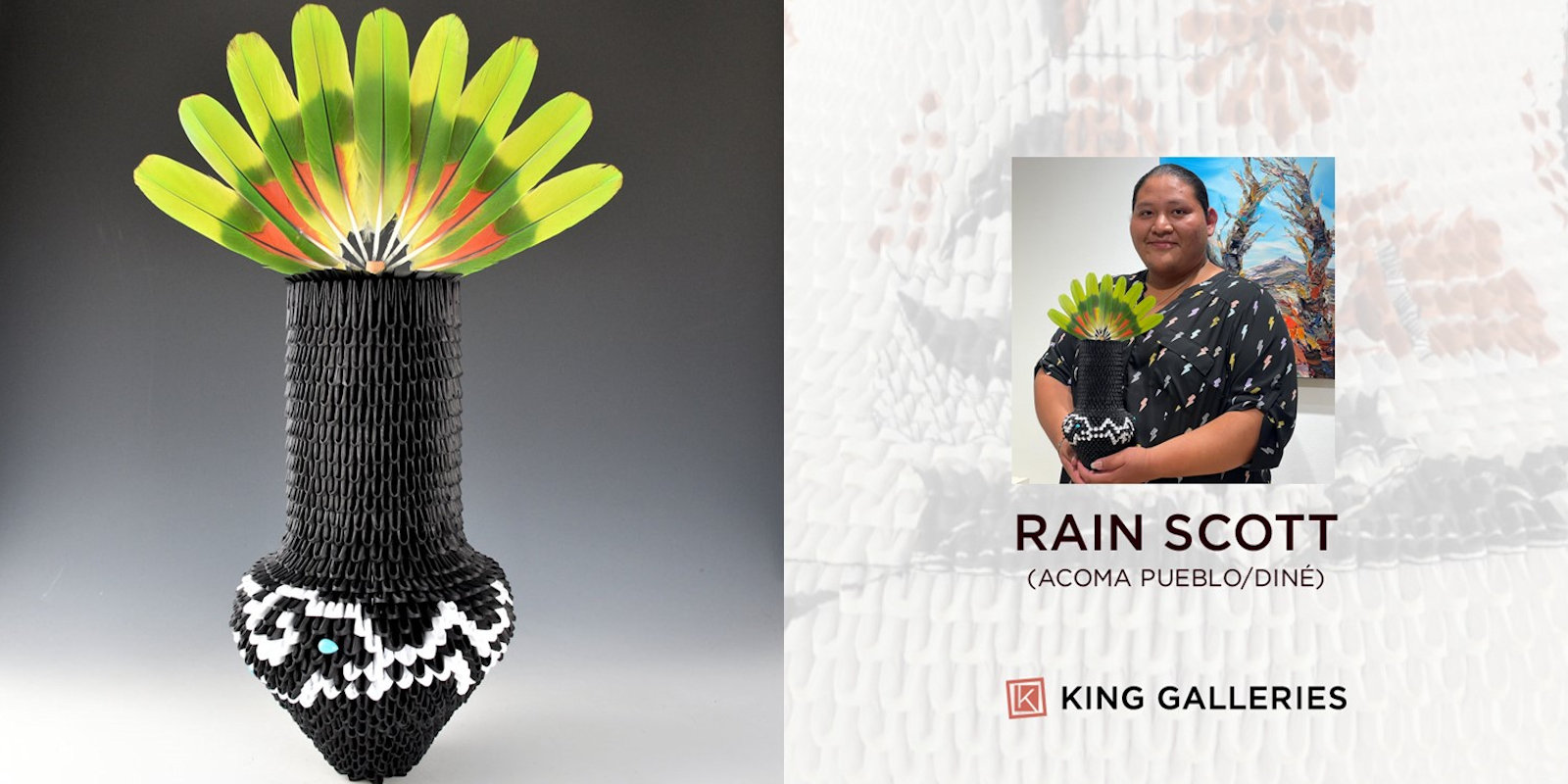 Rain Scott is half Navajo and half Acoma. Growing up, he would watch his father, Navajo silversmith Raynard Scott, make countless jewelry pieces out of silver, turquoise, and other precious gemstones. His upbringing sparked a passion for art, taking a particular interest in painting and still life drawing. In 2011, he developed a new interest in Japanese origami art and traditional Acoma Pueblo ceramics. For the next couple of years, he tried and failed to find a teacher to teach him the traditional art form of Acoma pottery. Instead of giving up on his aspirations, he called upon his talent for origami art and knowledge of conventional Acoma pottery designs. As a result, he created an entirely new style of Native American art.
From 2013 to 2018, Rain experimented with his newfound artform. He sculpted simple peacock and swan forms, ultimately winning a youth award in the 2014 Heard Museum student art show. In 2018, he cut his first contemporary origami vessel in the shape of a white corrugated Acoma pot with a rounded shoulder and a short neck and finished with a simple black rim. Thus, his art form was born.
Since 2018, Rain Scott has combined the traditional Acoma Pueblo pottery designs with individually cut and folded origami modules into an art form that he calls “contemporary Indigenous origami.” The thick, sturdy walls and corrugated texture of his origami pottery make every piece pleasing to the eye and gratifying to touch. He pushes the boundaries further with every art piece he creates, incorporating new designs, shapes, colors, and components, including parrot feathers, turquoise, and natural sinew. Rain Scott’s creations have been awarded many awards at juried art shows in the Southwest, including the 2020 Alan Houser Innovation Award at the Heard Museum Guild Indian Fair and Market.
Rain Scott is half Navajo and half Acoma. Growing up, he would watch his father, Navajo silversmith Raynard Scott, make countless jewelry pieces out of silver, turquoise, and other precious gemstones. His upbringing sparked a passion for art, taking a particular interest in painting and still life drawing. In 2011, he developed a new interest in Japanese origami art and traditional Acoma Pueblo ceramics. For the next couple of years, he tried and failed to find a teacher to teach him the traditional art form of Acoma pottery. Instead of giving up on his aspirations, he called upon his talent for origami art and knowledge of conventional Acoma pottery designs. As a result, he created an entirely new style of Native American art.
From 2013 to 2018, Rain experimented with his newfound artform. He sculpted simple peacock and swan forms, ultimately winning a youth award in the 2014 Heard Museum student art show. In 2018, he cut his first contemporary origami vessel in the shape of a white corrugated Acoma pot with a rounded shoulder and a short neck and finished with a simple black rim. Thus, his art form was born.
Since 2018, Rain Scott has combined the traditional Acoma Pueblo pottery designs with individually cut and folded origami modules into an art form that he calls “contemporary Indigenous origami.” The thick, sturdy walls and corrugated texture of his origami pottery make every piece pleasing to the eye and gratifying to touch. He pushes the boundaries further with every art piece he creates, incorporating new designs, shapes, colors, and components, including parrot feathers, turquoise, and natural sinew. Rain Scott’s creations have been awarded many awards at juried art shows in the Southwest, including the 2020 Alan Houser Innovation Award at the Heard Museum Guild Indian Fair and Market.