

Collector's Corner
WESTWARD HO!: The Corps of Discovery’s Directive to Reach the Pacific Ocean
Jun
In 1803 the United States Government bought the Louisiana Territory from France for the sum of fifteen million dollars. With interest, the total price came to twenty-three million dollars. This purchase doubled the size of the United States and forever changed the balance of power in the Western Hemisphere. In order to learn more about this vast area and the land beyond it, President Thomas Jefferson commissioned the Corps of Discovery to traverse the Louisiana Territory and map it. The expedition, to be led by Captain Meriwether Lewis and Lieutenant William Clark, was also to explore the geography, plants, and animals of the regions they would pass through. The main objective of the Corps was to find a water passage to the Pacific Ocean. To that end, Jefferson sent a secret message to Congress on January 18, 1803 requesting the sum of $2,500 to explore the West – as far as the Pacific Ocean. At the time, the land beyond the newly acquired Louisiana Territory did not belong to the United States – it was populated by Native Peoples, but Spain, England, France and Russia were also vying for this land.
Another objective was to find out how the newly acquired territory could facilitate commerce. For this purpose, it was important for the Corps of Discovery to establish peaceful relationships with the Indigenous Nations they would encounter and to convey the benefits of trade with the United States.
President Jefferson wrote the following directive to Captain Meriwether Lewis regarding the Corps of Discovery and Native Nations they would encounter:
In all of your intercourse with the natives treat them in the most friendly & conciliatory manner which their own conduct will admit; allay all jealousies as to the object of your journey, satisfy them of its innocence, make them acquainted with the position, extent, character, peaceable & commercial dispositions of the U.S., of our wish to be neighborly, friendly, & useful to them, & our dispositions to a commercial intercourse with them; confer with them on the points most convenient as mutual emporiums, & the articles of most desirable interchange for them & us.
When the Corps of Discovery set out in May 1804 from the St. Louis, Missouri area, in addition to Lewis and Clark, it consisted of forty-five members made up of soldiers, hunters, civilians, several French boatmen. The most well-known members were York, Willam Clark’s slave; Toussaint Charbonneau, a French Canadian trader; his seventeen-year-old, pregnant wife Sacagawea who, though her husband said she was Shoshone, may actually have been a member of the Hidatsa tribe; their infant son Jean Baptiste, who was born on the journey,;and Seaman, Meriwether Lewis’ black Newfoundland dog.
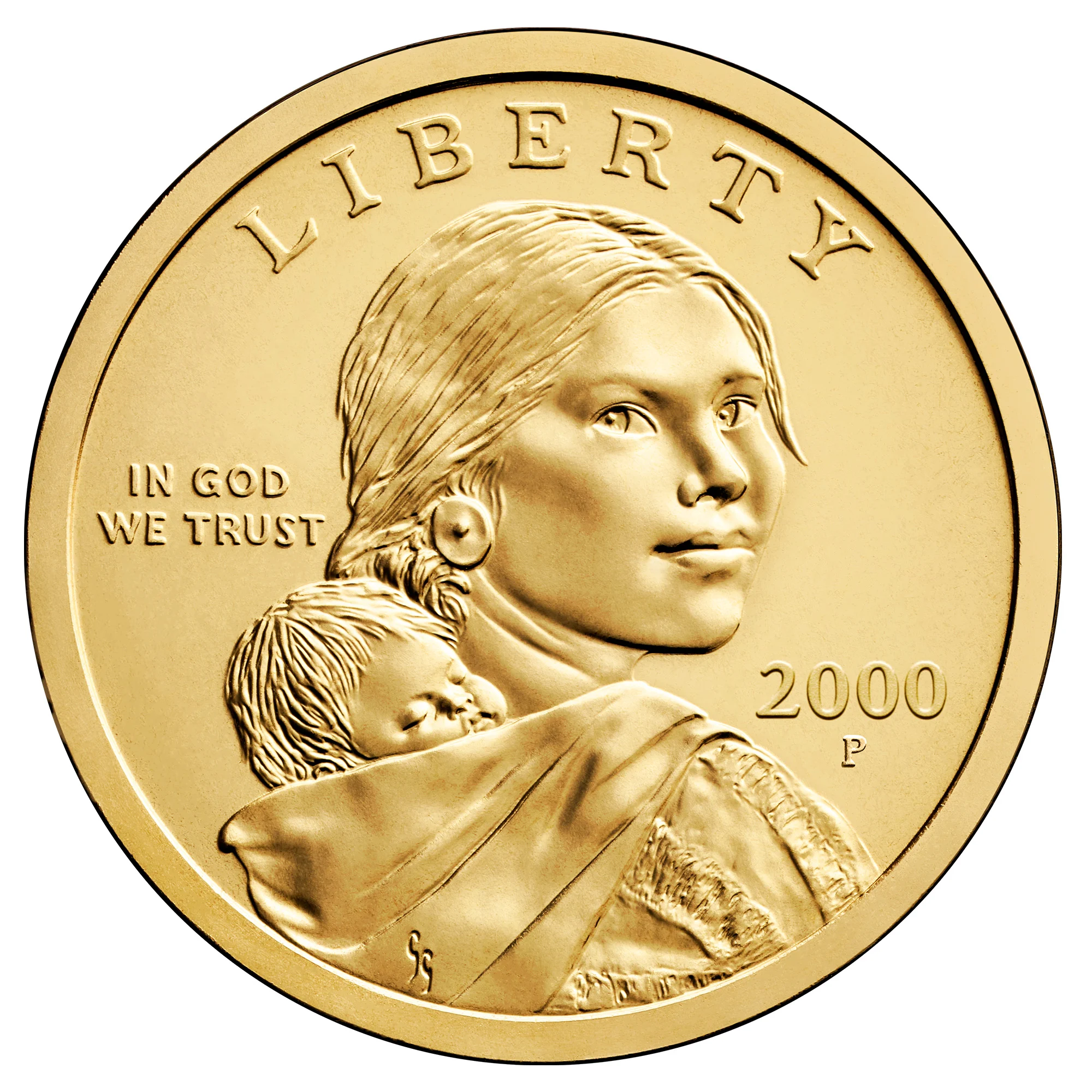
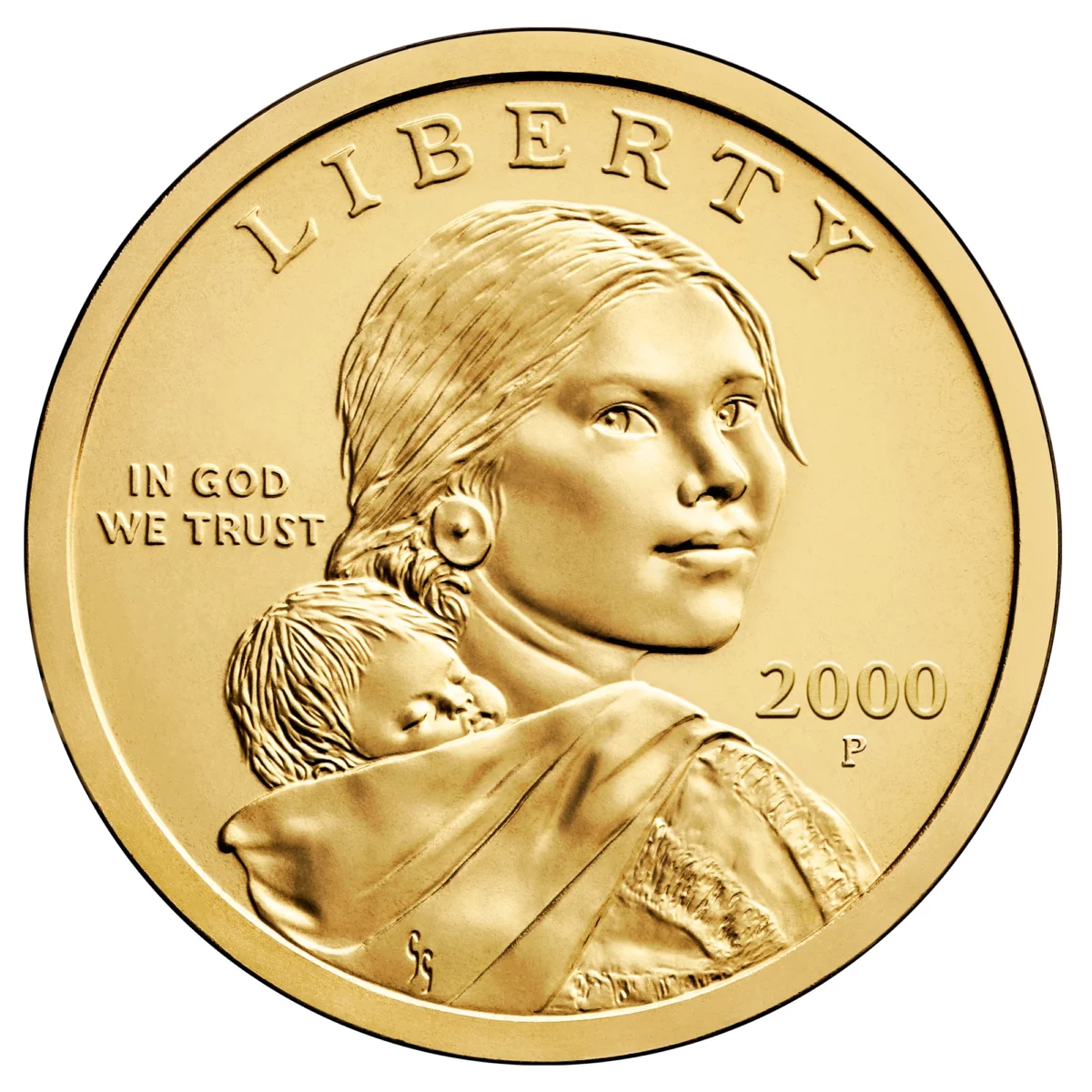
The Sacagawea Golden Dollar (recto). Minted from 2000 to 2008, this coin commemorates Sacagawea’s contributions to the Corps of Discovery’s mission.

The Sacagawea Golden Dollar (verso).
Sacagawea, the third most famous member of the expedition, was particularly important to the Corps of Discovery: Her presence and that of her infant son indicated to tribal groups that the intentions of the Corps was peaceful since war parties did not travel with women and infants. Sacagawea, also, sometimes acted as an interpreter with tribes whose languages she spoke and on a few occasions acted as guide. Sacagawea’s chief contribution, however, was saving the expedition’s journals when one of the boats in which the members of the Corps were traveling nearly capsized on the Missouri River on May 14, 1805.
In November 1805, the explorers reached Oregon after having crossed the Rocky Mountains and the Snake and Columbia Rivers. On their journey they had traversed what later became the modern-day states of Illinois, Missouri, Iowa, Nebraska, South Dakota, North Dakota, Montana, Idaho, Washington, and Oregon. Although they could could see and hear the ocean, it was still some distance away and because of extreme weather – violent winds, rain, hail, whirlwinds, pounding waves, falling trees, and a difficult terrain – it would take the Corps another eleven days to reach it.
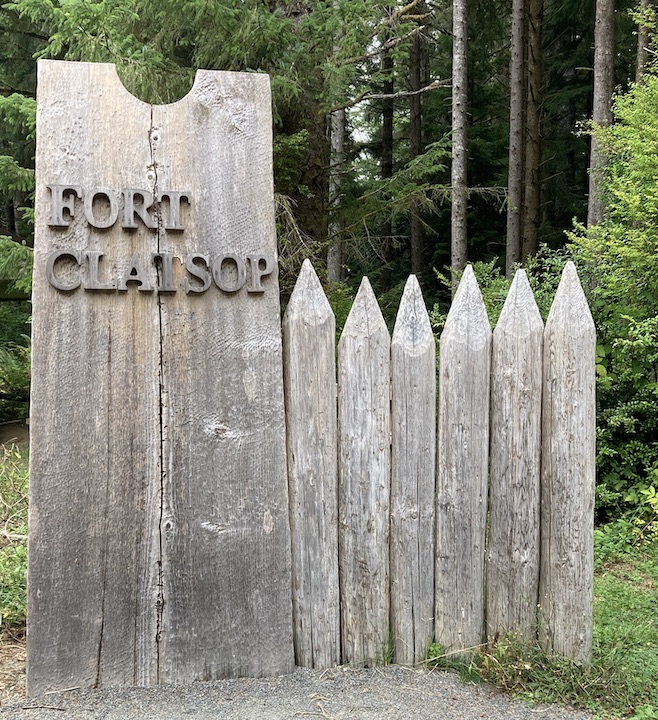
Entrance to the Lewis and Clark National Historical Park, Astoria, Oregon. (Photo by E. J. Guarino)
The Corps had been traveling for for eighteen months and because of the almost constant inclement weather and the time of year, it was decided by vote to spend the winter on the south side of the Columbia River, near present-day Astoria, Oregon. In early December 1805 members of the Corps began constructing a a 50-by-50-foot stockade, which they named Fort Clatsop since it stood in the homeland of the Clatsop people.
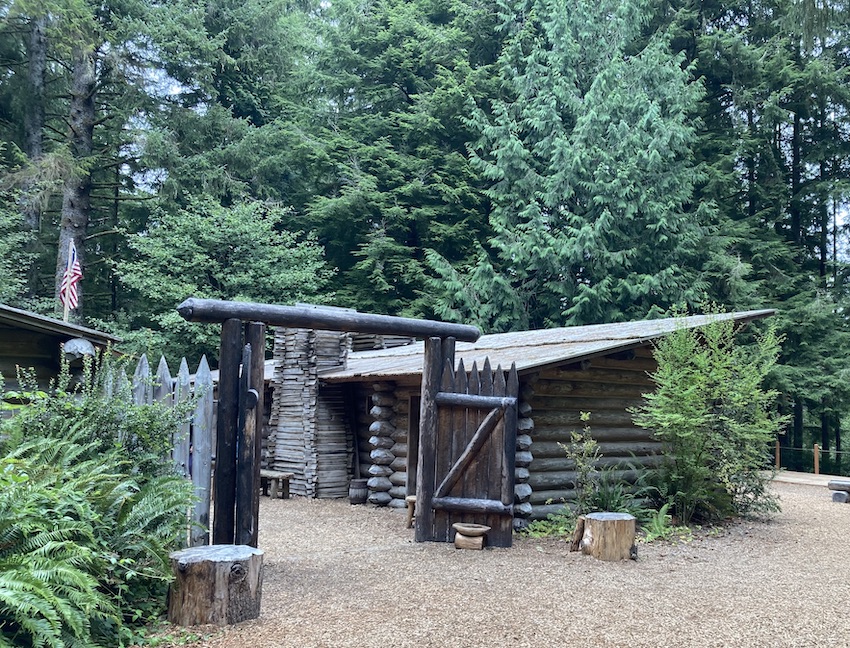
Reconstruction of Fort Clatsop, Lewis and Clark National Historical Park. (Photo by E. J. Guarino)
The Corps of Discovery remained at the fort from December 1805 to March 1806. During this period, it rained ninety four days out of 106. The men suffered with colds, influenza, as well as other illnesses. Lewis and Clark spent this period collecting plant specimens and studying the environment. They also drew maps, hunted, examined the remains of a beached whale, and distilled seawater for salt. Lewis and Clark meticulously recorded what they saw in their journals – fauna, flora, the environment, the landscape, and the people – with words, which were accompanied by highly detailed illustrations. This was something that was done throughout the entire journey of the Corps of Discovery.
Throughout the difficult winter at Fort Clatsop, Lewis and Clark compiled their notes into the “Estimate of Western Indians,” which was a criticism of the people and conditions they had encountered on the Pacific Coast. In this document, Lewis wrote of “the treachery of the aborigenes [sic] of America.” In truth, on their Westward journey most of the Corps encounters with Native Nations – Nez Perce, Shoshone, Mandan, Oto-Missouria, Hidatsa, Salish, and Yankton Sioux – were mostly peaceful.
At Fort Clatsop, the Lewis and Clark expedition interacted with the Nehalem, the northernmost band of the Tillamook; the Chinook, as well as the Clatsop, who were the fort’s closest neighbors and who came to visit and trade on an almost daily basis. It was recorded by Lewis and Clark that they were treated with “extrodeanary [sic] friendship.” All of these tribal groups were masters at building huge seagoing canoes as well as being shrewd traders. This was not their first encounter with White people. Trading ships had long visited the area. However, the Chinook and the Clatsop tribes had little interest in trading for the meager offerings the Corps had presented to them.
Relations with the Clatsops turned sour when they refused to sell the Corps one of their massive canoes. The solution of the expedition was simple: just steal one. So much for treating Native People “in the most friendly & conciliatory manner” as President Jefferson had directed.
After a difficult winter spent at Fort Clatsop, the Corps of Discovery began their return trip on March 23, 1806. Passing through the modern-day states of Oregon, Washington, Idaho, Montana, North and South Dakota, Nebraska, Iowa, Kansas, and Missouri, The Corps reached St. Louis on September 23, 1806, the journey haven taken approximately only six months because the swift current of the Missouri River allowed them to cover an average of seventy miles a day.
However, on the return voyage two Native tribes posed notable difficulties for the Corps of Discovery: the Blackfeet and the Brulé Sioux.
The most violent confrontation in the course of the expedition occurred on July 26, 1806. While in Montana, William Lewis and three other men temporarily separated from the main group of the Corps for a side excursion to find the source of the Marias River. They accepted the offer of eight Blackfeet men to share their camp near Two Medicine River. During the night, the Blackfeet attempted to steal the rifles and horses of Lewis and his men, a fight broke out and two Blackfeet teenagers were killed. Clark and his companions fled, fearing that a Blackfeet war party would soon be upon them.
On August 14, 1806 Sacagawea, her husband Charbonneau, and their son Jean Baptiste returned to the Hidatsa. Sacagawea received no compensation for her efforts during the expedition, while her husband did.
Later in the month, on August 30th, the remainder of the Corps was traveling down the Missouri River and encountered over 100 well-armed Brulé Sioux lined up on the riverbank’s northeast side. The Corps had been warned about this particular group: They were known for being aggressive towards traders, stealing their goods and demanding payment in the form of gifts before allowing outsiders to pass through their territory. When the Sioux attempted to block the expedition’s movement on the Missouri, William Clarke had the Corps’ interpreter yell insults across the river at the warriors, saying that if any came near they would be killed. What followed was three days of tense, difficult negotiations. Fortunately, in the end, diplomacy won out over violence and the Brulé Sioux permitted the Corps of Discovery to continue on their way.
The expedition finally reached St. Louis on September 23, 1806. Their entire journey had taken two years, four months, and nine days,
The Voyage of Discovery exemplifies the saying that history is complex and messy. For the most part, Native Americans were friendly, if a bit wary of the explorers. Some welcomed trade, but others saw their presence as an invasion of their territory. Unfortunately, Indians have often been portrayed in movies and on TV as savages and villains, rather than as a people protecting their homeland. Although the Corps of Discovery’s mission was ostensibly a scientific one, it cannot be denied that, ultimately, what lay behind it was the concept of Manifest Destiny – the idea that the westward expansion of the United States was somehow Divinely ordained. This doctrine had devastating effects on Native Americans, which are still being felt today.
For more information go to the following link: www.nps.gov/lewi