
Collector's Corner
SLEEPING WITH GHOSTS: Inuit Artist Napachie Pootoogook Confronts the Supernatural
May
Although the oldest known reference in the world to ghosts comes from ancient Mesopotamia, this concept has existed throughout time. Each culture has its name for ghosts and ideas of what they are capable of doing with regard to humans and why these spirits remain on Earth. The Romans referred to the spirits of dead ancestors as manes and called malevolent spirits lemures. To the Ancient Greeks the shadowy spirit of a deceased person was known as eidolon while the general term for a ghost was daimon. According to Japanese lore, shiryō was the spirit of a deceased person while yūrei was a vengeful ghost. So, it is no surprise that the Inuit have their own ideas about such spirits. In Inuktitut there is no one term for ghost; the Inuit have words for different types of spirits. The closest the Inuit have to the English word ghost is anirniq (Plural: anirniit). Anirniq refers to the life-force that is no longer connected to the body, but continues to exist after the body dies. These spirits dwell between the world of the living and the dead as all ghosts do.
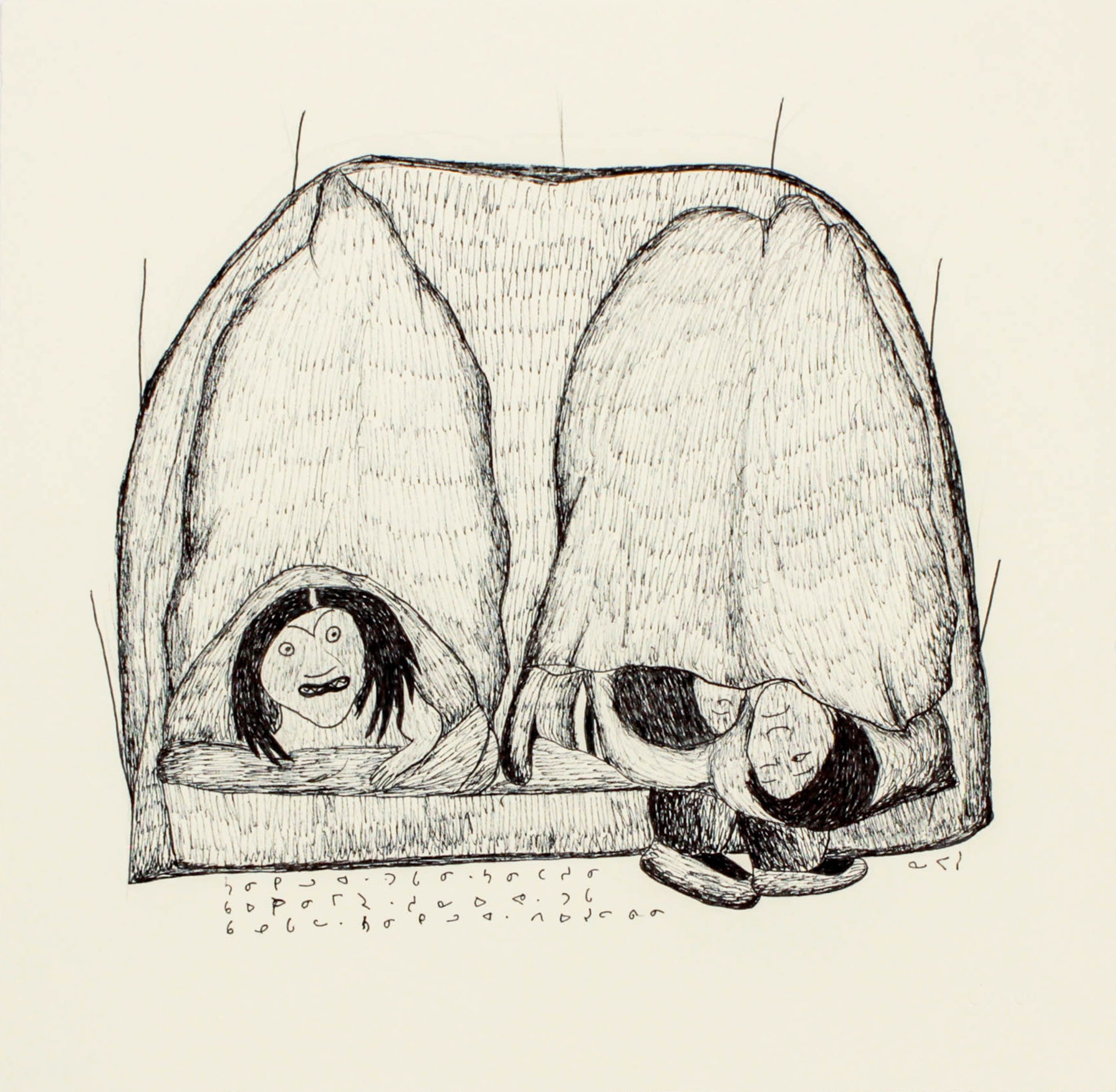
Sleeping with Ghosts by Napachie Pootoogook, Inuit, Kinngait (Cape Dorset), ink, 13” x 13” (1997/98). Collection of E. J. Guarino. Image courtesy of Feheley Fine Arts, Toronto and Dorset Fine Arts, Toronto.
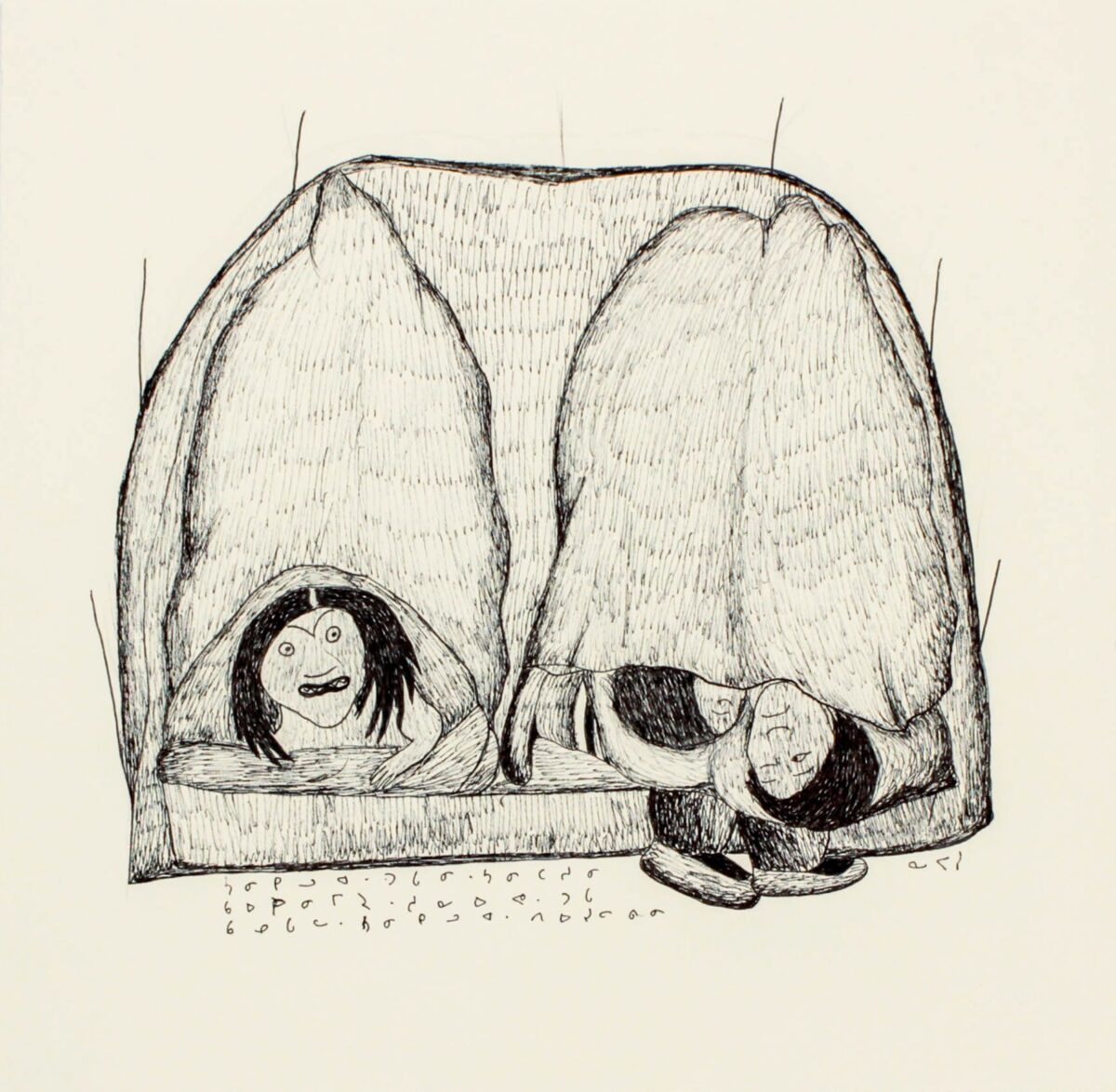
Generally, ghosts don’t make many appearances in Inuit art. However, famed Inuit artist Napachie Pootoogook addressed the subject in her drawing Sleeping with Ghosts. As with a number of Napachie’s works, this one raises more questions than it answers.
Wondering what the syllabics in Sleeping with Ghosts could possibly mean, I contacted Pat Fehheley, owner of Feheley Fine Arts in Toronto, who Emailed me back with the following information: “. . . here is the translation . . . for the drawing you asked about: ‘Sanikiluaq the ghost would invite other ghosts, and Sanikiluaq had different kinds of talent.’ That is direct; I think it could be rephrased as ‘The giant Sanikiluaq who was a ghost would invite other ghosts to visit him; he had unusual kinds of talent’.” The story of this ghost/giant may have been one that Napachie heard during the course of her life.
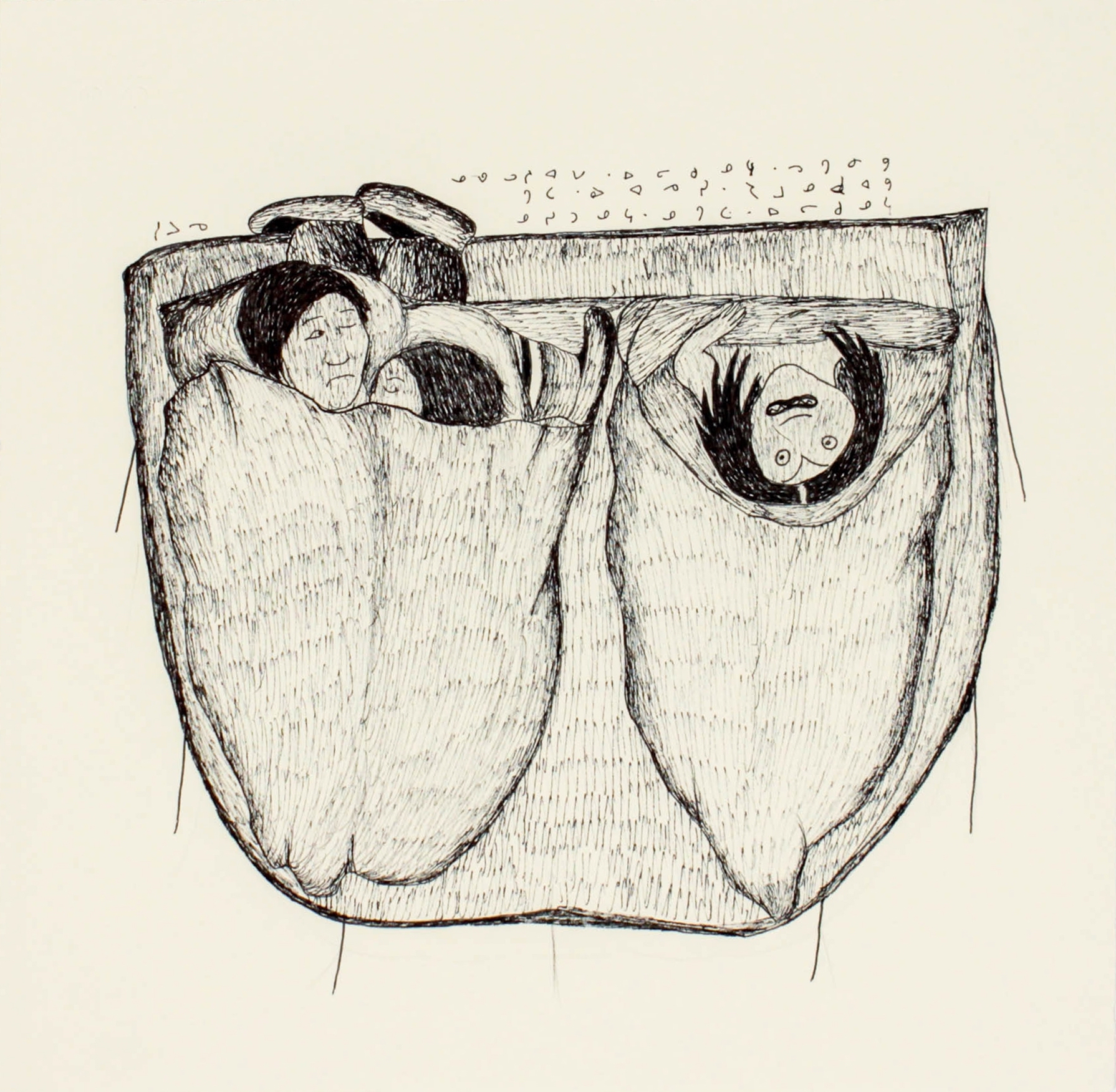
Sleeping with Ghosts by Napachie Pootoogook, the drawing turned upside down.
The drawing depicts a family sleeping together. On the right is what appears to be a husband and wife. Though it could be a mother and child, the image most likely represents a married couple. On the left is another figure wearing an odd expression. The viewer immediately wonders if this is the ghost of the title, mostly because of the figure’s facial expression. However, this person’s face my look strange because of what they are seeing with regard to the couple. Since Napachie used the word ghosts in her title rather than the singular ghost, this figure may, in fact, be one of the ghosts.
By turning the drawing upside down, one can see a number of things: One notices that there are booted legs with the sleeping couple, but they are in a position that is unnatural for the two figures. If they belonged to the couple, they would not be seen. The booted legs may very well belong to the ghost who is sleeping with these two Inuit. Looking carefully, one of the two people sleeping together has one eye open. Why ghosts would decide to crawl in with two living humans is anybody’s guess. The ghosts may deceased family members who are seeking comfort. Based on the expressions on the faces of the two figures that are completely visible, the tone of the drawing is not one of horror, but rather one of surprise and shock since these characters, like the viewer, don’t seem to know what exactly is taking place.
Late in her life, Napachie began to create a series of drawings documenting life as it was once lived by her people, thereby creating a body of work the likes of which had not been seen before. At the time Napachie produced these works, what collectors, curators and the general public expected and what they mostly got were benign images of Arctic wildlife and, for the most part, romanticized versions of traditional life as it was once lived on the land. What Napachie created was something very different and very daring. In addition to portraying the positive side of Inuit culture, Napachie also revealed many things that she found deeply troubling, which others would have preferred to have kept hidden. These works are truthful, authentic, and deeply personal. Incorporated into each drawing is a section of syllabic text explaining what is being depicted. Unlike the work of her mother, Pitseolak Ashoona, Napachie’s drawings often deal with the darker aspects of life. Wanting to document Inuit culture as it was, not as people imagined it, Napachie created drawings that showed what it took to survive in the harsh Arctic environment, Inuit myths, legends and local history, happy social events as well as encounters with non-Inuit. Included among these works are drawings that dared to depict prejudices, jealousy, violence, murder, suicide, child and spousal abuse, alcoholism, theft, rape, the sexual exploitation of women and, perhaps most shocking of all, cannibalism. Some her most provocative titles are Male Dominance, Trading Women for Supplies, and Composition (Eating His Mother’s Remains). Although the subject matter of Napachie’s drawings were often intense, each work is beautifully executed with an exquisite use of line. So, where does Sleeping with Ghosts fit into Napachie’s oeuvre? When Napachie Pootoogook set about recording traditional Inuit life she chose to portray it warts and all. The belief in ghosts is a part of Inuit culture and Napachie decided to include this subject in her drawings, which detail a way of life that was quickly changing because of exposure to the world beyond the Arctic.
Without Napachie’s documentation of traditional Inuit history, customs and beliefs, this body of cultural information very likely would have been lost to future generations. According to Pat Feheley, an expert in Inuit art, “She was the first artist to liberate drawing in Cape Dorset from the expected style and subject matter of traditional images, leading the way for so many.” Napachie Pootoogook made it possible for her daughter Annie Pootoogook, her nieces Shuvinai Ashoona and Siassie Kenneally, and her nephews Johnny Pootoogook and Itee Pootook, as well as many other Inuit artists, to express their unique voices.