
Collector's Corner
ART ISN’T EASY: Native Artists Take Control of Their Art and Their Careers
Apr
Art isn’t easy
Every minor detail
Is a major decision
Have to keep things in scale
Have to hold to your vision . . . .
“Putting It Together,” from
Sunday in the Park with George
by Stephen Sondheim
In the course of the last two and a half centuries, Native American artists have welcomed new artistic ideas and a variety of media. A number of ceramic artists, for example, also produce drawings and prints while other artists create installation pieces and murals. Native American artists refuse to be limited by expectations and biases and are demanding the same artistic freedom as any other artist. Patrick Dean Hubbell, Anita Fields, Sarah Sense, Cara Romero, Sallyann Paschall, Kay Walkingstick, and Holly Wilson have been leaders in taking control of their own artistic destinies.
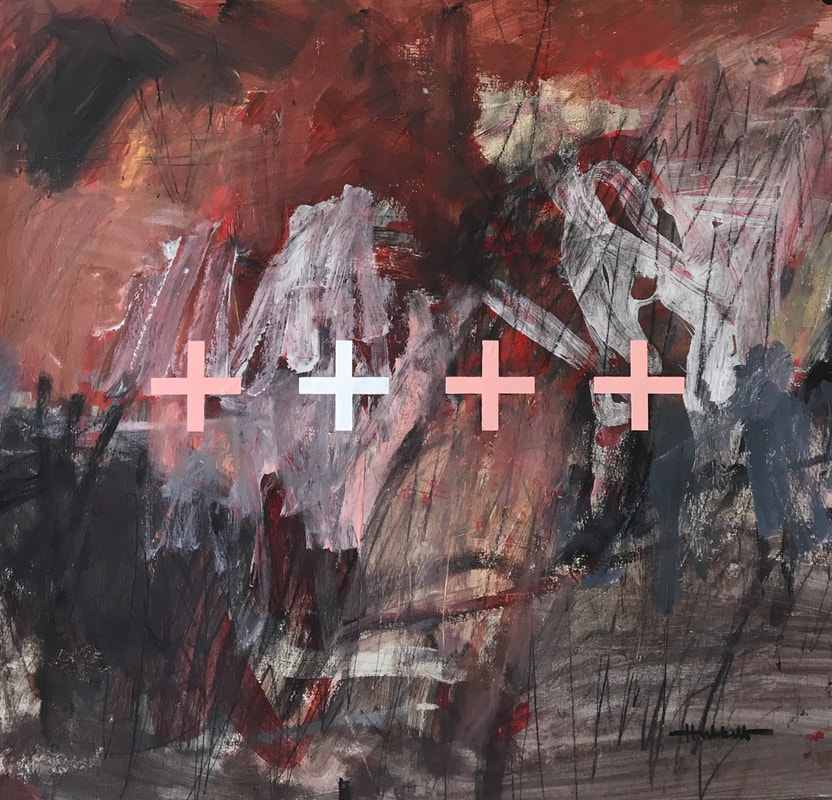
Untitled (#3) by Patrick Dean Hubbell, Diné (Navajo), 18 x 18 inches , mixed media on paper (2018).
Image courtesy of the artist. Collection of E. J. Guarino.
Patrick Dean Hubble is young Diné (Navajo) artist who is challenging conventions. Untitled (#3 ) is an abstract work with four crosses – three pink and one white – that appear to float in the center of the composition. The symbol of the cross has no connection to Christianity. It often represents Spider Woman, who taught the Diné to weave, and is a reminder of her teachings, as well as of wisdom, and spiritual energy. However, the four crosses could just as easily represent stars. Patrick Dean Hubbell’s work is influenced by Abstract Expressionism as well as by objects from his Diné culture – textiles such as wearing and saddle blankets, rugs, and medicine bags – all of which employ abstract patterns and geometric shapes.
Hubbell’s art is intuitive and emotional, something the viewer immediately feels with Untitled (#3), and he often employs automatic drawing. As an artist, Hubbell views abstraction through the lenses of Modern and Indigenous art. His use of gestural brushwork in combination with Diné geometric patterns is an important aspect of his paintings as well as his works on paper. \ The materials Hubbell uses in a great many of his works are a mixture of natural earth pigments, sandstone, sediment, minerals and other natural earth pigments he has gathered from Diné land, which he combines with acrylic paint and synthetic oil. Patrick Dean Hubbell is expanding the boundaries of Contemporary Art and is among the growing number of Native artists who have gallery representation.
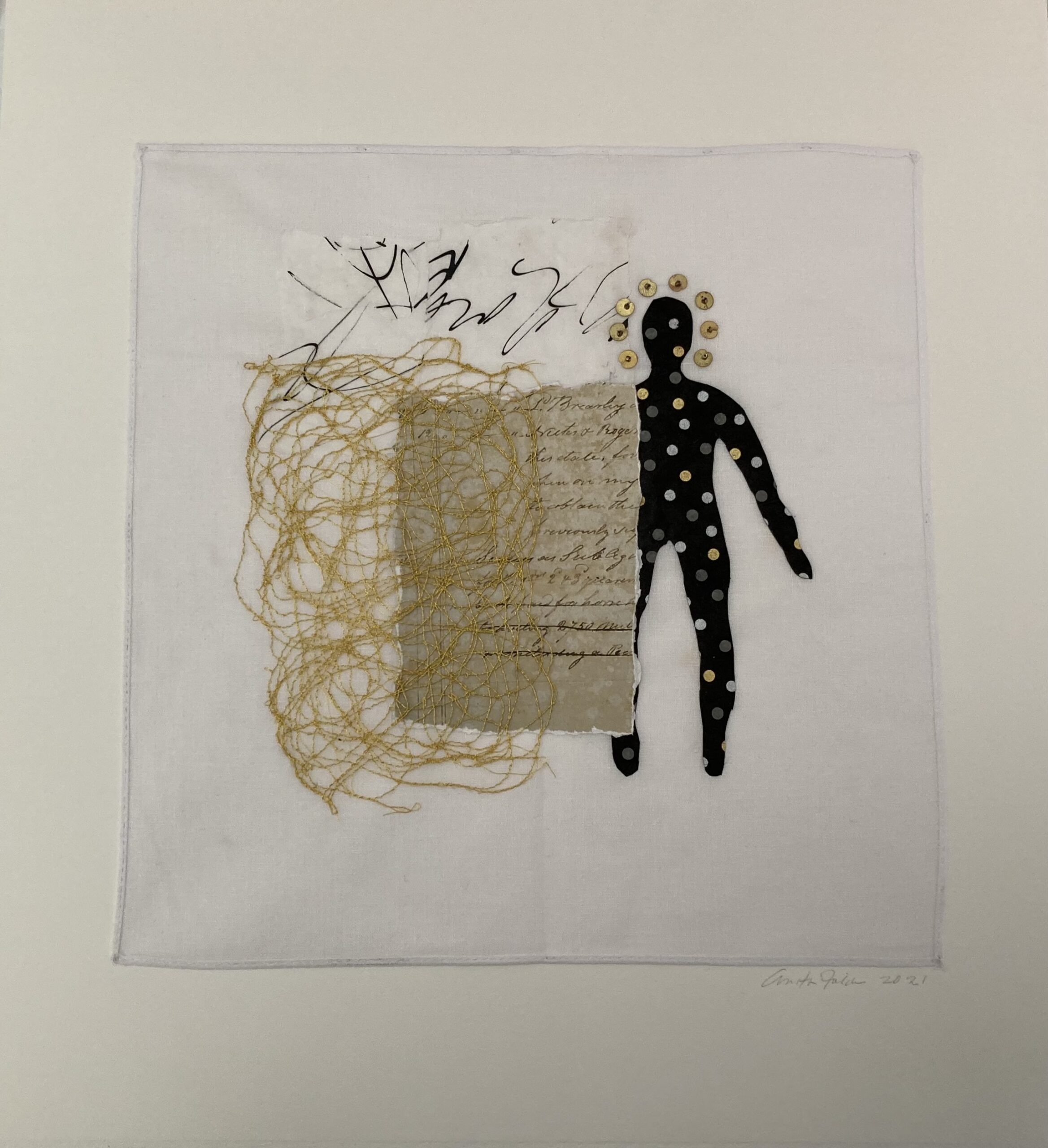
Move Forward 2 from the Move Forward Series by Anita Fields, Osage, mixed-media (thread, paper, cloth, inks, metal sequins, archival document facsimiles), 14 3/4“w x 16 1/2”h 3/4” with matte; 10 3/4” x 11”h without matte (2021). Image courtesy of the artist.
Collection of E. J. Guarino
Anita Fields is a fascinating multidimensional artist who works in a variety of media – ceramics, textiles, works on paper, mixed media pieces as well as installations. All of the artist’s work is intended to honor all women, especially those who are Native American.
In an email, Fields reflected on Move Forward 2: “A simple white handkerchief provides a foundation for my textile, paper, and embroidery thread collage. Handkerchiefs hold our tears, our sorrows and grief. We dab our brows with a handkerchief during intensely hot and sizzling Oklahoma summers. I remember my Eko (grandmother) tying up her jewelry, rings, and other goodies in a handkerchief and tossing it into her purse. The handkerchief seems fitting and suitable; a humble base to hold my thoughts and expressions about a world turned upside down.”
In addition to gallery representation, for many years Anita Fields has also presented her work to the public in venues such as the Santa Fe Indian Market.
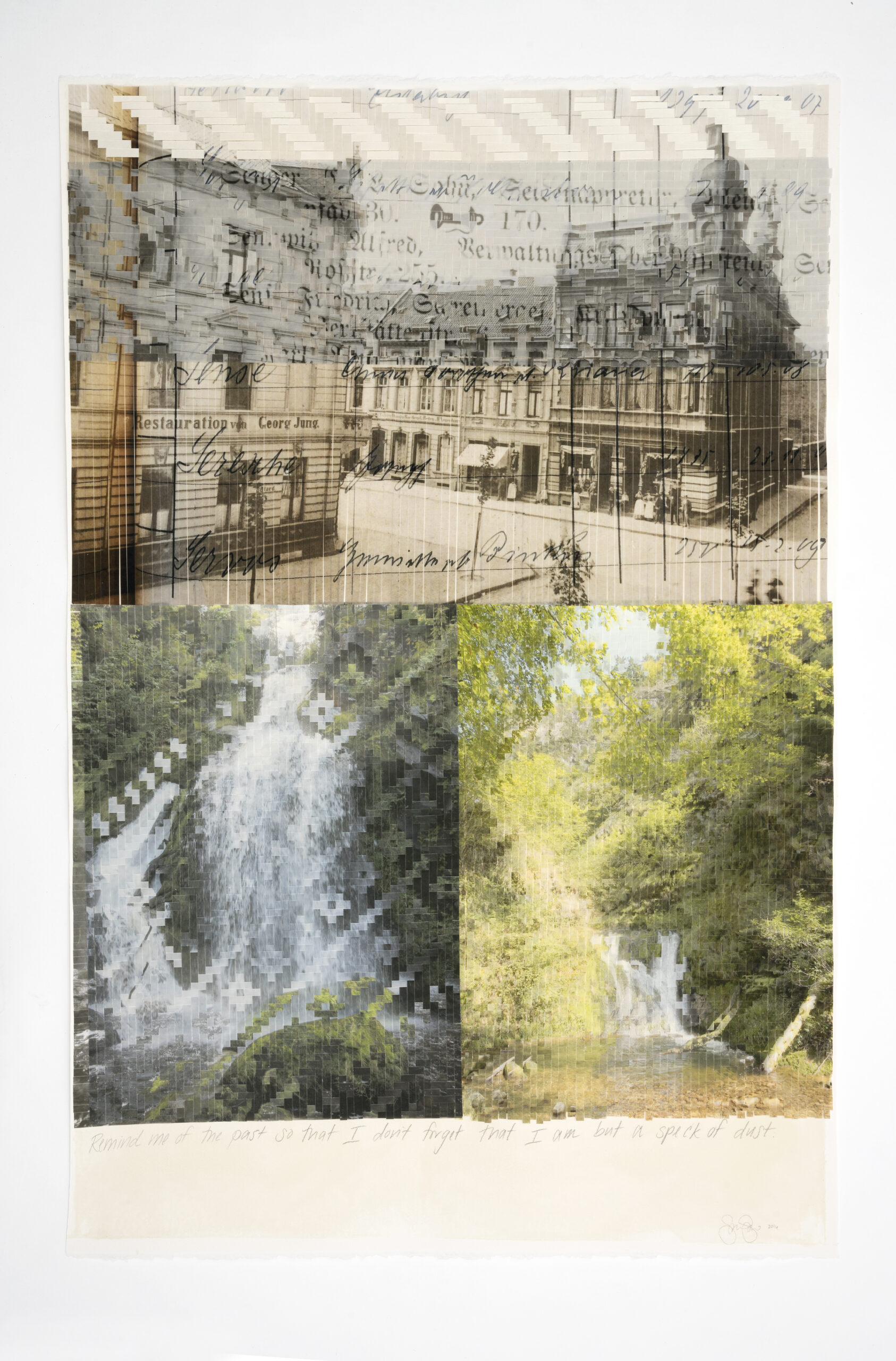
Remember 5 by Sarah Sense, Chitimacha/Choctaw, watercolor paper, rice paper, wax, inkjet prints, tape, graphite, acrylic, 45” x 30” (2016). Image courtesy of the artist. Donated to the Brooklyn Museum, New York from the Guarino Collection in 2024.
Over the course of many years, often without gallery representation, Sara Sense, through the force of her own determination, achieved the goal of having her work exhibited in museums in the U.S. and in Europe.
Using her own photography as well as found imagery, Sarah Sense creates complex images by employing traditional Chitmacha and Choctaw weaving techniques. Her work incorporates a wide variety of themes: Indigenous international art, including the Americas and Southeast Asia; the story of the Choctaw giving a significant monetary gift to the Irish during the Great Famine; Irish landscapes; the complexities of forced and voluntary migrations between Europe and the Americas; her Citimacha and German heritage; the stereotyping of Native Americans by Hollywood and other forms of popular culture; and, more recently, motherhood.
Remember 5 is a work in which the artist explores her ancestry. “It’s not about being Native. It’s not about being German,” the artist has stated, “It’s about the uncanny circumstances that are beyond our control, yet still important to recognize because they make up who we are.”
Sarah Sense is currently represented by the prestigious Silverstein Gallery in New York City.
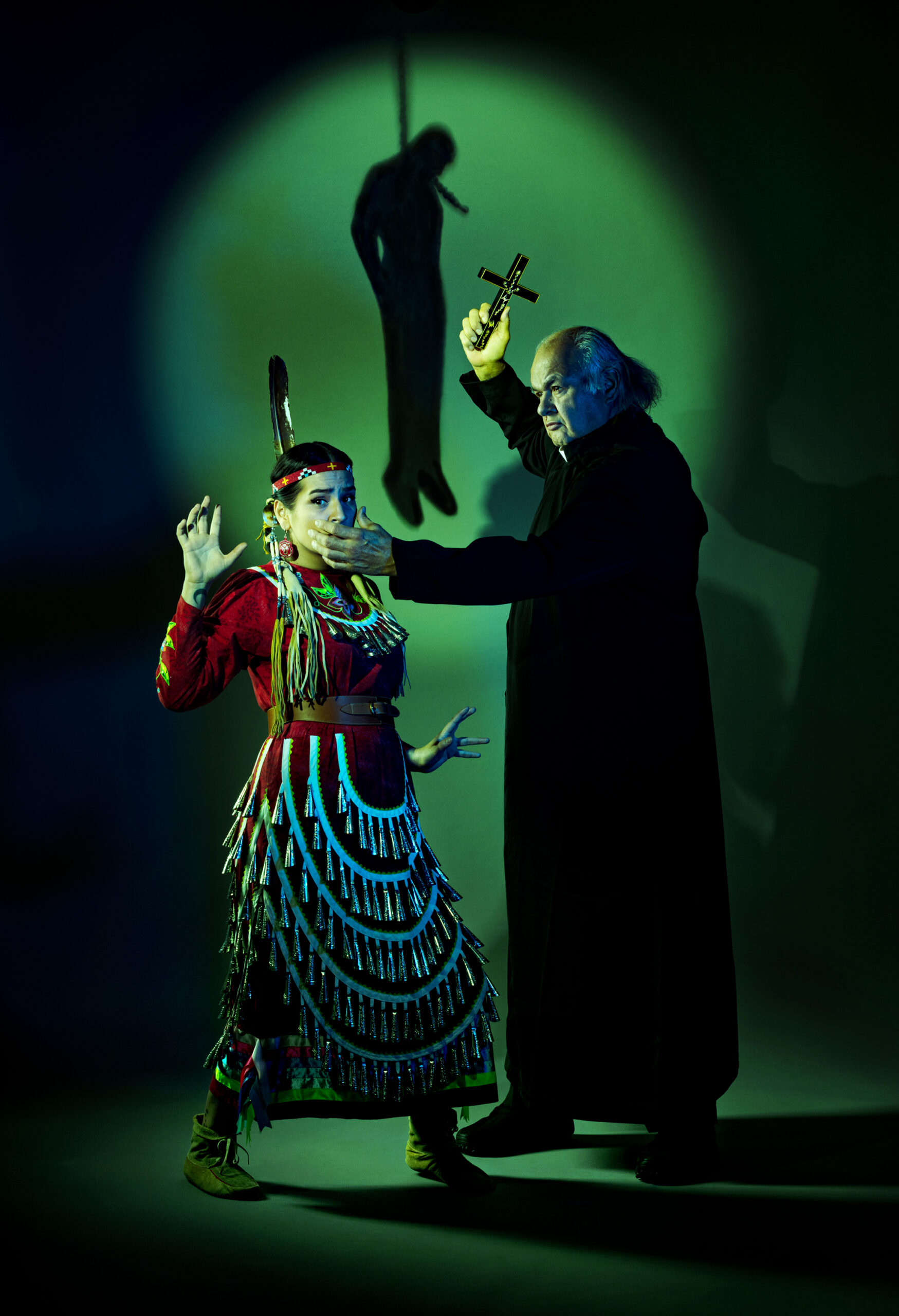
Don’t Tell by Cara Romero, Chemehuevi; image size: 12” X 13.6” + 1.5” to 2” white border on all sides, Edition: 1/15 (2021). Printed by the artist on Legacy Platine paper. Image courtesy of the artist. Collection of E. J. Guarino.
Like most Americans, Cara Romero is influenced by pop culture, which is evident in her art. Native Americans, particularly women, have been stereotyped in numerous ways in popular culture: They have been portrayed as both violent and overly sexual. Until fairly recently, such stereotypes went unchallenged.
One of the artist’s most striking and controversial works is Don’t Tell, which confronts Hollywood’s stereotyping of Native Americans as well as abuses committed by some members of the Catholic Church. In her write-up about the piece, Romero stated, “This terrifying image is shot in the classic 1940s and 50s American film noir-dubbed for as a psychological style of the dark side of American life. . . . Low-key noir lighting is used to convey the unknown and sinister lurking in the shadows. During this era of film, it was all too often that people of color were cast as antagonists. I thought it would be an important exercise to reimagine the genre with narratives that are terrifying to us. And, in effect, rewriting a history that exposes a truth. . . . Who chooses the bad guy? Who gets to tell those stories? What effect does it have on a child when they are always cast as the villain?”
For many years, Cara Romero connected with prospective collectors through Native art markets where, eventually, her work was noticed by curators. Most recently, she has opened her own Santa Fe gallery to exhibit her photography.
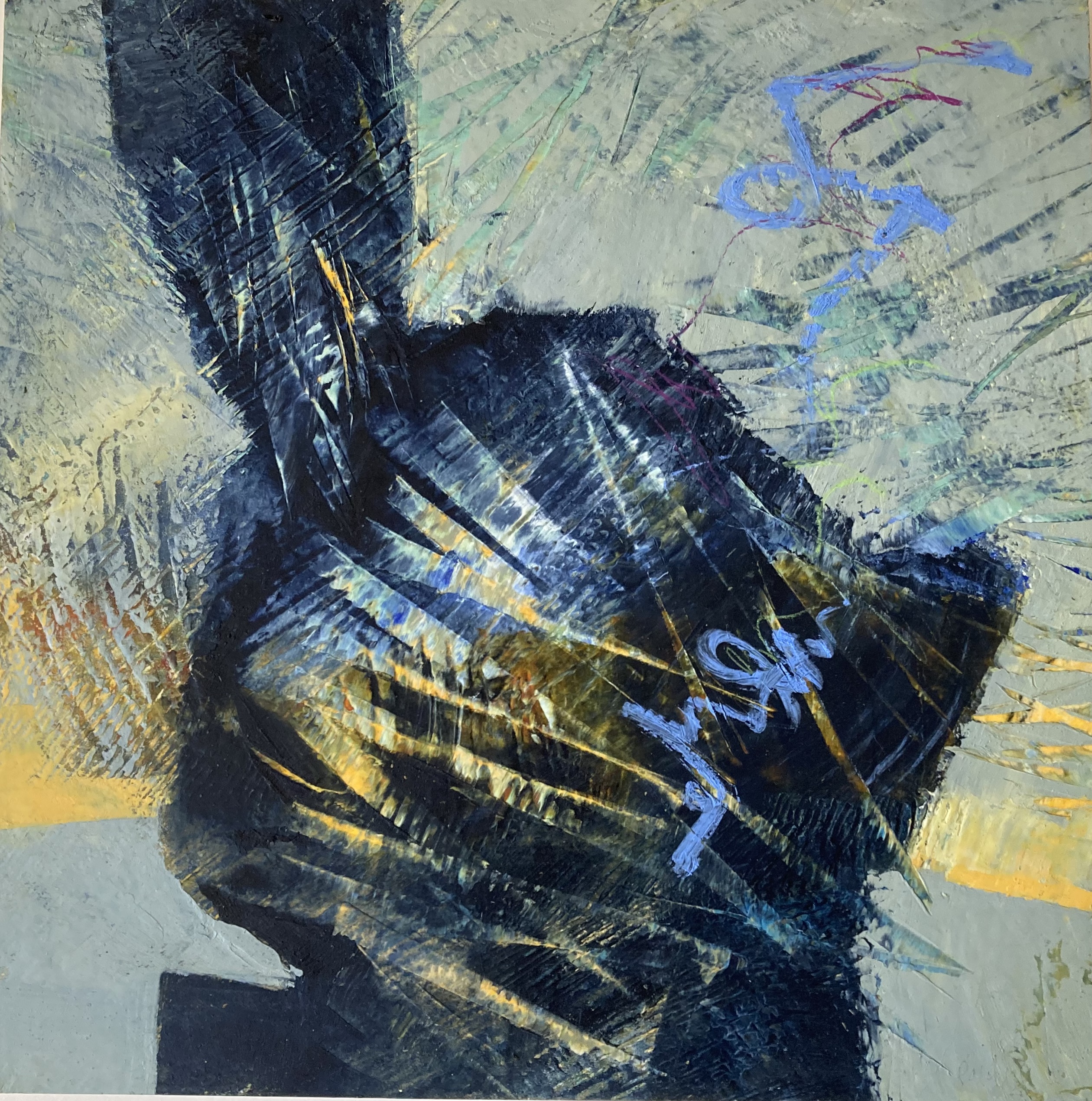
Blue Fest by Sallyann Paschall, Cherokee, oil/cold wax, on multi-media board on panel, oil stick embellishments, 12“ x 12“ (Nov. 2021). Collection of E. J. Guarino.
Sallyann Paschall is a prolific artist who produces paintings, collages, encaustics, lithographs, monotypes, intaglio etchings, and mixed media pieces. Blue Fest is a multimedia work, that looks very much like a shadow and is very mysterious. In an email Sallyann wrote, “My non-representational work is driven by snippets of images that cascade through my subconscious. As I proceed to paint, some of these snippets seem to appear and I then try to exploit them through color and mark making. The viewer can then make of it what they will. . . .”
For the most part, Sallyann Paschall has built her artistic career by exhibiting her work at Native markets and through her website. As a result, she has garnered a reputation as an important American artist of Native American heritage.
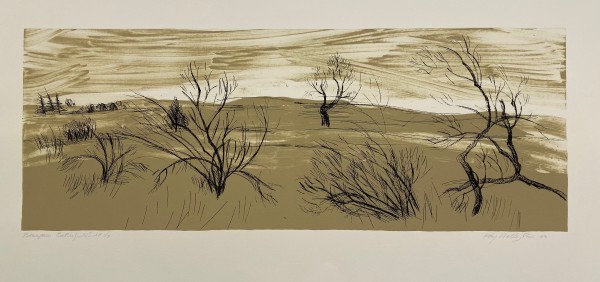
Bear Paw Battlefield 1 by Kay Walkingstick, Cherokee, Artist Proof #1/3 from edition of 16; two-color etching/lithograph on Rives BFK white. Collaborating printer Frank Janzen, TMP. Published at Crow’s Shadow Institute of the Arts, Pendleton, OR. 9” x 24” (2003). Collection of E. J. Guarino.
Kay Walkingstick has managed to achieve success despite the many obstacles she has had to overcome. She began making art at a time when female artists and Native American artists were not taken seriously. Added to this was the fact that Walkingstick was working in a medium that, at the time, was considered non-traditional for a person of her background. Nonetheless, she persevered, producing a diverse range of paintings and works on paper and, despite the odds, has been represented by a number of important galleries.
Bear Paw Battlefield 1, one of her many prints, references Bear Paw Battlefield in Blaine County, Montana, where the final engagement of the Nez Perce War of 1877 took place. Using a limited palette, Kay Walkingstick is able to convey to the viewer a sense of utter desolation.
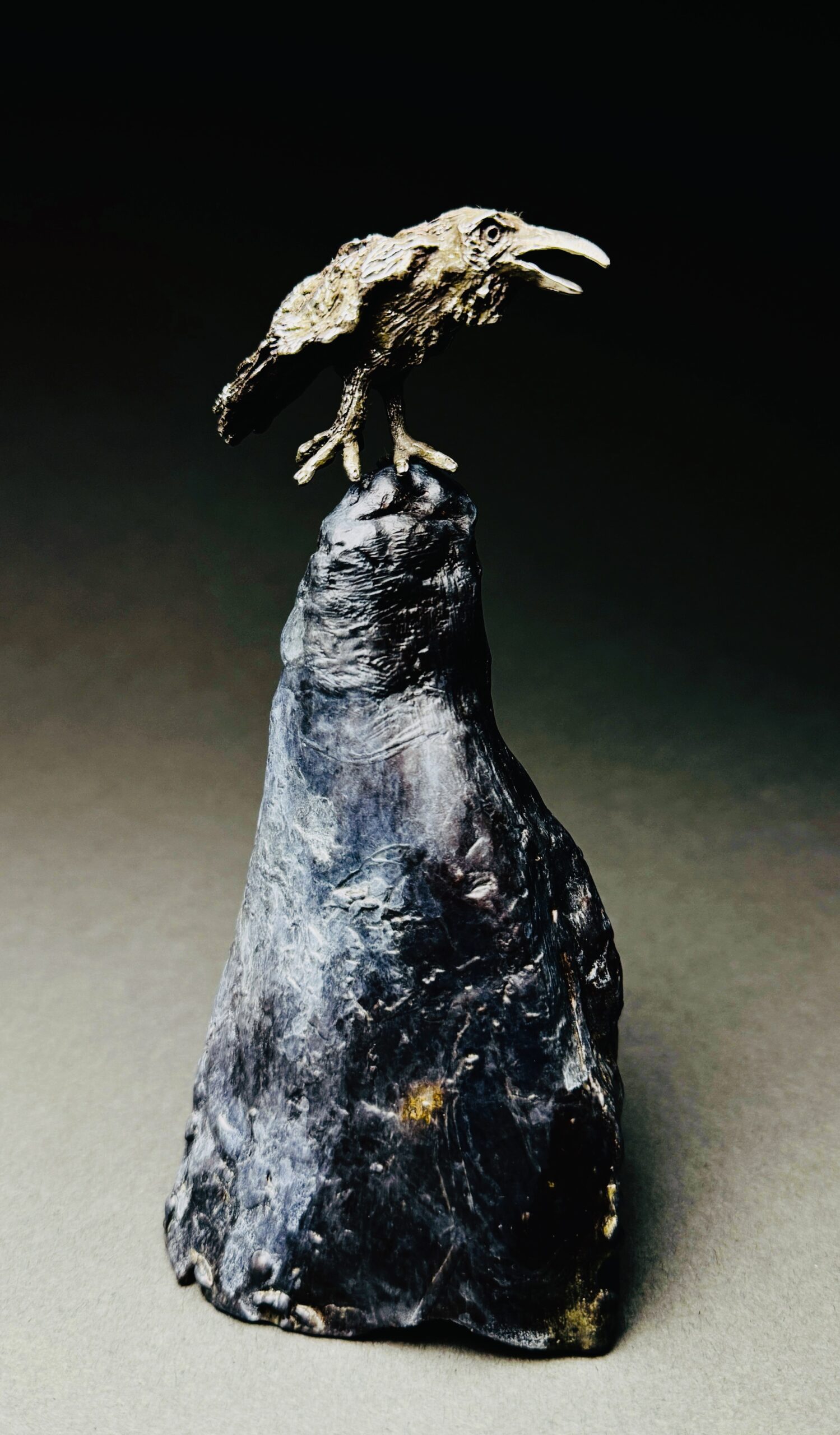
Sight by Holly Wilson, Delaware Nation and Cherokee, Sterling Silver, Unique Cast Bronze, Patina, 6” h x 3” w x 2.5” d (2025). Collection of E. J. Guarino.
At this point in time, Holly Wilson is most known for her sculptures, which, though they tend to be small, are often part of large installation pieces. The artist’s work explores many themes: family history, personal experiences, self, motherhood, and war. Wilson also produces drawings, prints, jewelry, large-scale metal sculptures, as well as ceramic and glass works of varying sizes. The pieces she creates are never confrontational or didactic. Instead, they draw the viewer in to consider challenging subjects.
Holly Wilson’s sculpture Sight is a small, but powerful work. A bird, perhaps a crow or a raven, sits upon what could be a rock or a mountain and looks out at the world. The viewer is left to contemplate just what this creature sees. According to Wilson, the bird has sought a high place because doing so affords a wider perspective. Also, the bird’s feet are made to look like human hands, which suggest transformation.
By dint of her unwavering perseverance, Holly Wilson has garnered gallery representation as well as museum exhibitions. She also presents her work to the public through Native art markets, particularly the Santa Fe Indian Market, as well as by means of her own website.
Most Native American artists do not have gallery representation and rely on events such as the annual Santa Fe Indian Market, the Heard Museum Guild Indian Fair & Market, and similar venues to present their work to collectors, curators, and to the public at large. This fact has forced many to become business people in addition to being an artist. It is exciting to note that many more Native American artists have gallery representation than in the previous century and a number of artists have opened their own gallery. In addition, artists use the Internet to promote their work and many, if not most, now have their own websites and have also become adept at using mobile credit card processing devices, such as Square, to take payments. Speaking eloquently through and about their art, Native artists have taken control of their careers by mastering the diverse ways that can connect them with collectors, curators, and the public.