
Collector's Corner
CURIOUSER AND CURIOUSER: Considering Tayaraq Tunnillie’s Sculpture Sedna and Wife to Be
Apr
The Inuit goddess Sedna has been depicted in countless curious and unexpected ways. Sometimes an artist’s approach is humorous, other times not. Often the goddess is front and center, giving the impression of being larger than life; at other times her presence may be suggested by the image of hands minus fingers, or simply a musical instrument. Some images are vibrant with color while others are two-tone, or even back-and-white. Sedna has also been depicted with traditional Inuit facial tattoos, and there are even works in which Sedna is shapeshifting or transforming. The goddess as subject matter for artists appears to be never-ending. Though there are numerous exceptions, Sedna is most often shown with long flowing hair, bare breasts, and her lower body covered in scales and ending in a tail.
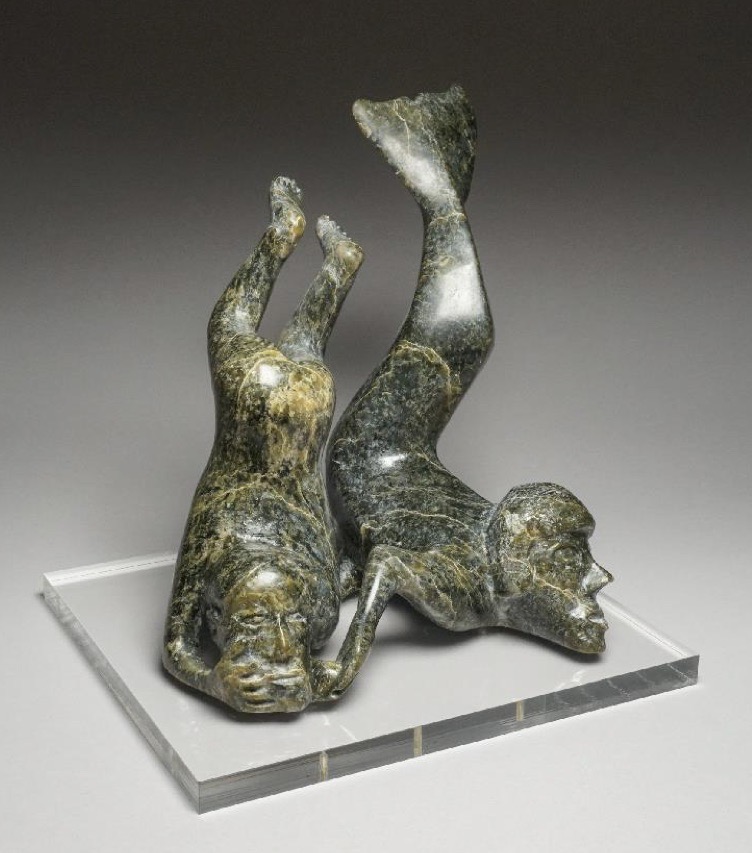
Sedna is most often portrayed as a female who resembles a mermaid but there are exceptions. One of the most notable of these is Sedna and Wife to Be by Tayaraq Tunnillie. This sculpture is extremely thought-provoking since it seems to go against what is commonly accepted about the goddess.
Sedna and Wife to Be by Tayaraq Tunnillie, Kinngait (Cape Dorset) stone, 9” x 7” x 5” (1994). Collection of E. J. Guarino. Image courtesy of Feheley Fine Arts, Toronto, and Dorset Fine Arts, Toronto.
Part woman, part fish, it is Sedna who controls the bounty of the sea, and if angered, she can be extremely vengeful, withholding the fish and sea mammals upon which the Inuit rely. It is Sedna who decides whether humans eat or starve. Known by a number of other names such as Taleelayo (The One Down on the Sea Bottom) and Nuliajuk (Mother of All Beasts), Sedna is one of the most important figures in Inuit culture.
There are a number of variations to Sedna’s story, but in each one her father tries to marry her off; she rejects all of the men presented to her; instead, she marries a dog. Angered, Sedna’s father takes her out to sea in his kayak, throws her overboard and, as she clings to the side of his vessel, he chops off her fingers and she sinks to the depths below. Most contemporary Inuit artists portray the goddess minus the gory detail of her missing fingers. She is often presented as more playful than vindictive and is often portrayed as vain.
If a taboo had been broken or the goddess had been disrespected in any way, she had to be placated. It was believed that Sedna held the fish and sea mammals in her hair and that, when angered, a shaman had to enter into a trance, visit her, and appease her by listening to her complaints about the transgressions committed against her, singing to her, and combing her hair with a bone comb, which she could not perform herself because she had no fingers. Mollified, Sedna would then set free all of the animals she had restrained so that they could be hunted.
Sedna has been presented in sculpture, prints, and drawings in many different ways, depending on the how each artist viewed her. She has been portrayed as beautiful, angry, vengeful, petty, spiteful, and self-absorbed. Whether as protector, avenger, or seductress, Sedna continues to intrigue both artists and collectors.
Where exactly does Sedna and Wife to Be fit into stories about the goddess? Simply put, it doesn’t seem to do so for a number of reasons. If Sedna is female, why is she taking a wife? Why did the artist choose to portray the goddess and the wife to be as he did? As I thought about this fascinating sculpture, “Curiouser and curiouser,” the words that Alice spoke in Alice’s Adventures in Wonderland, came to mind.
Looking at the sculpture, one cannot help but notice that Sedna’s face seems decidedly masculine. However, according to Elyse Jacobson, gallerist at Feheley Fine Arts, Toronto, “It is rare but ‘sometimes’ Sedna has been depicted as a male. I believe it to be more of a shapeshifter than a ‘sea-god’.” This may or may not be the case, but the sharp features of Sedna’s wife give this figure, as well, a male cast, making the work even more curious.
Both figures appear to be moving downward as if descending into the sea with the Sedna figure holding on to the wife to be. One can only wonder if the wife is being kidnapped? However, there are no myths about Sedna kidnapping anyone. Nonetheless, in the not-too-distant past, kidnappings did take place among the Inuit. Women were often abducted against their will to become a man’s wife. Sometimes, if a desired female was already married, a man would simply kill her husband and claim the woman as his own. Considering the vast expanses and harsh Arctic environment, there wasn’t much women could do, especially if they became pregnant. They were at the mercy of the man and all they could do was hope for the best. If they resisted or rebelled, they were subjected to beatings.
Of course, one can only speculate as to what was in the artist’s mind when she created Sedna and Wife to Be. Predominantly noted for her sculpture, Tayaraq Tunnillie most often creates these works from dark green stone. Her figures are bold, strong, and expressive, employing gesture and strikingly carved faces to communicate emotion as well as to convey a narrative. In her work Tunnillie explores the themes of Inuit mythology, such as the sea goddess Sedna; transformations; and everyday life in the Arctic.
Ultimately, Sedna and Wife to Be is a fascinatingly enigmatic work that is open to a myriad of interpretations. At first glance, the sculpture simply appears to be a representational work. However, it does have elements of the surreal – a being half human and half sea creature. The work becomes even more intriguing as one digs deeper. Pondering what the work might mean takes one through a mental labyrinth that has a number of possible dead ends. This aspect of Sedna and Wife to Be is what makes this work endlessly intriguing.