
Collector's Corner
A LONG AWAITED GOAL ACHIEVED: Acquiring a Ceramic Work by Juan Quezada
Feb
A number of years ago, I donated all of the pottery in my collection from the famous Mexican pottery village of Juan Mata Ortiz to the Brooklyn Museum. However, neither my collection nor the Brooklyn Museum’s holdings contained a piece by Juan Quezada, the village’s most celebrated artist, whose work is known worldwide. Anyone who has heard about Mata Ortiz pottery probably knows about Juan. When a work by Juan Quezada became available at King Gallerie,s I immediately acquired it with the intention of making it a promised gift and eventual donation to the Brooklyn Museum.
I waited many years to acquire a work by Juan Quezada. When I was first collecting and learning about Mata Ortiz pottery I traveled to Mata Ortiz and was invited to Juan’s house. I was at the beginning of a month-long trip through the Southwest, so I had to be very careful with my limited funds. Juan had one piece available. However, it was pricey (for that time period – the early 90s) and the piece didn’t really speak to me. Little did I imagine that it would take me almost thirty years to acquire one of Juan Quezada’s pots.
So just who is Juan Quezada and why is he so famous? Juan’s story is one of the most celebrated in the history of modern ceramic art. It can be said that Señor Quezada single-handedly reincarnated (some say reinvented) the pottery tradition of the pre-Hispanic Casas Grandes culture whose techniques had been lost for centuries.
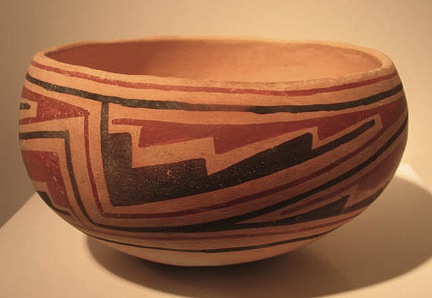
Casas Grandes polychrome bowl, artist unknown, Chihuahua, Mexico, 4”tall x 7” wide(ca. 1300-1400 A. D.) Collection of E. J. Guarino.
The village of Mata Ortiz, where Juan Quezada lived, is within walking distance of the ruins of Paquimé, a city that was once the center of what archaeologists have dubbed the Casas Grandes culture.
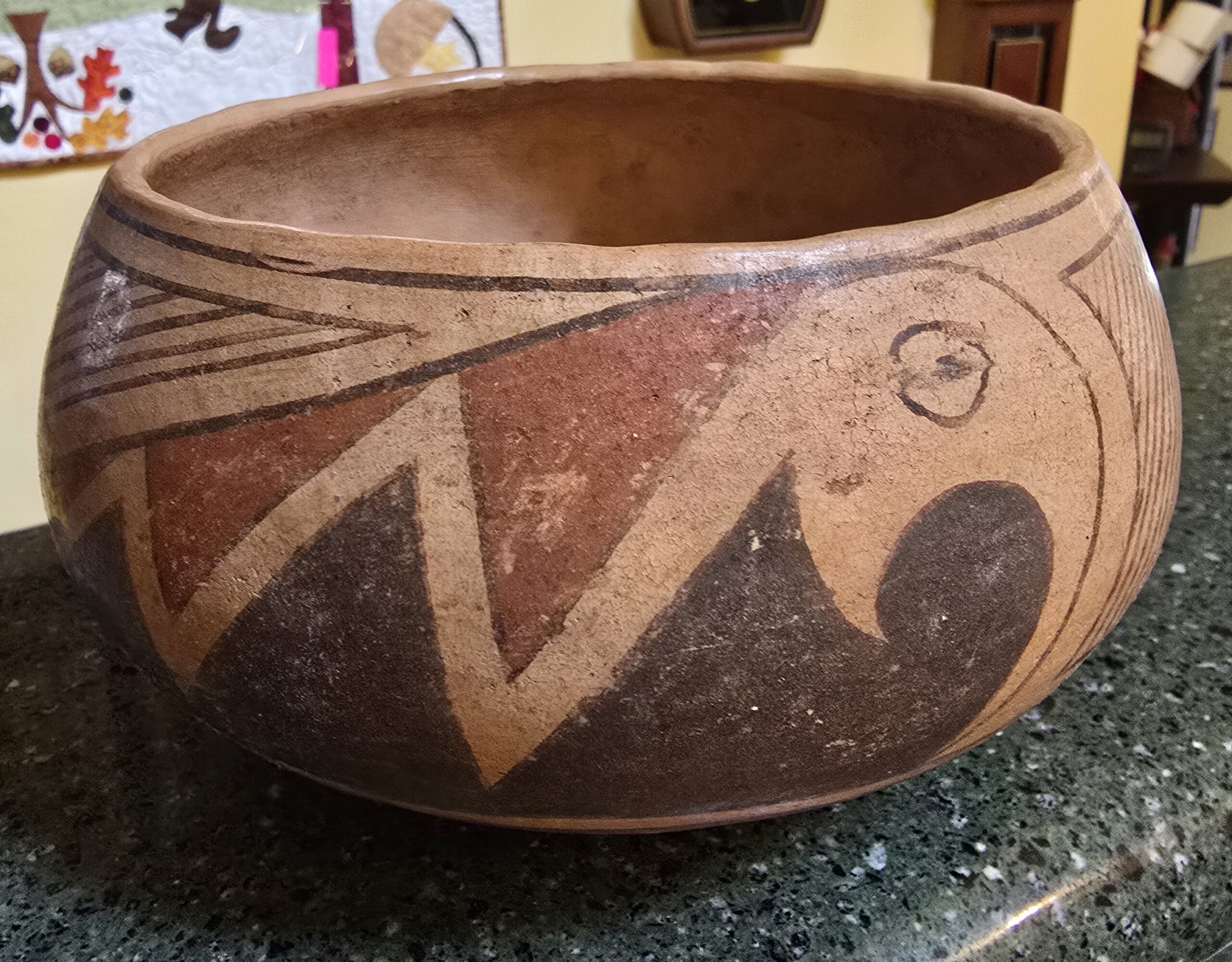
Early Casas Grandes style pot by Juan Quezada, 3″ tall and 21” in circumference, with a diameter of 6 1/2” (circa 1975). Collection of Richard Cleary. Photo courtesy of Richard Clearly.
Paquimé, which reached its height in the 14th and 15th centuries, was an important cultural and trade center with connections to the Pueblo cultures of what is today the southwestern United States and northern Mexico, as well as to the great Mesoamerican cultures to the south. Ballcourts found at Paquimé are similar to those found at Tenochtitlán, Chichén Itzá, and other Mesoamerican sites. In addition, a number of structures at Paquimé have T-shaped doorways reminiscent of those found at Ancestral Puebloan sites such as Chaco Canyon 700 miles to the north. The construction of Paquimé is attributed to a culture archaeologists have named the Mogollon. These Native American peoples inhabited Southern New Mexico and Arizona, Western Texas, and Northern Sonora and Chihuahua in Mexico.
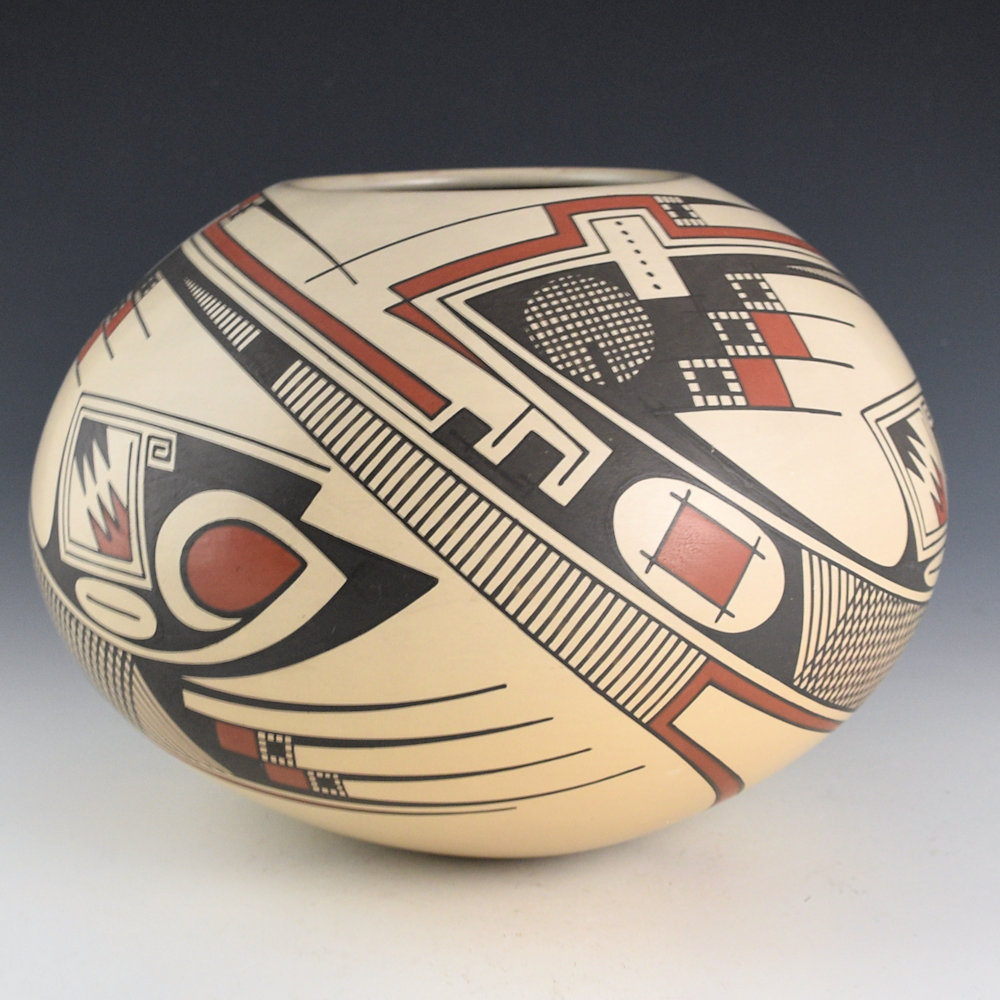
Wide bowl with Casas Grandes designs by Juan Quezada, Mata Ortiz, 9”w by 6.75”h (circa 1990s). Collection of E. J. Guarino. Image courtesy of King Galleries.
For years, Señor Quezada kept finding pottery shards when he frequently wandered through the ruins of Paquimé. His curiosity piqued, he began to experiment with pottery making, trying various clays, slips and firing methods. Eventually, through trial and error, he was able to create pots quite similar to those produced by the Casas Grandes people centuries ago. A few of these pieces made their way to New Mexico where anthropologist Spencer MacCallum saw them and was so impressed that he turned detective to track down the maker of these unsigned pots. MacCallum eventually was able to find Quezada and the two worked together for years, the anthropologist promoting the artist’s work.
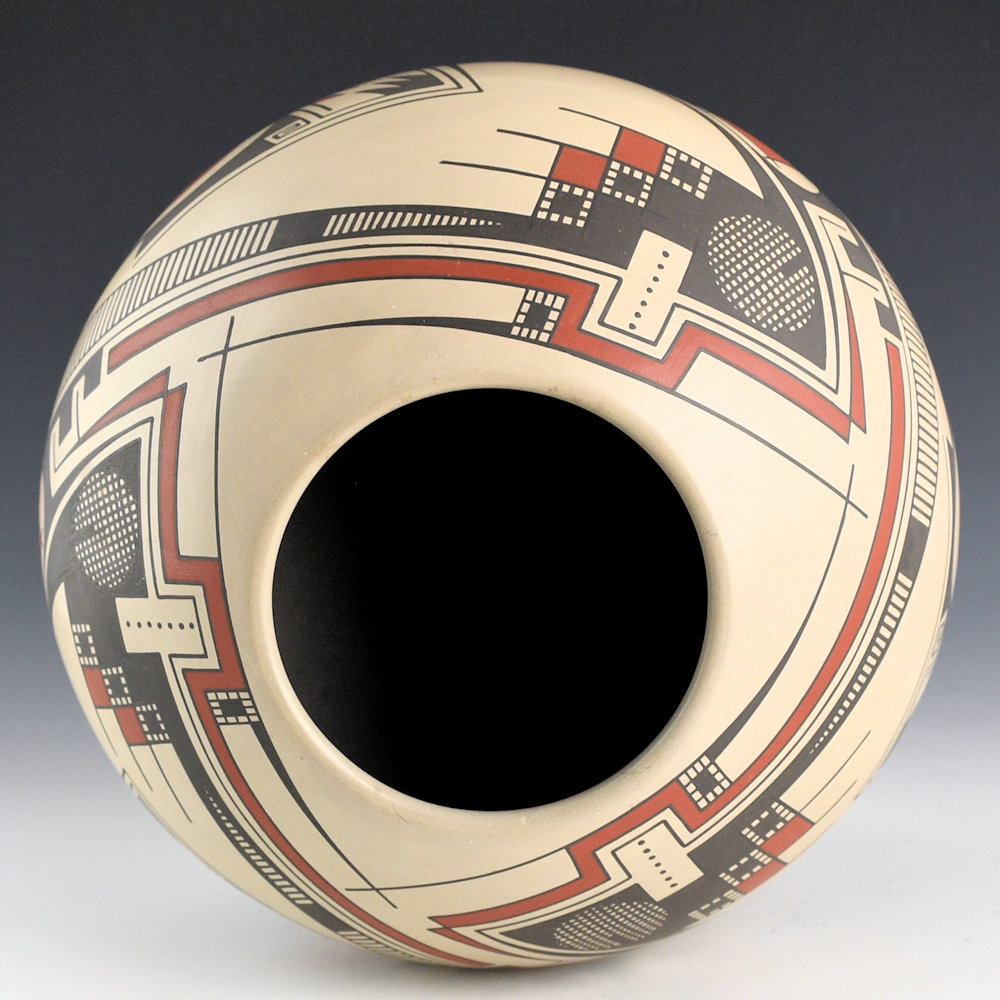
Wide bowl with Casas Grandes designs by Juan Quezada (detail). Collection of E. J. Guarino. Image courtesy of King Galleries.
Although many of Señor Quezada’s early works bear a striking resemblance to Casas Grandes pottery, ever the innovator, he came to develop his own unique style and his success on an international scale inspired others in Mata Ortiz to take up pottery making, which has become the main source of income in the village.
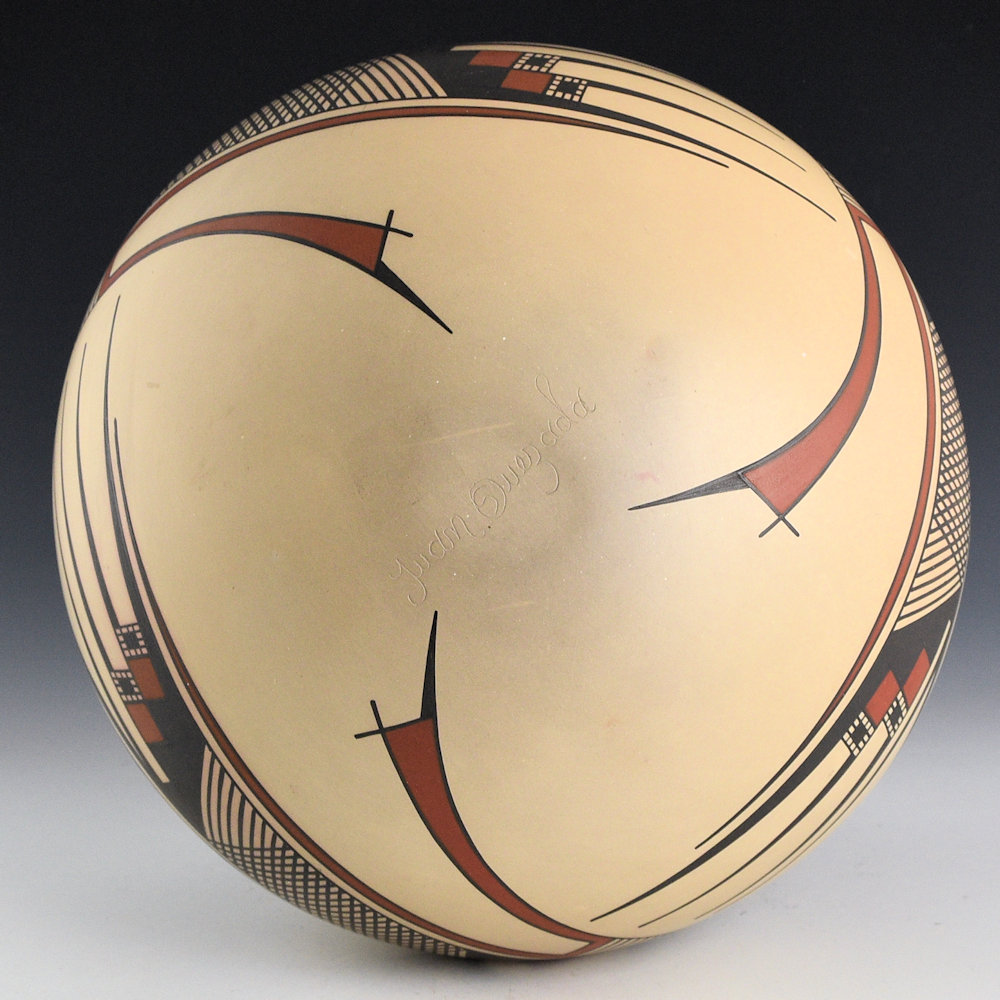
Bottom of Wide bowl with Casas Grandes designs, which bears Juan Quezada’s signature. Collection of E. J. Guarino. Image courtesy of King Galleries.
Inspired by Quezada’s success, members of his family and others in the village decided to try their hand at pottery making. Today, there are over 400 potters in Mata Ortiz, many of whom proudly declare that they were personally taught by Juan Quezada. Some potters emulate what Quezada has achieved, while others try to see how far they can depart from his work and still create an exceptional pot.
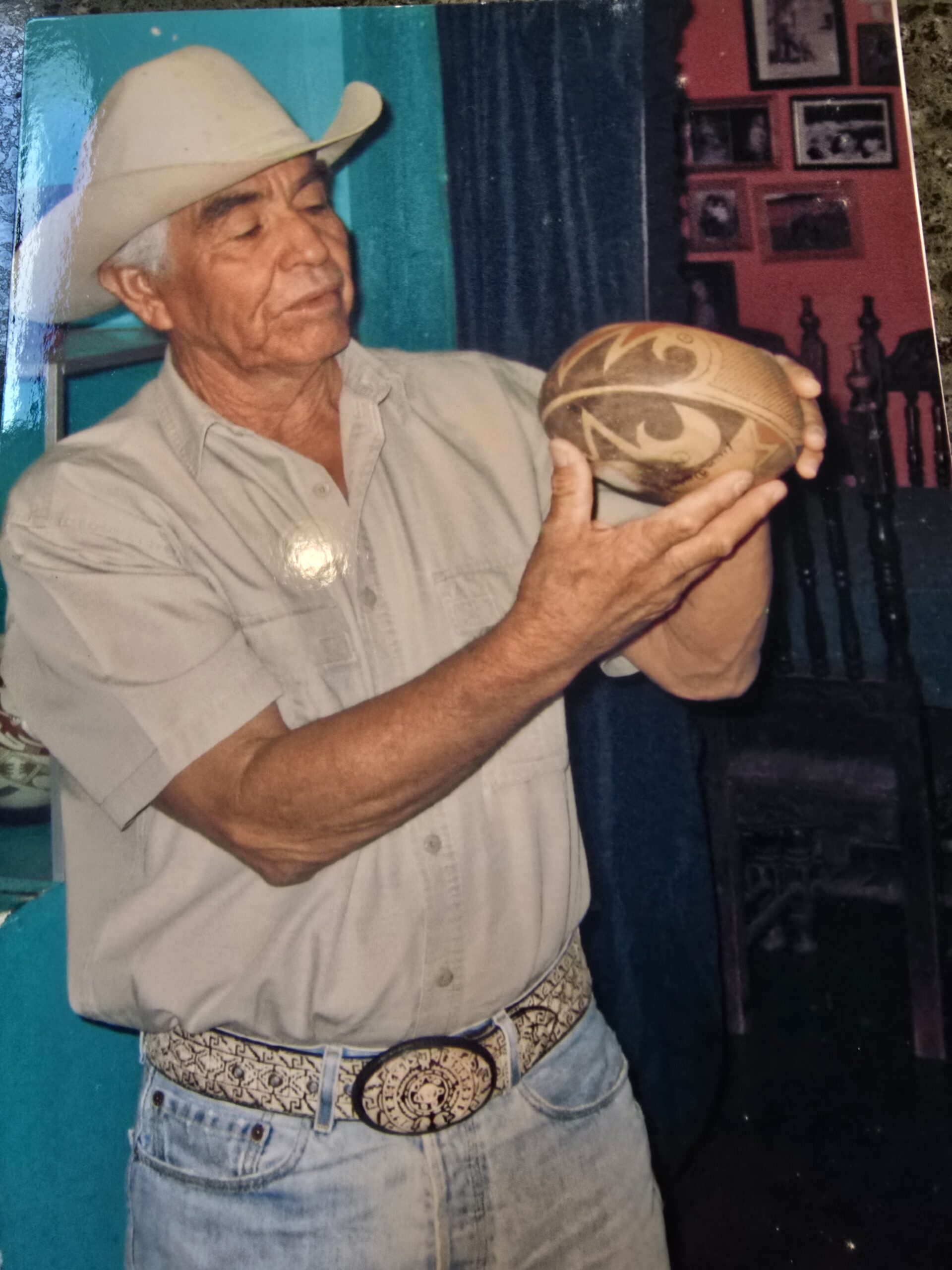
Photo of Juan Quezada holding one of his early pieces, which is in the collection of Richard Cleary. Photo courtesy of Richard Cleary.
For collectors of Mata Ortiz pottery, owning “a Juan,” as admirers often refer to pieces by Mr. Quezada, is tantamount to finding the Holy Grail. It was a goal that took me years to achieve. Although Juan Quezada’s earliest ceramics reflect his interpretation of Casas Grandes pottery, his ceramic art developed well beyond that into a new, innovative type of pottery style. Juan’s creativity inspired Nicholas, Reynaldo, and Lydia, along with Consolación, Reynalda, Rosa, Jesús, and Genoveva, his brothers and sisters, to make pottery as well. Eventually, other family members as well as neighbors took up pottery making with some 300 Mata Ortiz families engaged in creating pottery. Many of the pots are so dazzling that one’s breath is taken away. Some of the pieces have a “surprise” hidden on the bottom, which many people miss. Often, these are the most spectacular designs on the pot. The most sought-after Mata Ortiz pottery is as thin as china, exquisitely painted, and reveals the creative spirit of a community that, in spite of living in a remote area, consistently produces some of the most exceptional contemporary ceramic art.
People often mistakenly assume that innovations only come from the young. Ageless of spirit and ever curious to explore the medium of ceramics, Juan Quezada was producing pottery well into his seventies and beyond. Because of this one man a remote Mexican village became a center for a unique form of contemporary ceramic art.
NOTE: For more information on Juan Quezada and Mata Ortiz pottery, consult The Miracle of Mata Ortiz: Juan Quezada and the Potters of Northern Chihuahua by Walter P. Parks and The Many Faces of Mata Ortiz, essays by Susan Lowell, Jim Hills, Jorge Quintana Rodrígues, Walter Parks, and Michael Wisner.