
Collector's Corner
THE ROOTS OF ABSTRACTION: The Genre’s True Beginnings
Jan
Long before the term abstract art was coined in the late 19th century, ancient peoples, including Native Americans, were producing it. Although artists such as Hilma Af Klint, Vassily Kandinsky, Kazimir Malevich, Piet Mondrian, Frantisek Kupka, and Robert Delaunay are said to have “invented” abstract art in the early 20th century, that is not actually the case. For millennia, the Indigenous Peoples of the Americas, for example, have been creating abstract imagery – on rockfaces, parfleches, beadwork, clothing, basketry, and pottery – and continue to do so. Although the abstractions left upon rockfaces were most likely done by men, those created on parfleches, beadwork, clothing, basketry, and pottery were created by women. What has come to be termed continuum is an important component of the Indigenous art of the Americas. While much mainstream art is based on the concept of deconstructing or disassembling the artwork of previous eras, Indigenous artists tend to take a different approach. Although many contemporary Native artists reference and reinterpret the art produced by their predecessors, they look upon it with reverence and see their own art as being connected to that of their ancestors.
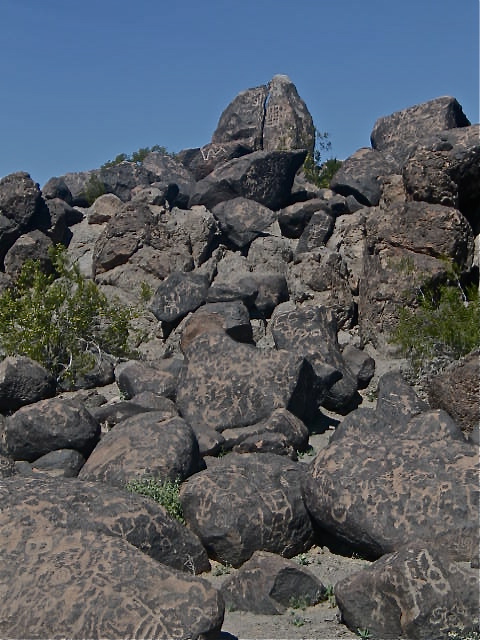
Petroglyphs at Painted Rock Petroglyph Site 90 miles southwest of Phoenix.
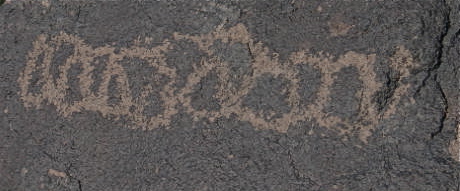
Abstract design petroglyph, Painted Rock Petroglyph site.
Petroglyphs, which are carved into rock surfaces, and pictographs, which are painted onto rock, are one of the earliest forms of recorded imagery. Throughout the Americas, there are huge numbers of places where petroglyphs and pictographs can been seen. Some of the most famous are located in the American Southwest. Created by Native people in the ancient past, petroglyphs and pictograms are mysterious and fascinating to the modern viewer. We can only speculate as to why ancient people created these images and what they mean, but it was clearly important to them to do so since it took time and effort to produce them.
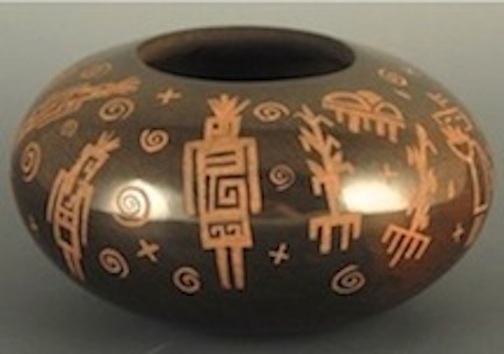
Bowl with etched petroglyphs and petroglyphs by Johnathan Naranjo, Santa Clara, 4.5”w x 2.5”h (2013). Collection of E. J. Guarino.
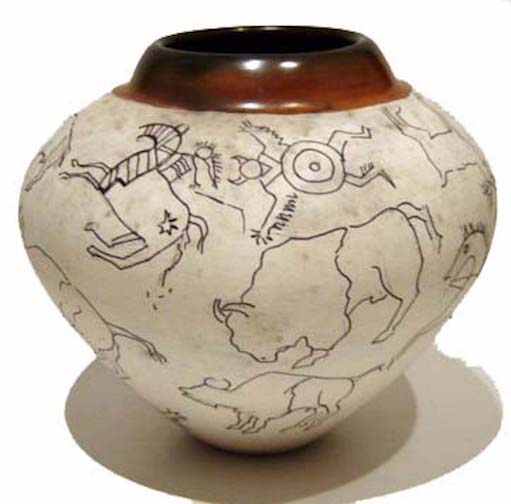
Ledger drawing pot by Jody Folwell, which references ledger drawings and petroglyphs, Santa Clara, 6.5”w x 5.5”h (2006). Collection of E. J. Guarino.
Many rock art images are abstractions, but they are recognizable – snakes, deer, turtles, scorpions, the sun, the moon, and even weaving patterns. However, exactly what the ancients meant to communicate can only be guessed at. Of all the depictions, perhaps the most enigmatic of are the totally abstract designs. Some of the petroglyphs and pictographs may be visual reminders of important stories; some may record significant events, or be warnings of dangers ahead on the trail; while others may document dreams and visions. These abstract designs are the most puzzling to the modern viewer, however. Nonetheless, the ability of the ancient people of the Americans for abstraction continues to inspire modern artists.
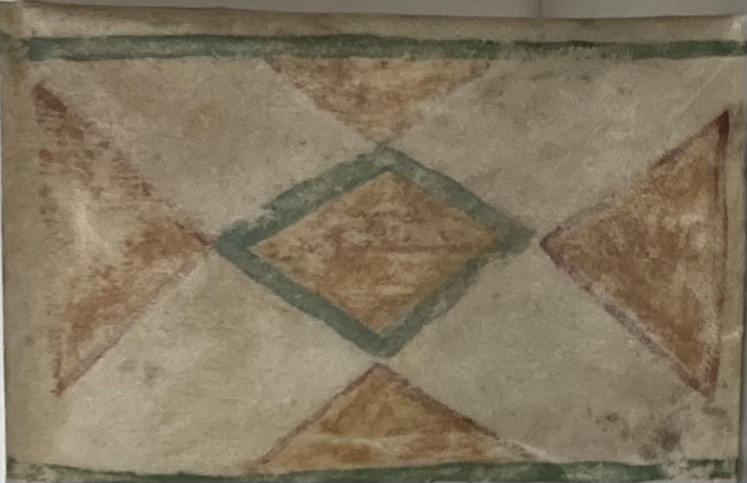
Child’s parfleche, Plains Indian, 6” x 4” (ca. 1890). Recto.
Collection of E. J. Guarino.
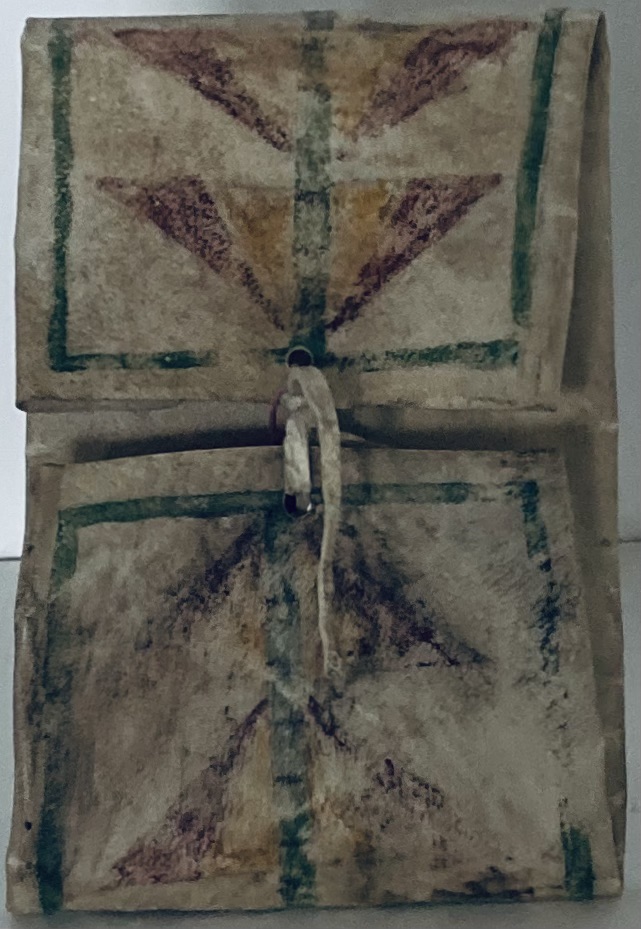
Plains Indian Child’s parfleche. Verso.
When horses were reintroduced into the Americas by Europeans, many Native American tribes quickly adapted to these new animals, realizing that they could be useful for many purposes such as for travel, warfare, and as beasts of burden. Horses allowed many nomadic groups to be much more mobile, enabling them to cover much wider distances. Needing something in which to transport their belongings and food on their journeys, Plains Indians developed the parfleche. The word for this unique container was probably coined by French-speaking hunters and trappers. “Par” is derived from the French verb parer, meaning “to parry,” and flèche is French for arrow. This may seem odd, but rawhide, the material used to make parfleches, was originally used to create shields to defend against arrows. Because rawhide is lightweight and waterproof, it was ideal for making parfleches. Traditionally, the parfleche was decorated with colorful and vivid geometric designs. Although serving a functional purpose, parfleches are also abstract works of art because of their bold graphic elements.
Miniature parfleches are not uncommon. They were given to children as toys but, more importantly, they served to teach children how to be responsible for their personal possessions such as toys, clothes, and pemmican.
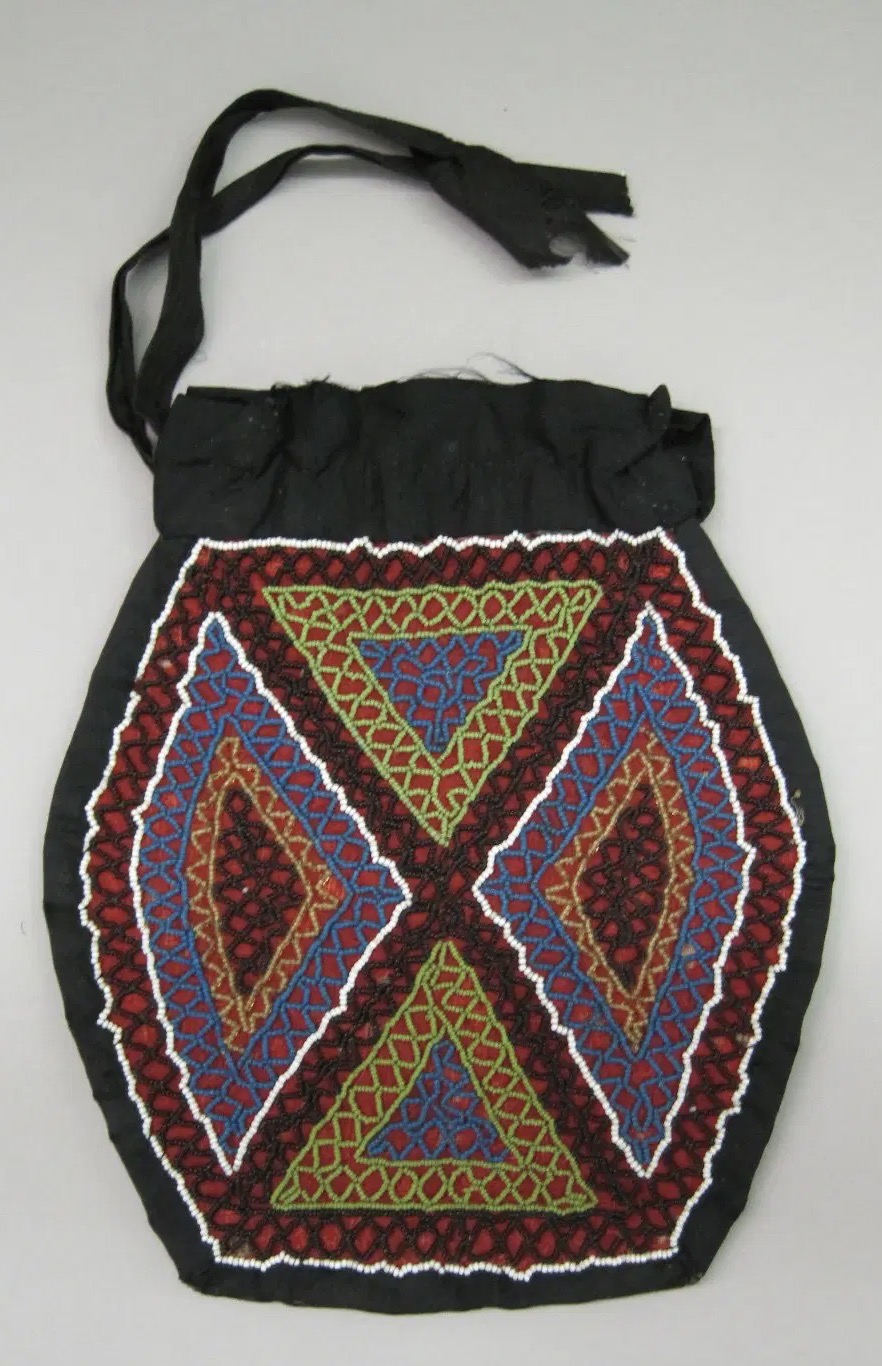
Mi’kmaq Beaded Pouch, cloth, beads, 6 3/8” x 7 1/2,” including strap (ca. 1820 – 1840). Gift of the Edward J. Guarino Collection in memory of Josephine Guarino to the Brooklyn Museum in 2016. (Photo courtesy of the Brooklyn Museum.)
For well over two hundred years Mi’kmaq, Seneca, Mohawk, Cayuga, Tuscarora, Oneida, Onondaga, Lakota, Cheyenne, Cherokee, Nez Perce, Crow, Arapahoe, Ojibwe, Odawa and Potawatomi beadwork artists have been producing spectacularly colorful pieces. These were made in the form of hats, clothing, tablecloths, mats, purses, boxes, horseshoes, canoes, picture frames, various types of holders for matches, glasses, scissors, whiskbrooms, and pincushions in the shape of stars, hearts, strawberries and women’s shoes. Beadwork has also been used to decorate clothing and moccasins. In the past, beadwork artists were anonymous and their work was trivialized as “tourist art” and many pieces were denigrated as “whimsies.” It has now come to be understood that beadwork is profoundly significant to Native American culture, expressing identity, values, and beliefs, but it has only recently been taken seriously by non-Natives as an art form.
Some Native groups employed representational imagery, referencing plants and animals, others created works decorated with abstract designs, while a number of tribes used a combination of representational and abstract iconography.
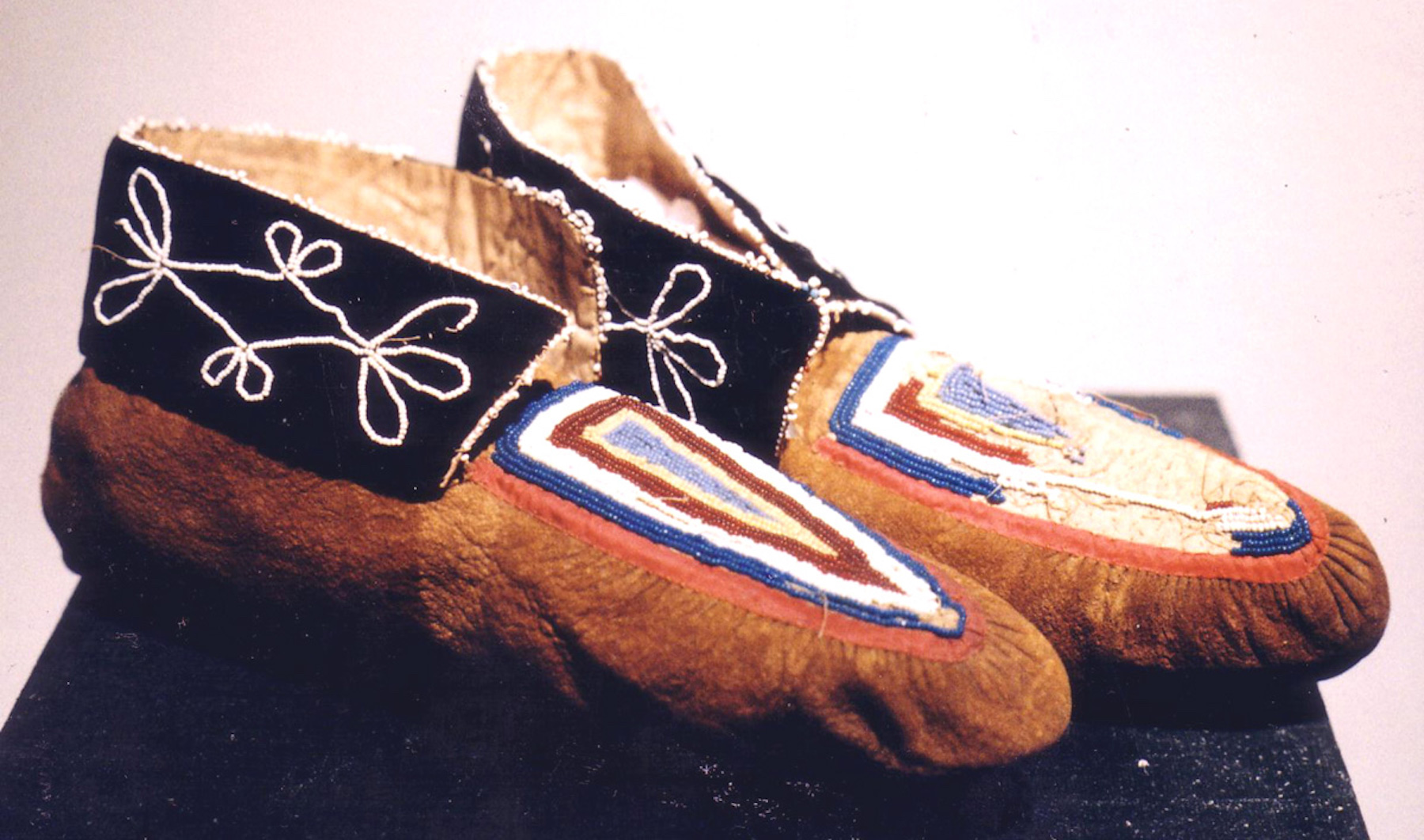
Haudenosaunee moccasins with abstract designs, beadwork, cloth, hide, 10” long, (circa 1870). Collection of E. J. Guarino.
The beadwork of the Haudenosaunee (Iroquois) for example, is rich in imagery, much of it representational. However, abstract designs were also created. Beadwork has deep significance for the Haudenosaunee. Throughout their history they have used beadwork to express spiritual beliefs and political values as well as to preserve cultural memory and to record important events and memorialize treaties. Originally created out of shells, over time, the shape, colors, sizes, and materials from which the beads were made changed. Contact with Europeans introduced glass beads, which the Haudenosaunee readily incorporated into their art form. Beadwork decorated clothing, moccasins, and pouches. However, during the Victorian Era Haudenosaunee women not only created the usual items of Native clothing, but also invented new beaded objects, which would appeal to non-Natives: whiskbroom holders, sports caps, smoking caps, Glengarry caps (of Scottish origin) bags, pincushions (especially those that were boot-shaped), wall holders, and commemorative items bearing specific dates. A number of such items were decorated with abstract imagery such as curvilinear designs and geometric patterns. Haudenosaunee beadwork imagery frequently abstracted natural forms.
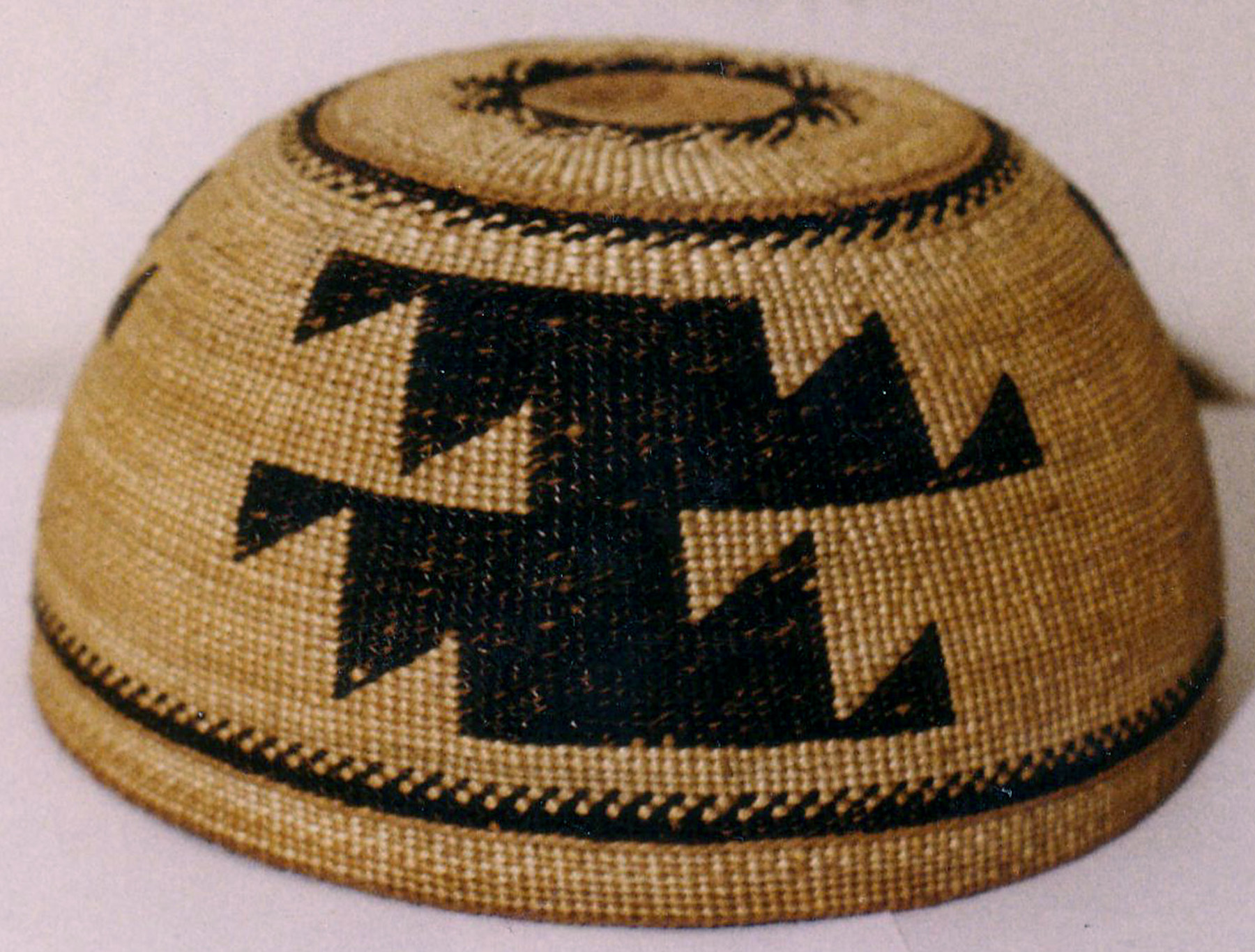
Hupa basketry hat, hazel or willow sticks for the foundation, spruce root or pine root for sewing splints, bear grass, woodwardia fern and bracken fern for designs, 4”h x 7” in diameter (circa 1890 – 1910). Collection of E. J. Guarino.
Woven caps, often mistaken even by museums as baskets, were and are still created and worn by the Hupa, Karuk, and Yurok tribes of Northern California. Called Xoji Qosta:n ( pronounced ho ji kos), these basketry hats could take up to a year to create, and as they were being woven, their maker would say prayers in order to put good intentions into them. The abstract designs of these caps carry symbolic meanings and often have names such as “Friendship,” “Frog’s Hand,” and “Grizzly Bear Paw.” The hats resemble an acorn top since acorns were a staple of Hupa life.
Hupa, Karuk, and Yurok women realized that tourists and collectors would pay more for their caps than for baskets and started making them for these markets. However, basketry caps made for the tourist trade and for collectors were smaller, took less time to make, and used fewer materials. Today, such caps would not fit anyone’s head.
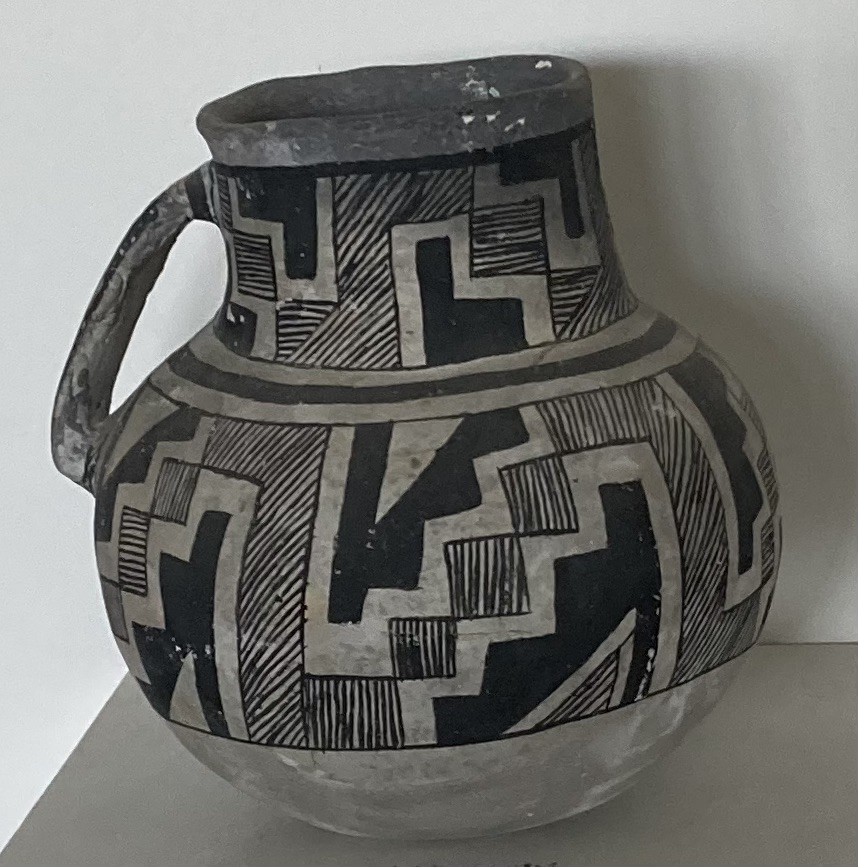
Ancestral Pueblan (Tularosa) black-on-white pitcher, 6” tall (1150 to 1325 A.D).
Collection of E. J. Guarino.
Ancestral Puebloans, the ancestors of today’s Pueblo People, are noted not only for spectacular cliff dwellings but also for their exquisite ceramics. Although they created utilitarian forms – bowls, beakers, pitchers, mugs, canteens, and jars (more commonly referred to as ollas) – the pottery created by Ancestral Puebloans is today regarded as art rather than craft. Although some vessels were undecorated and are considered plain ware, and others were corrugated, having an intentionally rough exterior, the most dazzling pieces are decorated with stunning abstract designs that would make any 21st-century artist jealous, yet these abstract masterworks were created close to 1,000 years ago.
Although we tend to think of abstract art as a modern invention, Native Americans have been abstracting the natural world and their spiritual beliefs for thousands of years. Many 20th and 21st-century artists owe a debt to abstract Indigenous works that were created in the Americas in past centuries. The color field paintings of Mark Rothko, for example, look very much like the pre-Colombian Peruvian textiles he collected.