

Collector's Corner
UNCOVERING THE PAST: Remembering the Indigenous History of the Oregon Coast
Oct
Rugged and visually stunning, the Oregon Coast is rich in history, but most of it is buried under what came afterward – Westward Expansion and, eventually modern life and all it entails. Today, tourists flock to Astoria, Seaside, Cannon Beach, Manzanita, Pacific City, Lincoln City, Newport, Florence, Bandon and other coastal resort towns mostly unaware of what came before. However, prior to Europeans reaching the Pacific Northwest Native Peoples were living and thriving on the Oregon Coast. A diversity of Native groups lived along the Oregon Coast and flourished on its bounty – the Clatsop, Nehalem, Tillamook, Nestucca, Siletz, Yaquina, Alsea, Siuslaw, Kalawatset, and Hanis. Villages of the Coastal Rogue tribe, also known as the Chetco and Tutuni, as well as the Tolowa extended as far south as present day northern California. Taken from Native American tribal names and languages indigenous to the area, place names such as Clatsop, Nehalem, Tilamook, Coos Bay, Yachats, and Coquile are reminders of a history that has mostly been rendered invisible.
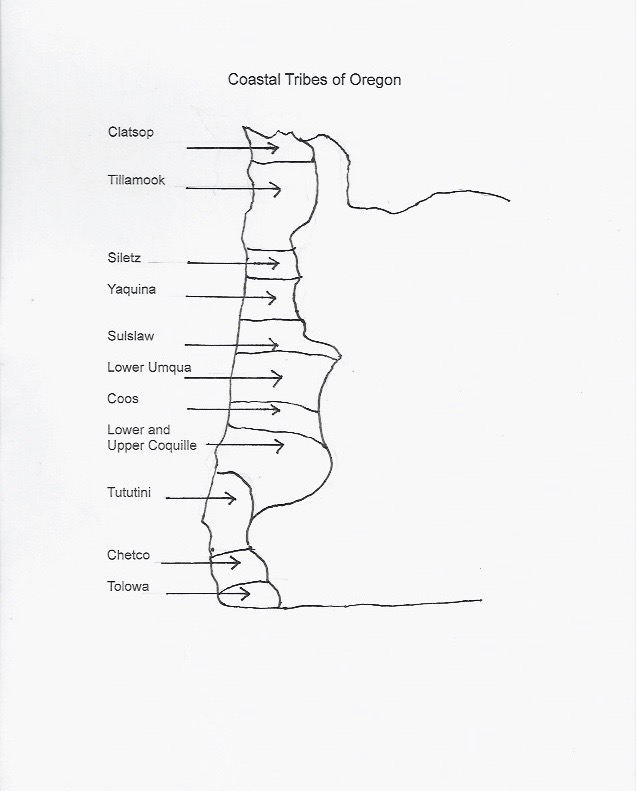
Tribes of the Oregon Coast. (Map courtesy of Jeff VanDyke.)
The history of Oregon before the arrival of Europeans has received little consideration compared to other parts of the country. It is the Southwest that has probably received the most attention from historians, archaeologists, and tourists. When the Pacific Northwest has been studied the focus has usually been on the Native populations of Washington State, British Columbia, and Alaska rather than Oregon. However, there is a rich vein of history to be mined in the state, particularly the coast.
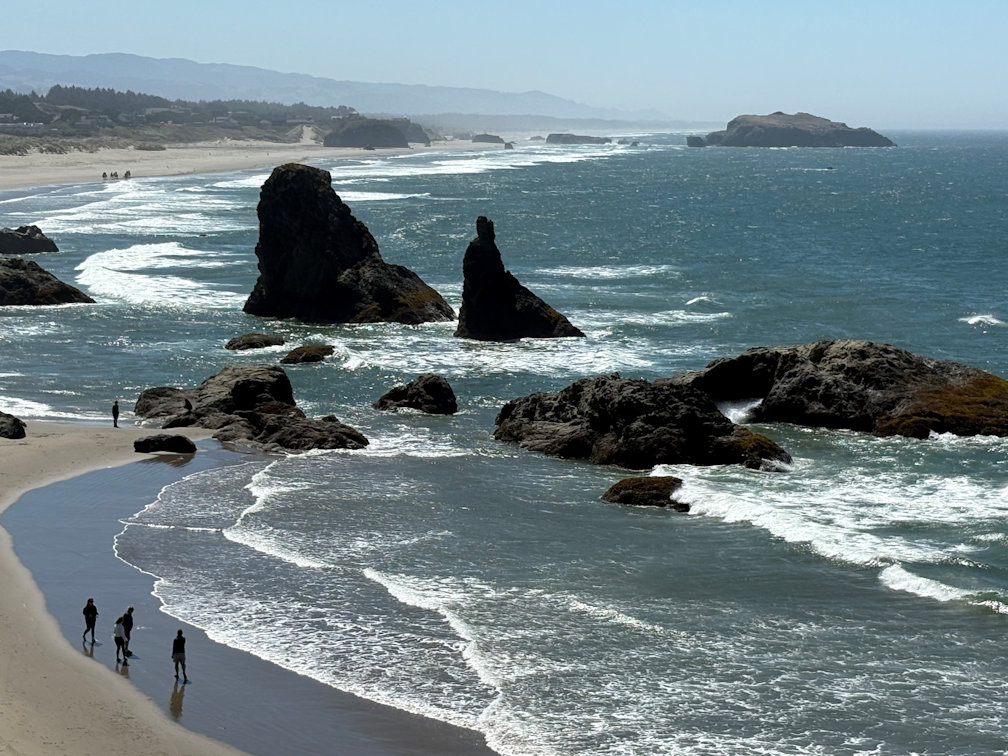
Bandon Beach (Photo courtesy of Jeff VanDyke.)
A diverse range of Native groups lived along the Oregon Coast and flourished on its bounty, building villages near rivers and estuaries, which gave shelter during storms, access to a variety of foods and building materials as well as proximity to the ocean. The coastal tribes spoke diverse languages and were, for the most part, isolated from each other because of the rugged landscape. They were also isolated from the inland tribes by the Oregon Coast Range, a series of mountains that extends more than 200 miles north and south and is thirty to forty miles wide. Some elevations are as high as 4,101 feet above sea level with average elevations around 1,500 feet. However, trails along the beaches served as trade routes for the coastal tribes, allowing them to participate in extensive trade fairs held on the banks of the Columbia River. Their trade network stretched for many thousands of miles – as far north as the Arctic, inland to the Great Prairie, west to the Hawaiian Islands, and south to California and beyond.
For millennia, Indigenous People were drawn to the rich resources of the Oregon Coast.. The vast ocean to the west and the great forests to the east provided a veritable supermarket of natural resources. The sea provided clams, mussels, crabs, sea anemones, seabirds and their eggs, a wide variety of fish, seaweed, seals, sea lions, and whales. Rivers, too, offered sustenance in the form of salmon. The land offered deer, elk, beaver, birds and their eggs, as well as plants such as camas, skunk cabbage, salal, and miner’s lettuce, and also provided berries, bulbs, roots, and seeds. Plants were not only used for food, but also for medicinal purposes and for weaving clothing, nets, mats, and baskets and also provided building materials for homes and canoes. Coastal Peoples gathered hazel, willow, fir, maidenhair fern, bear grass, woodwardia fern, spruce roots, and western red cedar.
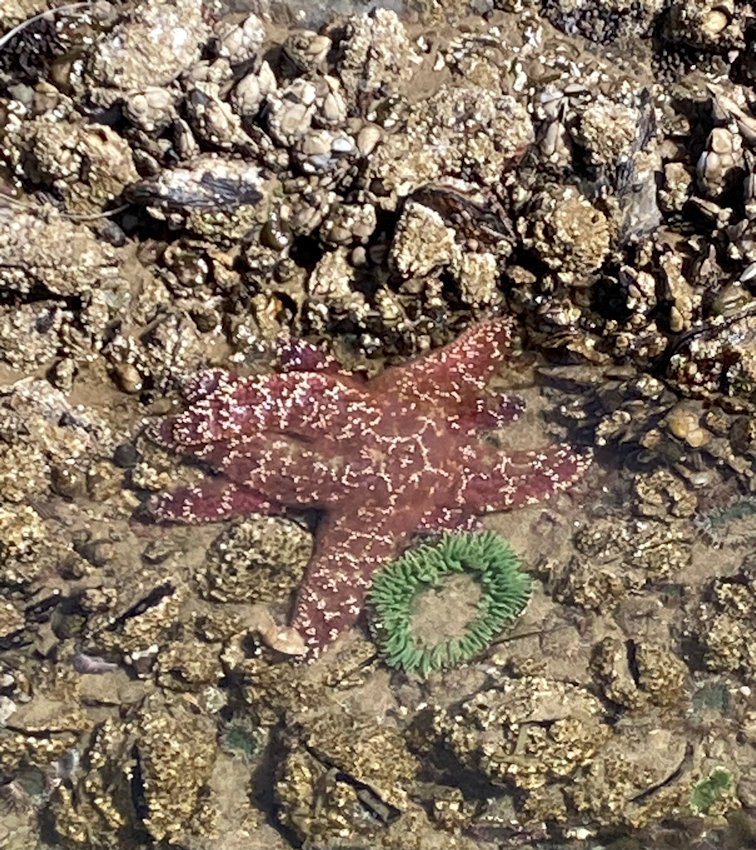
Starfish, sea anemones and mussels, Oregon Coast. (Photo by E. J. Guarino.)
In 1700 the Oregon Coast was hit by a devastating earthquake followed by a massive tsunami. Although it is not known how many people were killed, the coastline, estuaries, and other low-lying areas were dramatically changed. Houses, food stores, nets, fish weirs, canoes, tools and utensils were washed away and natural resources destroyed. The Lewis and Clark Expedition arrived some 100 years later in 1805, reaching as far as the Pacific. Within a relatively short period of time, life on the north Oregon Coast was transformed. Where once Native villages once stood up and down the coastline, this was no longer the case. By the mid-1800s, Native villages were no more. After millennia of living on the Oregon Coast, more unwanted change came with the arrival of explorers and fur traders – disease, famine, and seizure of ancestral lands. Conflicts arose over land and natural resources. In the course of two centuries, survivors had their ancestral lands confiscated; they were forcibly moved to reservations; and sometimes outright murdered. The Oregon Coast is a land of sun, rain, fog, and mist. Sections of Oregon’s coastline are noted for their dramatic rock formations while the Central Oregon Coast is dominated by massive sand dunes.
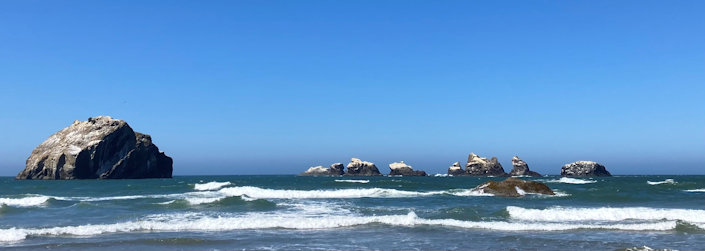
Face Rock and Kittens Rocks, Bandon, South Oregon Coast. (Photo by E. J. Guarino.)
On the southern Oregon Coast, Bandon is one of a number of that is noted for sea stacks, tall columns of rock isolated from the coastline. Bandon’s sea stacks have been given fanciful names such as Face Rock, Cat and Kittens Rocks, Wizard’s Hat, Howling Dog, Table Rock, and Elephant Rock.
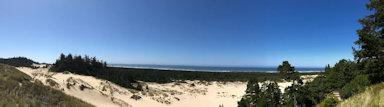
Oregon Dunes National Recreation Area, Central Oregon. (Photo by Jeff VanDyke.)
Oregon’s central coast is dominated by massive sand dunes that separate the region’s lush rain forests from the ocean. Extending forty miles south from Florence, in places the dunes stretch 2.5 miles inland and some rise to 500 feet. This unique landscape is not a barren desert, but contains lakes, forested areas and low-lying plains. These topographic features provide habitats for a wide variety of mammals and birds including mice, voles, porcupines, minks, black bears, foxes, deer, elk, Canada geese, and the western snowy plover, a threatened species. The dune environment includes plants such as the evergreen huckleberry, bog blueberry, shore pine, and Sitka spruce.
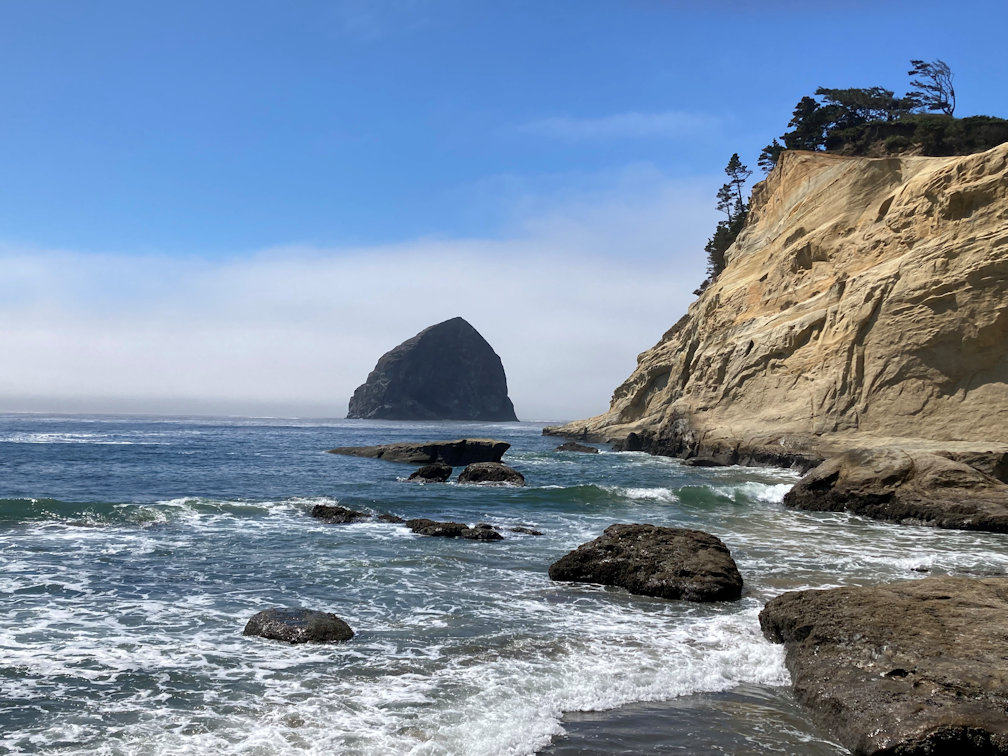
Haystack Rock, Pacific City. (Photo by E. J. Guarino.)
Famous for the giant Cape Kiwanda sand dune and an offshore “sea stack” known as Haystack Rock (one of three so named monoliths on the Oregon Coast, Pacific City is small in population (1,000), but large on charm. It is another popular tourist destination where one can climb a massive sand dune or simply gaze out at a massive geological wonder.
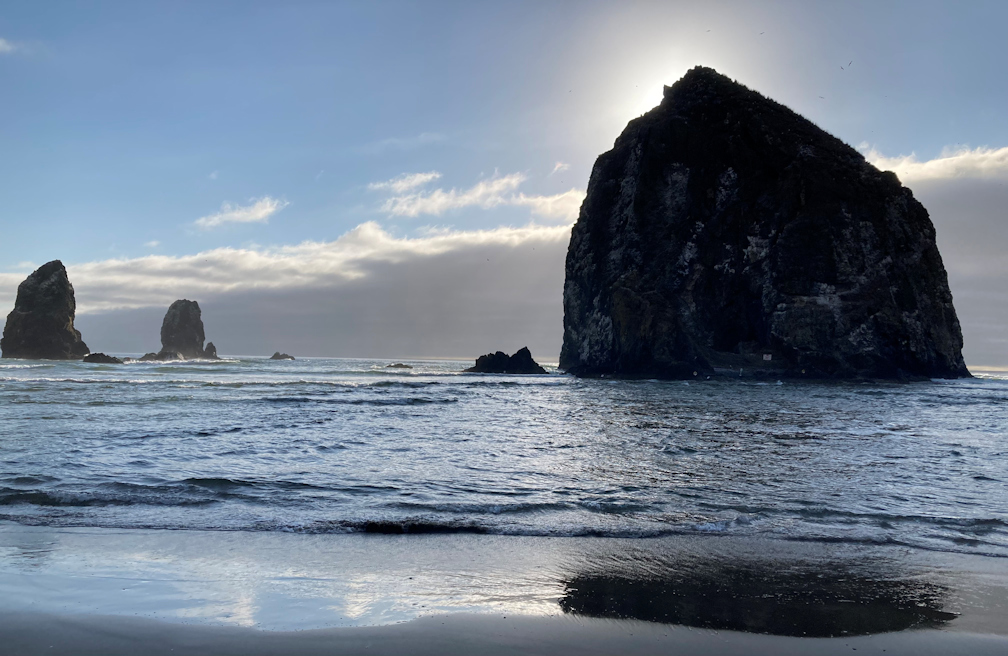
Haystack Rock, Cannon Beach. (Photo by E. J. Guarino.)
On the north coast, Cannon Beach is popular with day-trippers, tourists, and those who own or rent beach houses because of its stunning natural beauty and its proximity to Portland. The town occupies what was once the site of a Tillamook village called NeCus’. Like Bandon, Cannon Beach is noted for dramatic rock formations, the most specular of which is Haystack Rock, standing 235 feet tall. Unfortunately, most of the Indigenous history of the Oregon Coast has been obscured by the trappings of modern life. Where there were once Native villages, there are now beach towns. Where Indigenous People once fished, hunted and gathered, affluent folks frolic and modern roads, highways, and superhighways cover the landscape. Fortunately, much of Oregon’s visual splendor, particularly its coast, remains, but there is much more to appreciate. The Oregon Coast is one of our country’s most spectacular and unique landscapes, but it has a complex and often disturbing history. Although much of the Indigenous history of the Oregon Coast is hidden, fortunately many places have names that reference Indigenous tribes and languages. In many other places in the U.S., including national parks, however, most Native place names have been replaced over time, thus erasing any knowledge of a Native presence.