
Collector's Corner
EMPATHY: An Inuit Artist Responds to the Holocaust
Though the Inuit community of Cape Dorset is geographically isolated, it is not as separated from the rest of the world as it once was. Books, magazines, film, TV, air travel and, more recently, the Internet have connected once remote areas of the Arctic to other countries and cultures. Arctic peoples are no longer unaware of what is happening outside of their communities. If an event is newsworthy, those living in the Arctic will know about it. The famine in Ethiopia, the Challenger Space Shuttle Disaster, and the attacks on the World Trade Center on 9/11 have all been subjects for Inuit artists. Though located some 3,000 miles from where the Holocaust took place, artists in Cape Dorset are well aware of this tragic part of modern history.
Among the most surprising works exemplifying the global awareness of Inuit artists and, in particular, their knowledge of the Holocaust, are Daymare, a drawing, and Untitled (Study of Daymare), a monoprint, both by Arnaqu Ashevak. So what exactly inspired an artist living in the Arctic to create not one, but two works about the Holocaust? In an interview with Pat Feheley, owner of Feheley Fine Arts, Toronto, Arnaqu Ashevak stated, “I saw a documentary about the Holocaust victims back in World War II; I started drawing about it. It’s a strong image. I called it Daymare because it was like a nightmare but happening in the daylight. It was like a dream, but it still happened.”
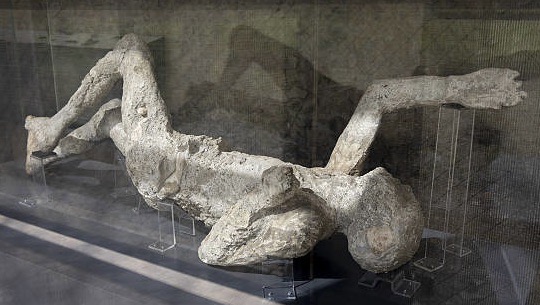
Plaster cast of a victim from the 79 AD destruction of Pompeii by the eruption of Mount Vesuvius.
Oddly, what first attracted me to Ashevak’s drawing and print had nothing to do with the Holocaust. Instead, the two works reminded me of casts I saw of victims who had died in the ancient Roman city of Pompeii as a result of the massive eruption of Mount Vesuvius in 79 AD. This was a holocaust caused by Nature unlike the 20th century’s Holocaust, which was caused by humans motivated by hatred. It was only after I had read what Arnaqu Ashevak said was the inspiration for his two 1998 works on paper that I understood what they were about.
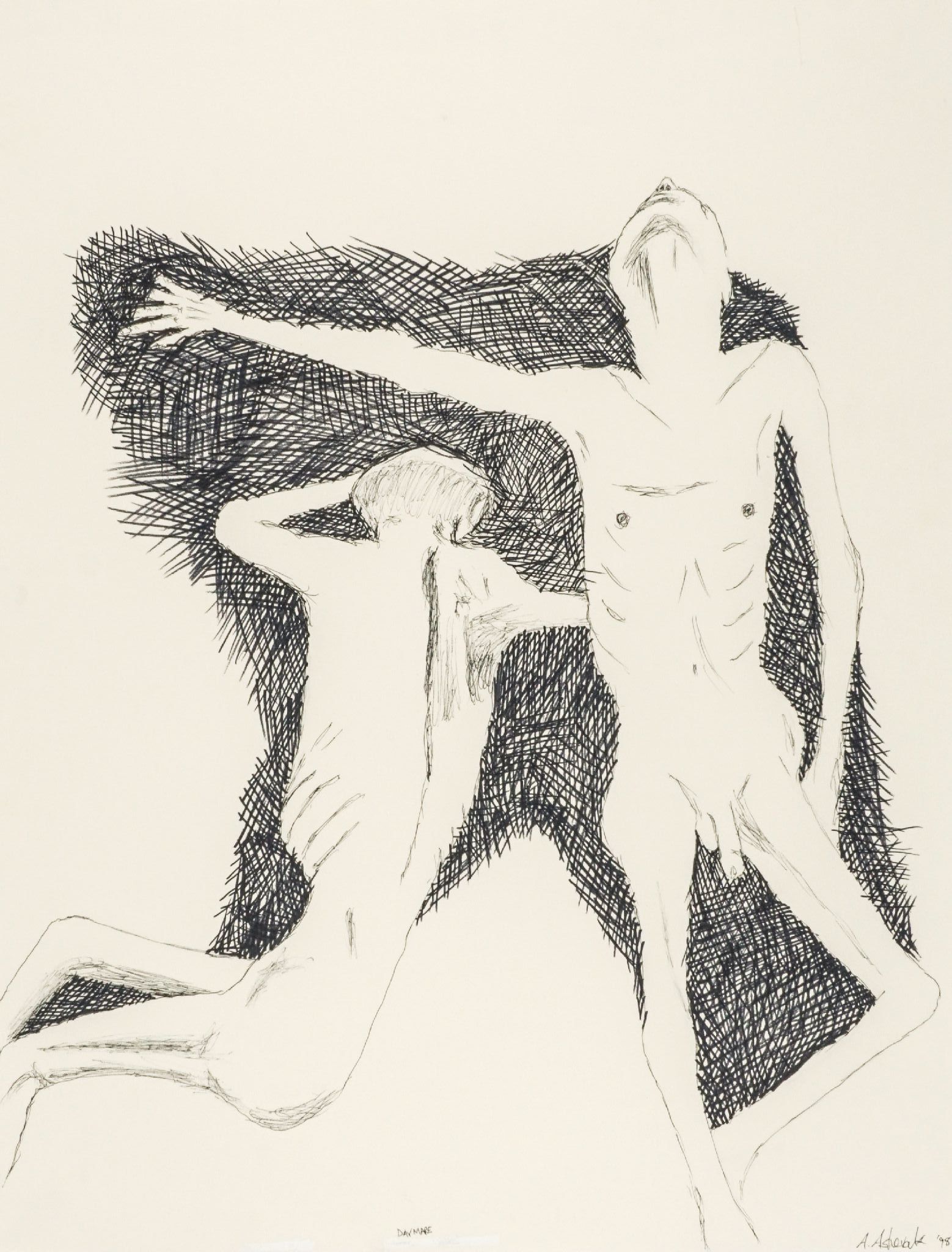
Daymare by Arnaqu Ashevak, Kinngait (Cape Dorset), graphite and ink, 26” x 20” (1998). Image courtesy of Feheley Fine Arts, Toronto, and Dorset Fine Arts, Toronto.
For some, the genocide of the Jews in Nazi concentration camps in Europe is a matter for Jews and not for anyone else. Fortunately, this is not the predominant mindset. Arnaqu Ashevak was clearly moved by what happened to the Jews and knew that if it could be done to them it could be done to anyone. Thousands of miles away from Europe, Ashevak was inspired by a documentary about the Holocaust. We may never know the name of the documentary Ashevak viewed, but it might, in fact, have been Nuit et brouillard (Night and Fog) directed by Alain Resnais, which I showed every year in the Film History classes I taught. Made in 1955, ten years after the liberation of the Nazi concentration camps, and released a year later, the film’s title is taken from the Nazi program of abductions and disappearances, which was known as Nacht und Nebel (Night and Fog). Whatever film Ashevak saw, the plight of the Jews in Europe clearly touched him. Daymare, a drawing, is one of Arnaqu Ashevak’s two responses to what he saw in the documentary. The depiction of the two nude bodies is disturbing but, as an artist, Arnaqu did not shy away from what might be troubling to his audience. The figures are emaciated and the one on the right is in a position of anguish with is head thrown back. The background appears coarse as if they are lying on some sort of rough-hewn blanket. Whether what the viewer is seeing are two corpses or two starving men is left up to interpretation. The artist most probably saw such images in the film he viewed. There are certainly such scenes in Night and Fog.
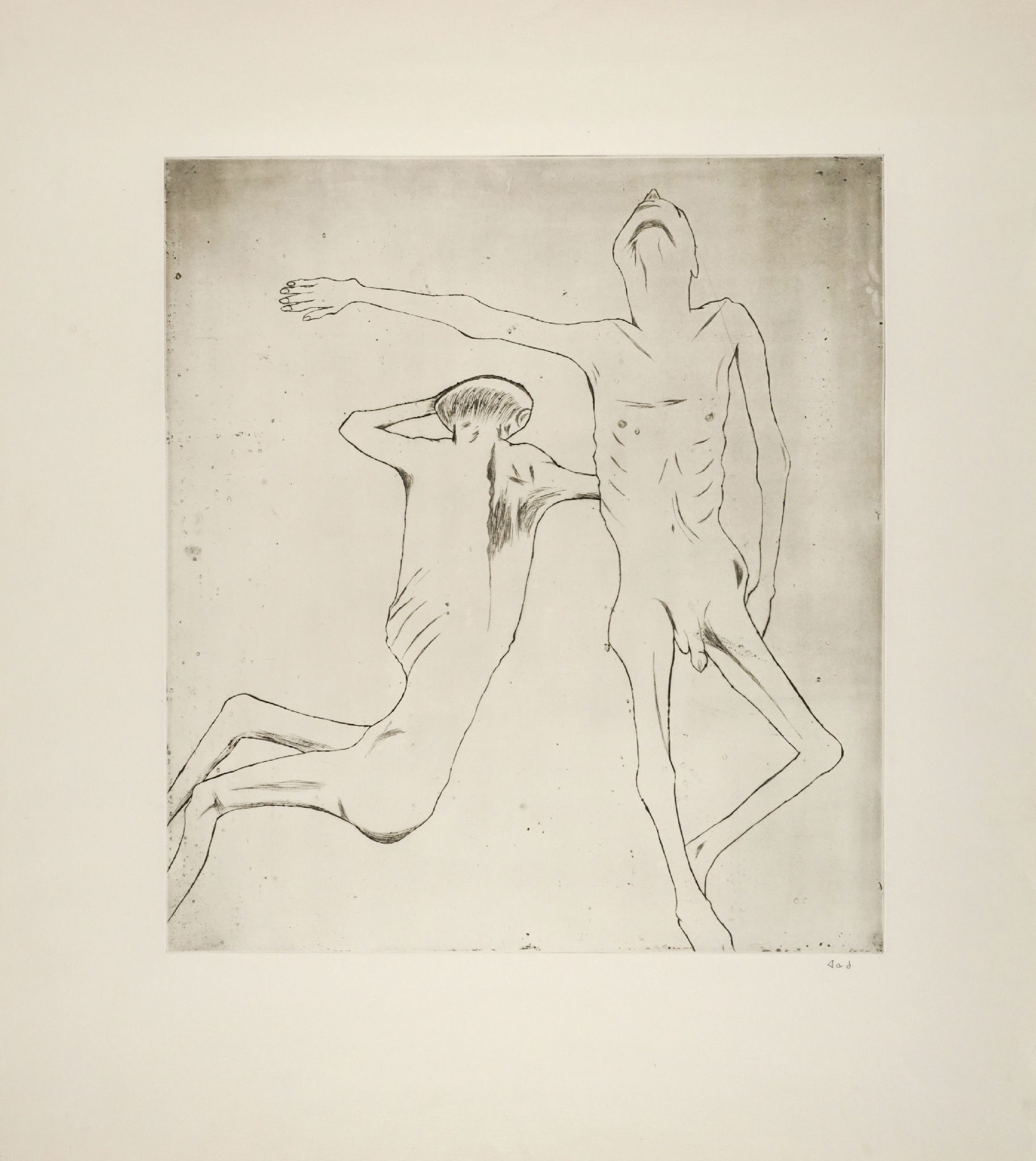
Untitled (Study of Daymare) by Arnaqu Ashevak, Kinngait (Cape Dorset), monoprint etching and acquaint, 35 1/4” x 31 14” (1998). Image courtesy of Feheley Fine Arts, Toronto, and Dorset Fine Arts, Toronto.
Usually, studies come before the final work. However, the titles of such works are usually written as Study for – the important word being for, indicating it was created before the final work However, the title for the Ashevak print is Untitled (Study of Daymare). The word of could suggest it was created after the drawing, but whether or not this is the case is not known.
The print version of Arnaqu Ashevak’s drawing differs in a number of respects. The coarse-looking background of the drawing has been omitted and the figures appear to be lying on a floor or, perhaps, floating. Rather than the sharp contrast of black-and-white in the drawing, the monoprint is monotone. In terms of size, the study is somewhat larger than the original.
As works of art, Daymare and Untitled (Study of Daymare) are thought-provoking and unsettling and rightfully so. Both works reference one of the worst events in 20th century history. That an artist living in a small community in the Arctic with a population of under 1,500 should be drawn to a genocide that took place decades in the past, on the other side of the world, to people to which he has no connection, except our common humanity, is astonishing and reassuring.
There are many collectors who believe that painful and unsettling subject matter has no place in Inuit art, preferring romanticized versions of how life was once lived on the land as well as colorful depictions of Arctic wildlife. The harshest criticism has come from some Inuit who feel that controversial themes should not be addressed by artists in their community out of fear that collectors will reject such works. Nonetheless, Arnaqu Ashevak refused to be bound by such limiting ideas, refusing to allow anyone to put him into a box. What he has created is a unique body of work and Daymare and Untitled (Study of Daymare) are prime examples of his artistic output.