
Collector's Corner
CE N’EST PAS UN HAMBURGER (THIS IS NOT A HAMBURGER): Ceramic Artist Susan Folwell Strikes Again
Aug
For many years now, I have been a fan of artist Susan Folwell’s work so much so that I often jokingly say that my home contains the Museum of Susan Folwell Ceramic art. It is very hard for me to resist a piece by Susan. So, it should come as no surprise that I could not pass up one of her newest pieces Diners, Dives, and Drive-Ins on Route 66. It fascinated me and I felt that there was a great deal to unpack here. As strange as it may seem, as soon as I saw Diners, Dives, and Drive-Ins on Route 66 René Magritte’s painting Ceci n’est pas une pipe (This is Not a Pipe), a Surrealist masterpiece, immediately came to mind. As with that work, the viewer realizes that the hamburger represented in Diners, Dives, and Drive-Ins on Route 66 is not actually a hamburger, but simply a facsimile of one. Like the pipe in the Magritte painting, it is not the object itself, only an image of it. Diners, Dives, and Drive-Ins on Route 66 also brought to mind Meret Oppenheim’s Object – Le Déjeuner en fourrure (Lunch in fur), another Surrealist masterpiece. This artwork, which consists of a a fur-covered teacup, saucer and spoon, set the art world on its ear. Like Magritte and Oppenheim, Susan Folwell is often a provocateur. Her work can be humorous, playful, satiric, and always thought-provoking.

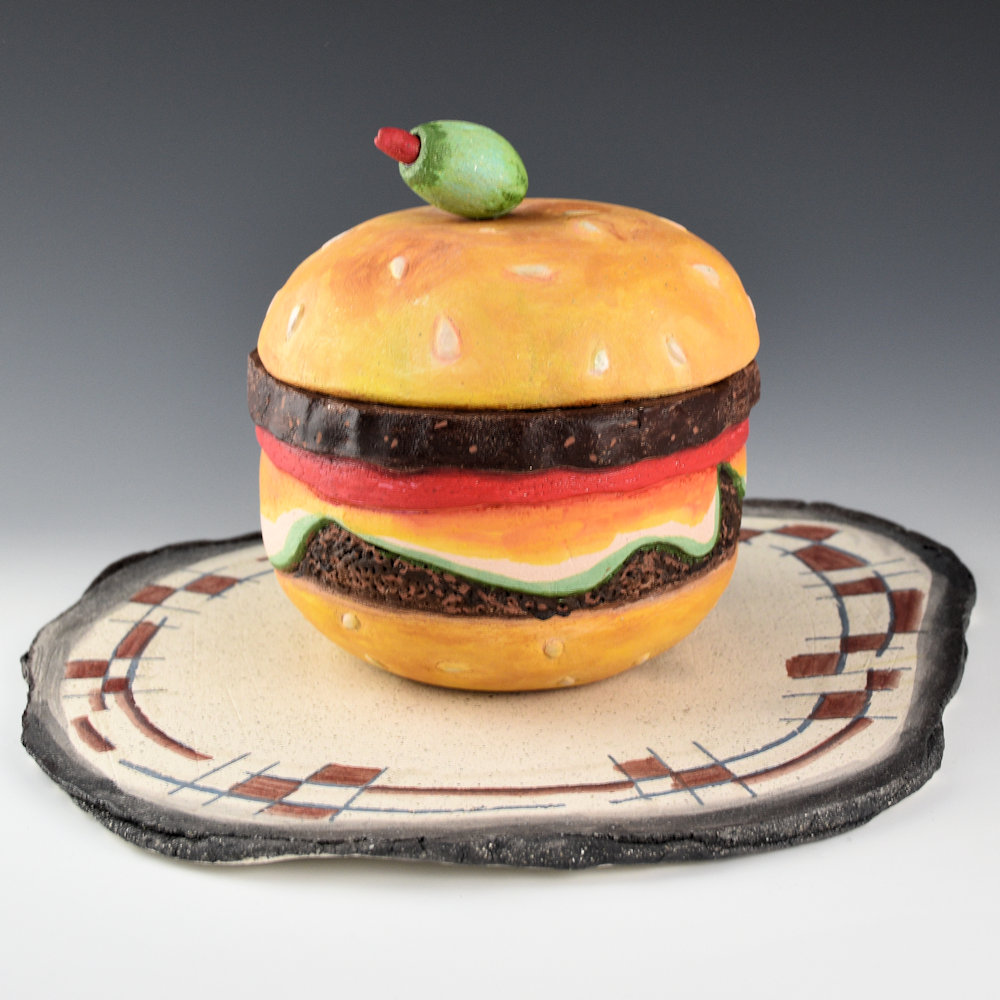
Diners, Dives, and Drive-Ins on Route 66 by Susan Folwell, Santa Clara Pueblo, plate/tile: 11″ wide; burger 5.25″w x 6”h, (2026). Collection of E. J. Guarino.

Diners, Dives, and Drive-Ins on Route 66 disassembled.
Inspired by the many “diners, dives and drive-ins” along famed Route 66, Diners, Dives, and Drive-Ins on Route 66 is part of Susan’s Route 66 Series. One of the original highways in the U. S., Route 66 is often dubbed “The Mother Road” and “America’s Main Street.” This highway had so entered the popular imagination that in 1960 the TV show Route 66 was created and ran until 1964. It followed the adventures of two young men traveling Route 66 in their Chevrolet Corvette. Folwell’s Route 66 Series has been an important undertaking. The artist has stated that the southern part of Route 66 is very special to her. In her own inimitable way, she has documented those aspects of the route that are the most significant to her. The “hamburger” part of Diners, Dives, and Drive-Ins on Route 66 is one of Susan Folwell’s exceptional trompe l’oeil pieces. It is a bowl in the shape of a hamburger with a bun lid. The burger is incised and carved into the clay and has an olive on top. The “hamburger bun” has great texture and, when viewed from the side, it looks like landscapes. The clay “plate” on which the hamburger and bun rest is made from white micaceous clay and has racing stripes. The title of the piece is also a sly reference to Diners, Drive-Ins and Dives, a Food Network reality series hosted by Guy Fieri. Arguably America’s favorite sandwich, the modest hamburger has risen to the status of a cultural icon. Although there are many variations to this quintessential fast food, the burger is instantly recognizable to people around the world and, although there are national variations, it is most often associated with the United States, sometimes derogatorily. Susan Folwell’s Diners, Dives, and Drive-Ins on Route 66 forces us to reconsider this humble sandwich.

Untitled (Lips) by Susan Folwell, Santa Clara Pueblo, 2.75”h x 9” in diameter (2012). Collection of E. J. Guarino.
Susan Folwell and I have a history of playful humor with regard to titles for some of her pieces. When I was considering one particular piece by Susan that was decorated with images of lips, I asked her about the title and she responded, “It’s untitled.” Then, after a moment or two of thought she added, “Lips, I guess.” We then spent the next ten minutes or so laughing as we competed to come up with rude alternate titles. It was a tie. So, in the spirit of fun and brevity, I sometimes refer to Diners, Dives, and Drive-Ins on Route 66 simply as The Hamburger Piece. I’m sure Susan understands and approves. As an artist Susan never slavishly follows one style and is willing to create erotic as well as socially and politically provocative works. Her ability to move back and forth from one style to another with apparent ease and what seems like lightening speed is astonishing. However, each style serves an artistic purpose as do the forms she chooses as well as the way in which she decorates her ceramic creations. Folwell’s body of work reflects a love of beauty, a keen interest in the world, a sharp intelligence and a social conscience. In addition to her Route 66 Series, as well as her Taos Light: Canvas to Clay Pueblo Perspectives Series, Corn Maiden Series, and Cry Baby Series. Drawing from a seemingly endless well of creativity, Susan Folwell is one of the most exciting and innovative contemporary American artists. Her medium is ceramics, which she uses much like a painter employs canvas or a sculptor stone or wood. Folwell pushes this art form in new directions – narrative, political, satiric, erotic, spiritual, consistently confounds expectations of what Native American and art created by Native Americans should be. She refused to be limited by what others think ceramic art, especially that produced by Native artists, should be. As a contemporary artist, Susan Folwell refuses to be put into a box or, perhaps, a better word would be teepee. As an artist, Susan Folwell has employed Pop Art imagery, reenvisioned 18th century paintings, and has not been afraid to tackle subjects as diverse as the Iraq War, the AIDS Crisis, Pueblo politics, Indian gaming, the Kardashians, Osama bin Laden, the Covid 19 pandemic, and school shootings. In her work, she has also addressed the themes of romantic and erotic love, personal loss, and the beauty of the natural world. Many of her works are formal explorations of color and form, and her imagery ranges from the representational to the abstract and sometimes a combination of the two.