
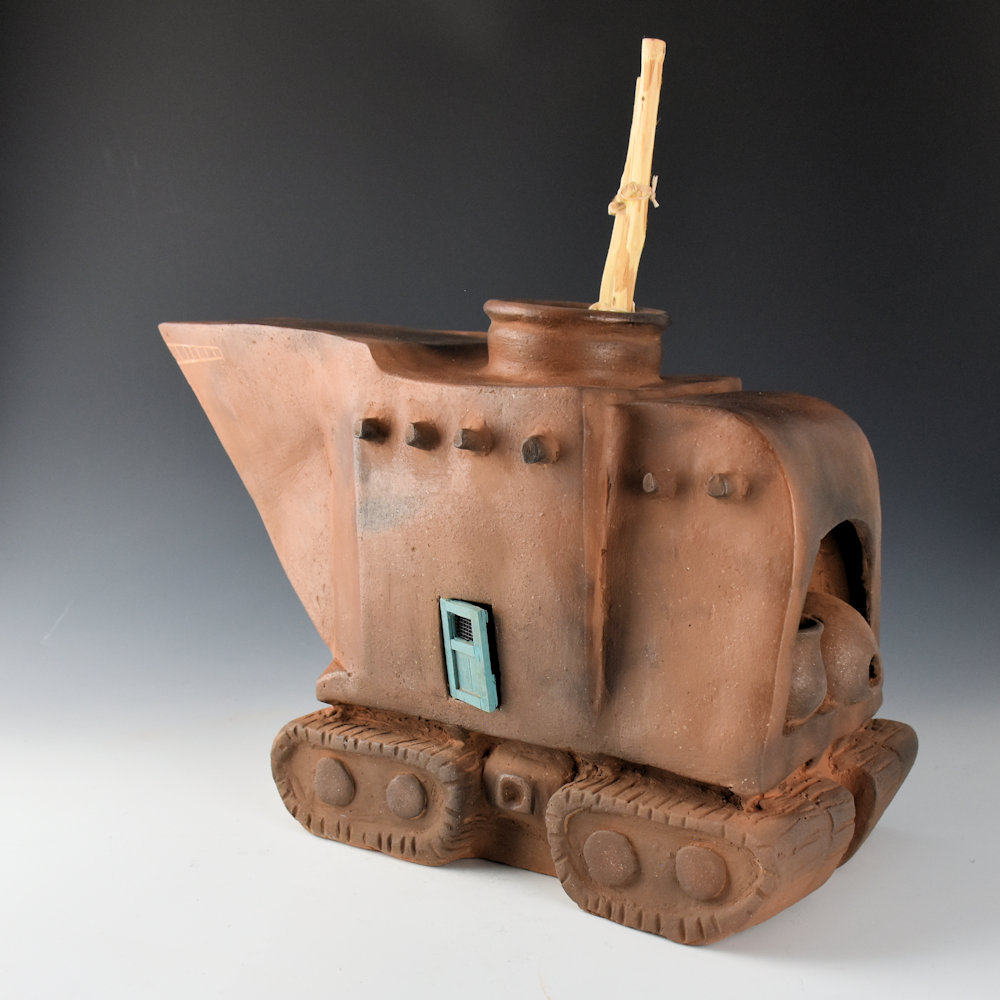

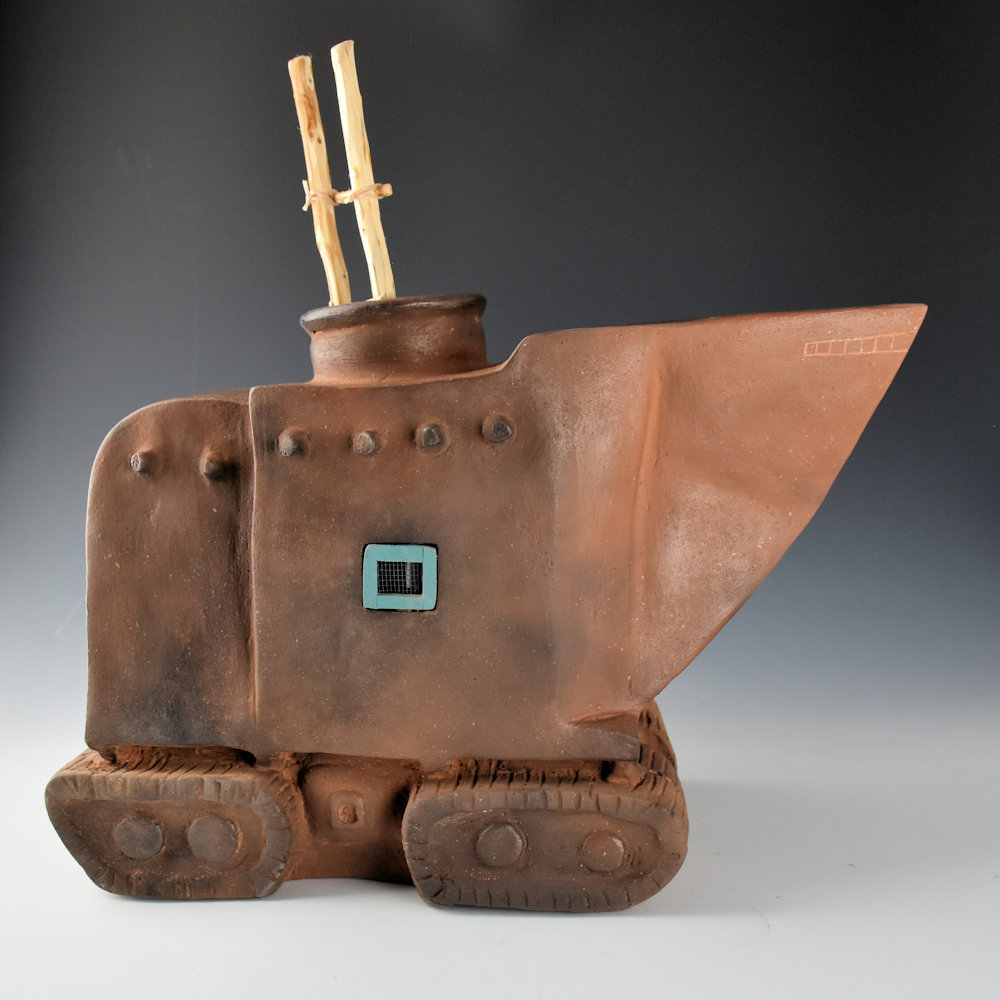
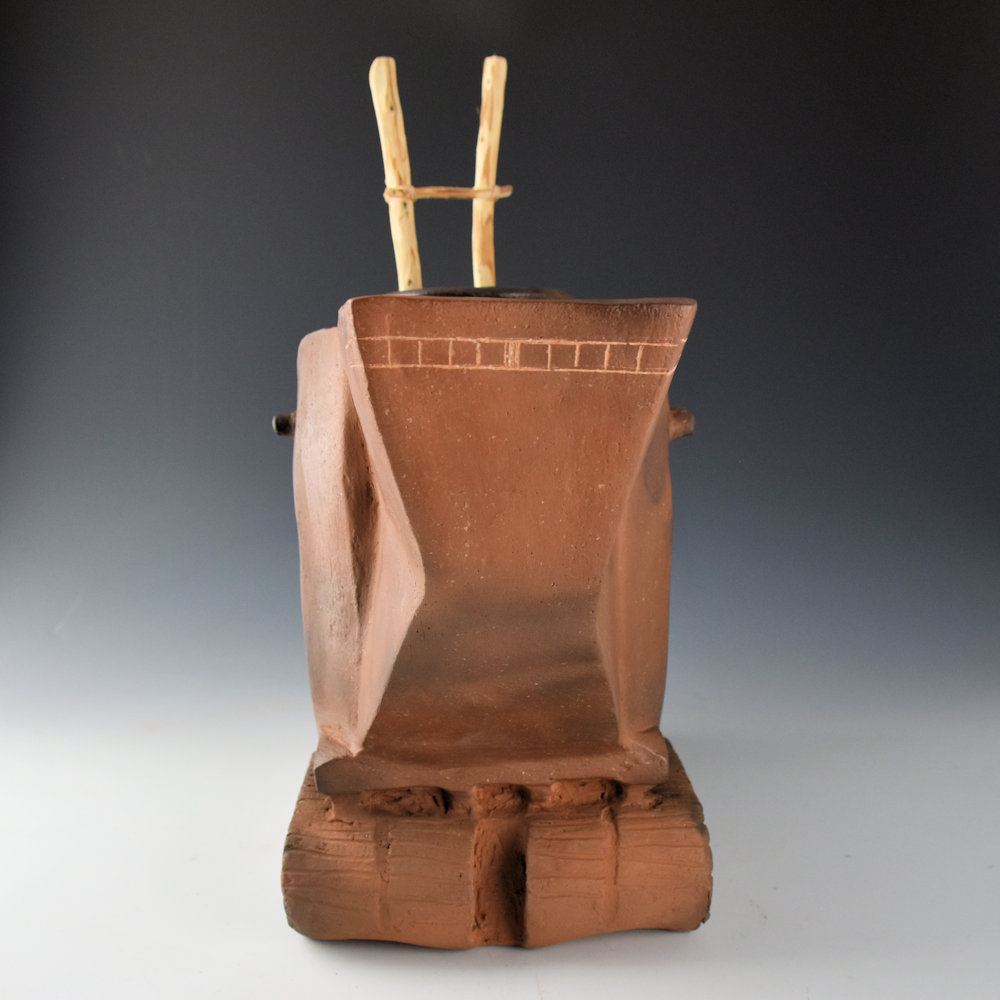
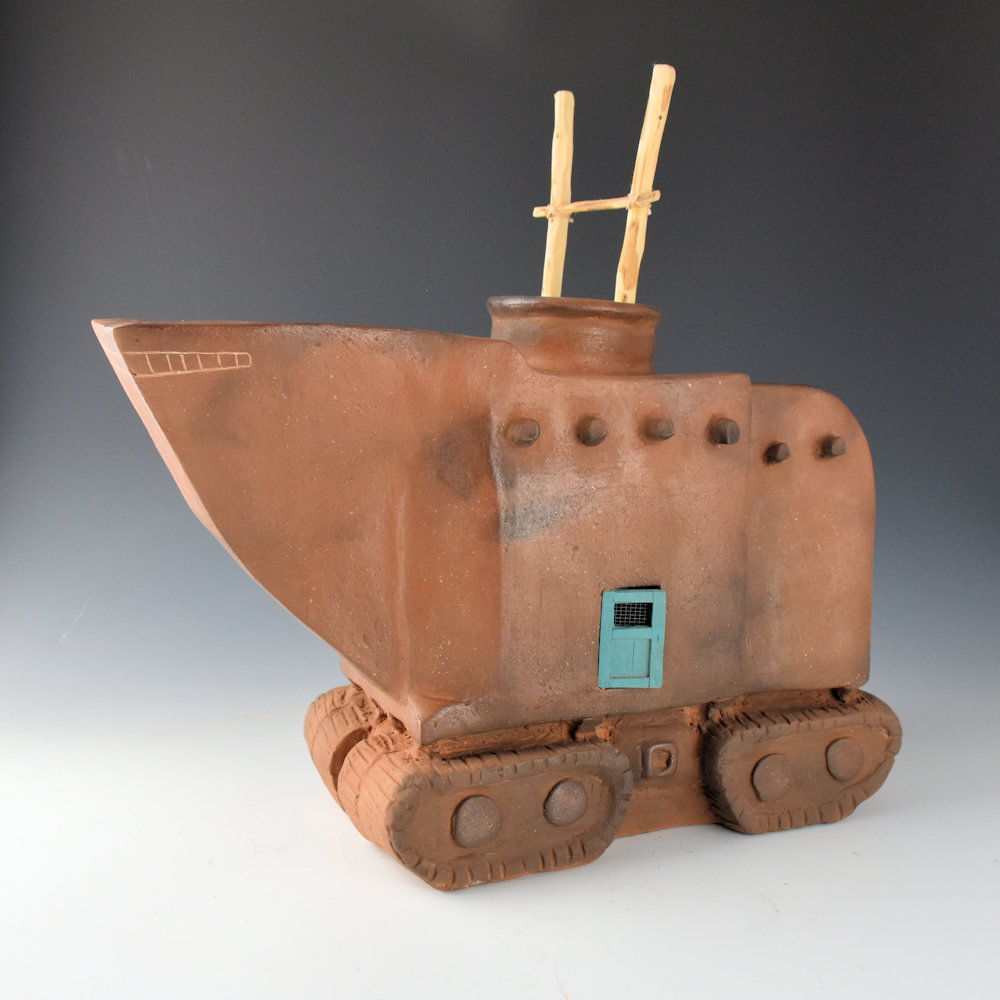
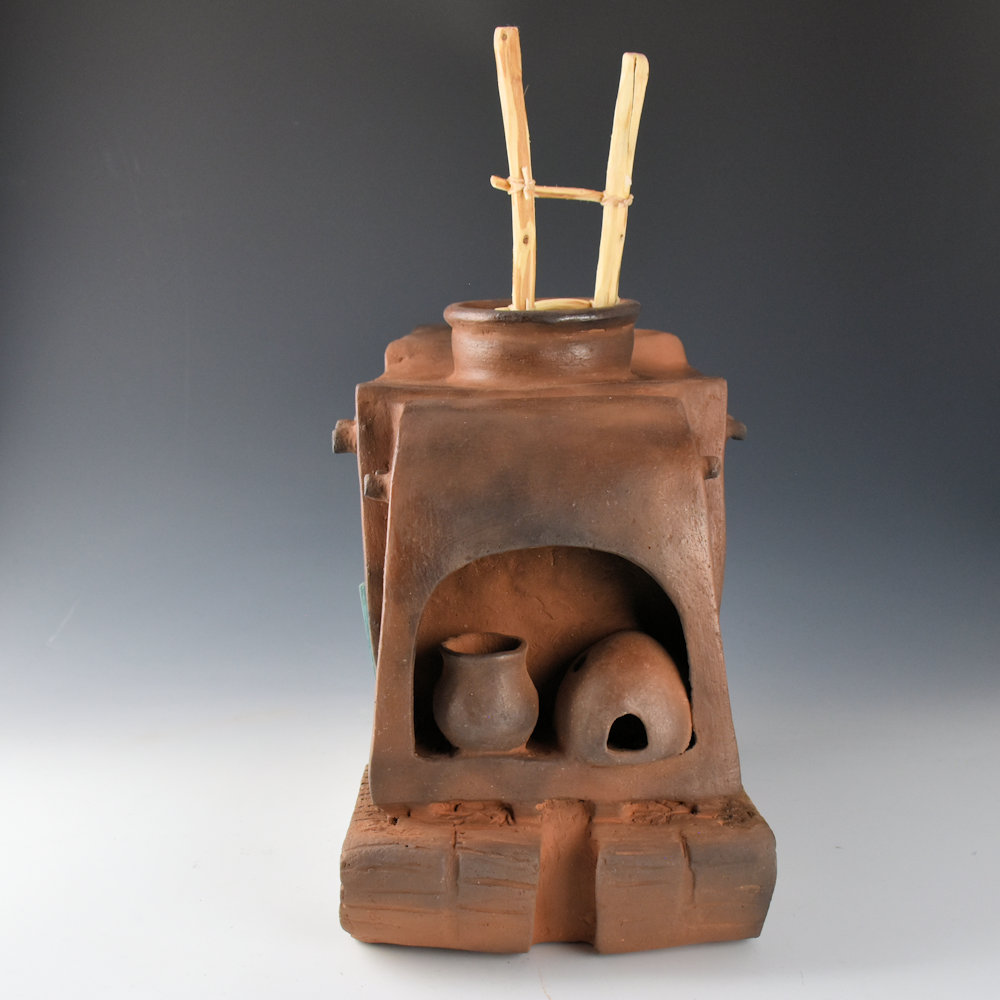
Earles, Chase Kahwinhut – Micaceous Jawa Trawler
$ 2,500.00
This is a unique piece by Chase Kawinhut Earles. This is part of his series focused on Indigenous Futurism as a means to better understand Caddo culture and pottery. Chase wrote of this piece:
It is titled, “In Memory of Crisita Romero” , short version: My Grandfather and my great Uncle General Scott Tonemah (Grandson of Stumbling Bear) would visit Taos and made a lifelong family friend, Crisita Romero. They made friends because Scott being Kiowa could speak Crisita’s language (Tiwa). She lived at Taos and became close to our family. We would visit her every year and we always remember her specific door, which I reproduced faithfully. She would always be selling us things each time we came whether pottery or art or weaving or food, cookies, breads. Reminds me of the lil jawas with a moving pueblo taking their wares from door to door.
The piece is made with traditional clay and pit-fired. Cedar and faux tendon ladder. Painted Wood door and window with window screen.
It is signed on the bottom “Kawinhut”. The name “Kawinhut” is important, as the last Caddo potter, Winhut, passed away in 1908 and Chase is continuing in her tradition of working with the clay and so his name is the masculine derivation of this family name.
The Caddo were a tribal group throughout the Oklahoma, Texas, and Louisianna areas. Chase draws inspiration from the ancient Caddo pieces and yet they are not replicas. The connection in the ancient work is in the clay, firing, and shapes. He is primarily self-taught both as a potter and in his research of the Caddo ceramic past. He has sought out the clay sources and each piece is coil built. They are then slipped with a clay and mussel shell mixture and then burnished three times. The result is a shiny surface with flecks of shell reflecting light. Each piece is then pit fired which not only hardens the clay but gives them fire clouds and color variations on the surface. After they are fired Chase etches into the surface of the clay to create intricate designs. The delicate designs are almost a surprise considering the hardness of the clay after the firing.
“I am working to both preserve and expand the cultural identity of the Caddo people through the revival of their pottery.” Chase Kawinhut Earles
Out of stock
This is a unique piece by Chase Kahwinhut Earles. This is part of his series focused on Indigenous Futurism as a means to better understand Caddo culture and pottery. Chase wrote of this piece:
It is titled, “In Memory of Crisita Romero” , short version: My Grandfather and my great Uncle General Scott Tonemah (Grandson of Stumbling Bear) would visit Taos and made a lifelong family friend, Crisita Romero. They made friends because Scott being Kiowa could speak Crisita’s language (Tiwa). She lived at Taos and became close to our family. We would visit her every year and we always remember her specific door, which I reproduced faithfully. She would always be selling us things each time we came whether pottery or art or weaving or food, cookies, breads. Reminds me of the lil jawas with a moving pueblo taking their wares from door to door.
The piece is made with traditional clay and pit-fired. Cedar and faux tendon ladder. Painted Wood door and window with window screen.
It is signed on the bottom “Kahwinhut”. The name “Kahwinhut” is important, as the last Caddo potter, Winhut, passed away in 1908 and Chase is continuing in her tradition of working with the clay and so his name is the masculine derivation of this family name.
The Caddo were a tribal group throughout the Oklahoma, Texas, and Louisianna areas. Chase draws inspiration from the ancient Caddo pieces and yet they are not replicas. The connection in the ancient work is in the clay, firing, and shapes. He is primarily self-taught both as a potter and in his research of the Caddo ceramic past. He has sought out the clay sources and each piece is coil built. They are then slipped with a clay and mussel shell mixture and then burnished three times. The result is a shiny surface with flecks of shell reflecting light. Each piece is then pit fired which not only hardens the clay but gives them fire clouds and color variations on the surface. After they are fired Chase etches into the surface of the clay to create intricate designs. The delicate designs are almost a surprise considering the hardness of the clay after the firing.
“I am working to both preserve and expand the cultural identity of the Caddo people through the revival of their pottery.” Chase Kahwinhut Earles
Brand
Earles, Chase Kahwinhut (b. 1976)
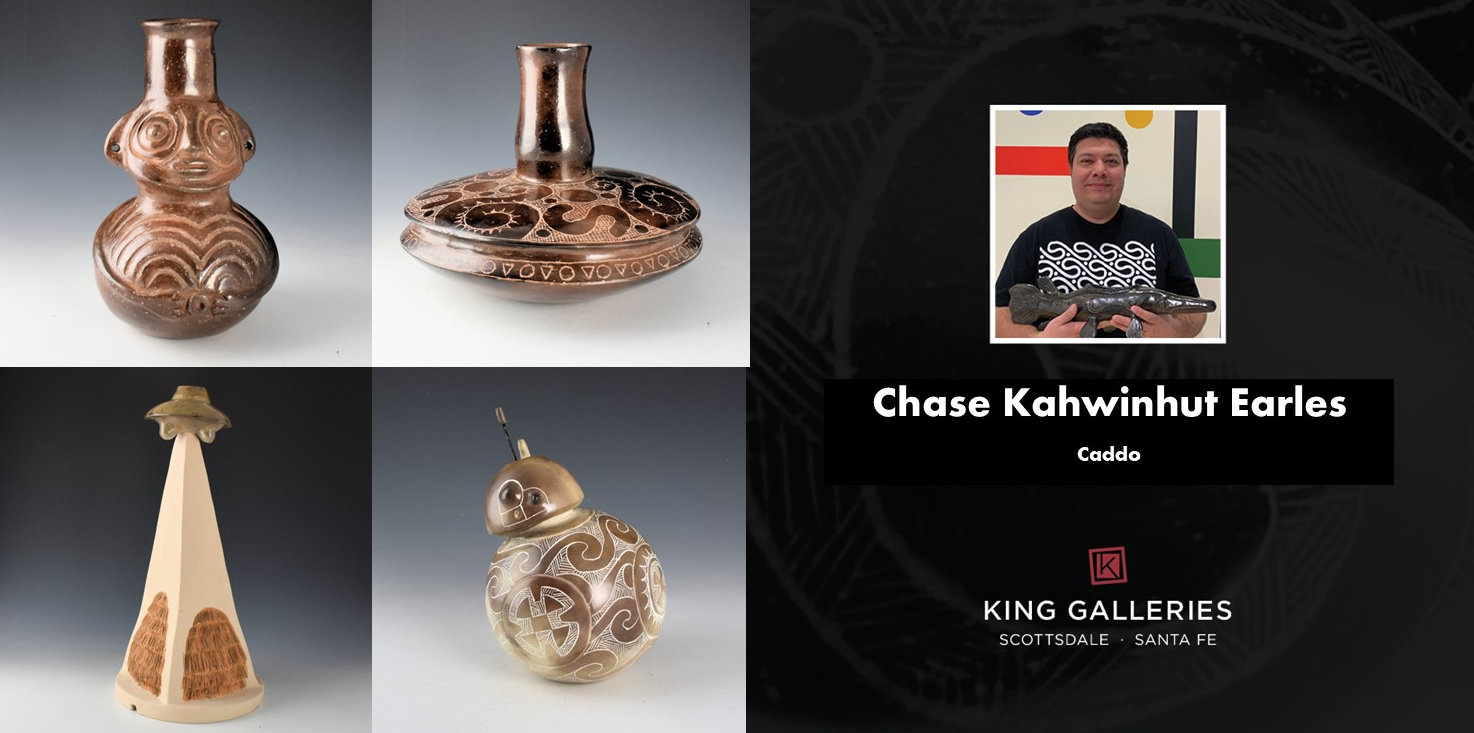 Chase Earles
Chase is one of the only Caddo potters working today. He says of his pottery, "My traditional Caddo pottery is built from handmade local and native clays. Most of the clay I use comes from sources on the White, Washita, and Red Rivers that I harvested and processed using ancient methods. After processing and preparing the clay with a temper of river mussel, sand, or bone, I hand coil the clay into form. Once the bottle or bowl has dried sufficiently, I pit fire the piece inside an open bonfire. This is the proper traditional method of ancient Caddo pit-firing.
Chase Earles says of his art form, "My contemporary Caddo pottery is inspired by my native tribe's ancient and unique heritage. It is their legacy that they wish to keep alive and advance by interpreting our ancient designs and symbols in a new and modern way using the methods and materials of our time. These pots of commercially produced clays are fired in a kiln using contemporary and experimental methods to produce striking surface effects and colors. However, no glaze is used. Instead, these pots are still all hand built using the coil method, built in the traditional shape and design of the Caddos, and hand-burnished to a glass-like sheen using a stone."
He has won numerous awards for his pottery, from Santa Fe Indian Market to the Cherokee Art Market.
Chase Earles further says, "Born in Oklahoma; I have always been an artist as long as I can remember, from the day the art teacher in kindergarten pulled me aside to draw something for the school. From then on, I was always drawing and painting, but until I found pottery, I didn't have a voice or a reason. Even as I decided to pursue pottery as a more hands-on approach and a closer-to-earth approach to art, I still lacked meaning. I had considered creating Pueblo pottery from the southwest, as that inspired me until I realized that because I am not a Pueblo native, I would be simply replicating Pueblo pottery and not truly creating it. That is until I connected with my tribe and heritage and learned of the true grandeur of our tradition and how it has been lost and hidden from the public. I then set forth almost obsessively learning the methods and designs of our tribe, creating works of art that are modernized to educate my tribe's people and the public about our tradition.
All of my tribe's ancient traditional pottery was hand-coiled from clay that was handmade from the local river source, which most notably included the Red River and the Arkansas River. These pottery pieces are then hand-burnished with a rock to look like glass without any glaze. The final touch before firing is the hand carving of the ancient scrolling designs, which include motifs centered around the origin stories of my Caddo people. Objects in the motifs include feathers, serpents, the sun and moon, and everlasting fire. What motivates me and challenges me to push the limits of describing our culture in my pottery art is the desire to truly educate people about what sets our tribe's tradition apart from all the other Southeastern tribes and to reveal to people the extent to which the Caddo's tradition was cherished by everyone across the nation in prehistoric and historic times."
ARTIST NEW ADDITION SUBSCRIPTION>
Chase Earles
Chase is one of the only Caddo potters working today. He says of his pottery, "My traditional Caddo pottery is built from handmade local and native clays. Most of the clay I use comes from sources on the White, Washita, and Red Rivers that I harvested and processed using ancient methods. After processing and preparing the clay with a temper of river mussel, sand, or bone, I hand coil the clay into form. Once the bottle or bowl has dried sufficiently, I pit fire the piece inside an open bonfire. This is the proper traditional method of ancient Caddo pit-firing.
Chase Earles says of his art form, "My contemporary Caddo pottery is inspired by my native tribe's ancient and unique heritage. It is their legacy that they wish to keep alive and advance by interpreting our ancient designs and symbols in a new and modern way using the methods and materials of our time. These pots of commercially produced clays are fired in a kiln using contemporary and experimental methods to produce striking surface effects and colors. However, no glaze is used. Instead, these pots are still all hand built using the coil method, built in the traditional shape and design of the Caddos, and hand-burnished to a glass-like sheen using a stone."
He has won numerous awards for his pottery, from Santa Fe Indian Market to the Cherokee Art Market.
Chase Earles further says, "Born in Oklahoma; I have always been an artist as long as I can remember, from the day the art teacher in kindergarten pulled me aside to draw something for the school. From then on, I was always drawing and painting, but until I found pottery, I didn't have a voice or a reason. Even as I decided to pursue pottery as a more hands-on approach and a closer-to-earth approach to art, I still lacked meaning. I had considered creating Pueblo pottery from the southwest, as that inspired me until I realized that because I am not a Pueblo native, I would be simply replicating Pueblo pottery and not truly creating it. That is until I connected with my tribe and heritage and learned of the true grandeur of our tradition and how it has been lost and hidden from the public. I then set forth almost obsessively learning the methods and designs of our tribe, creating works of art that are modernized to educate my tribe's people and the public about our tradition.
All of my tribe's ancient traditional pottery was hand-coiled from clay that was handmade from the local river source, which most notably included the Red River and the Arkansas River. These pottery pieces are then hand-burnished with a rock to look like glass without any glaze. The final touch before firing is the hand carving of the ancient scrolling designs, which include motifs centered around the origin stories of my Caddo people. Objects in the motifs include feathers, serpents, the sun and moon, and everlasting fire. What motivates me and challenges me to push the limits of describing our culture in my pottery art is the desire to truly educate people about what sets our tribe's tradition apart from all the other Southeastern tribes and to reveal to people the extent to which the Caddo's tradition was cherished by everyone across the nation in prehistoric and historic times."
ARTIST NEW ADDITION SUBSCRIPTION>