
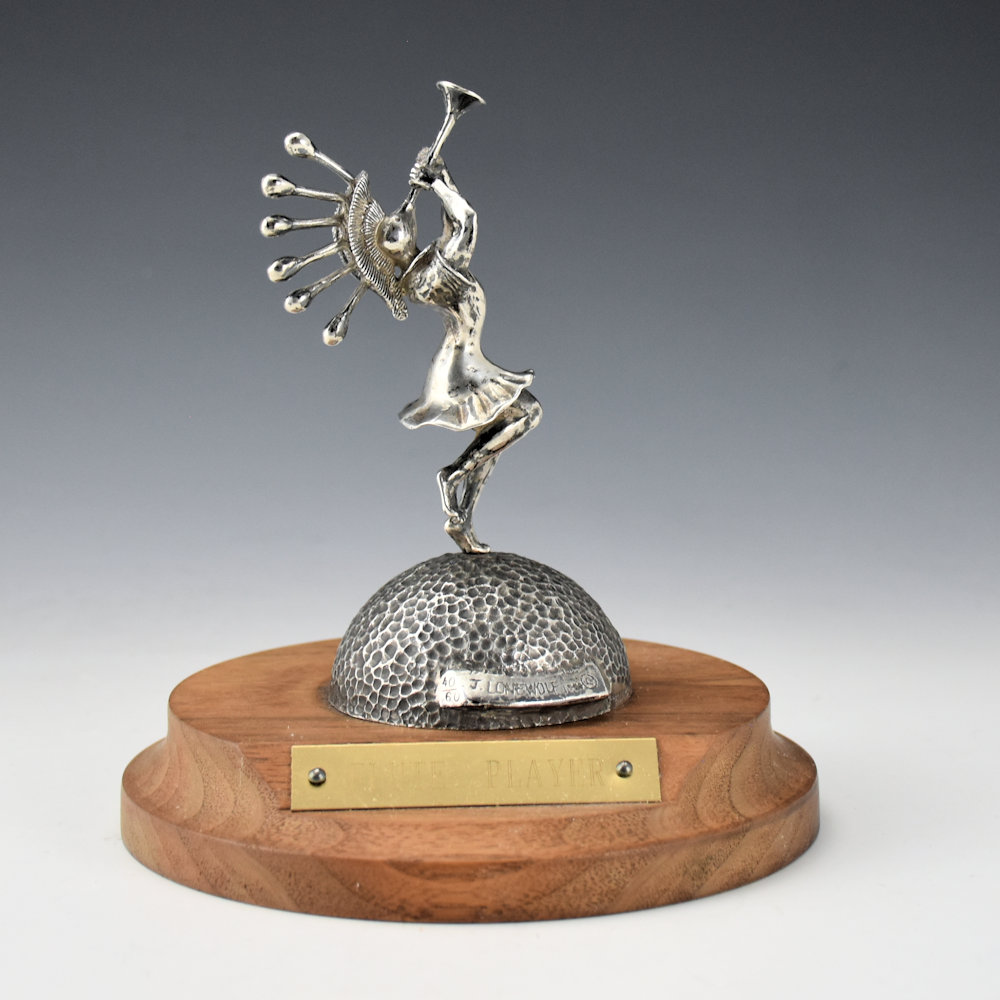

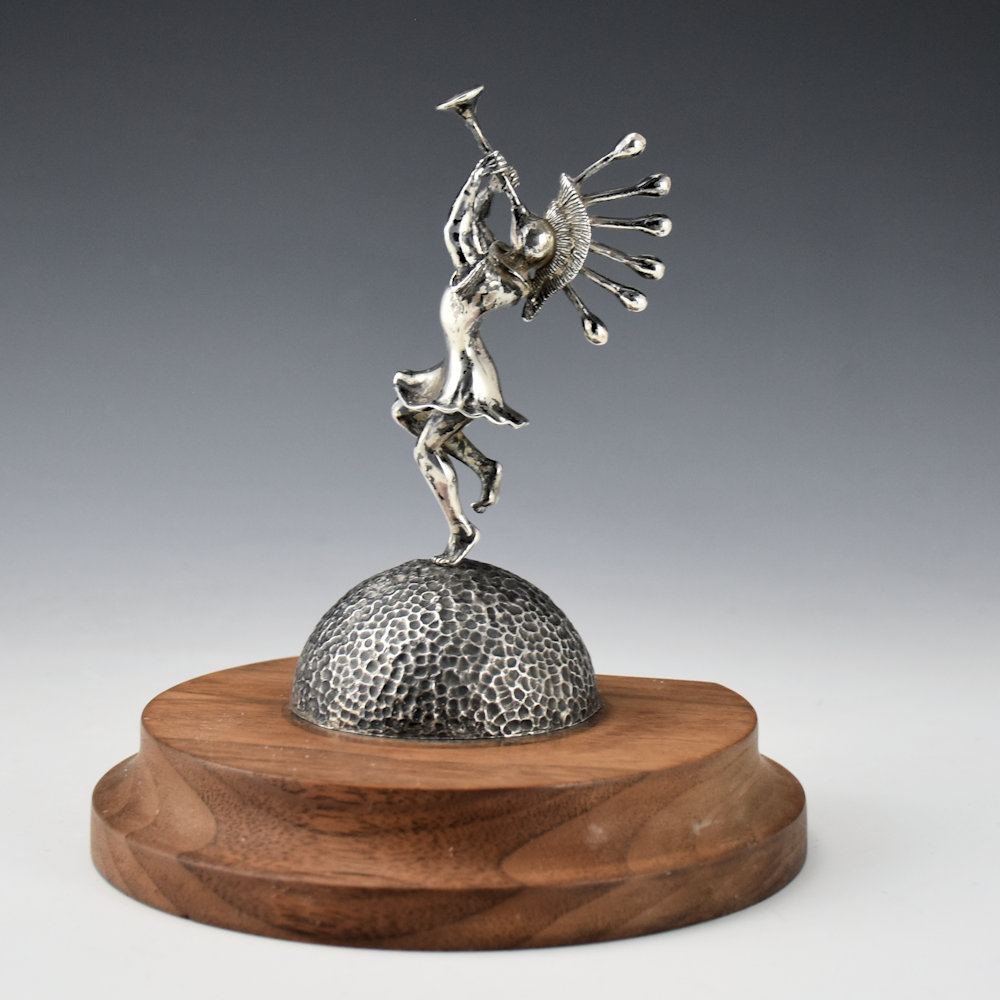
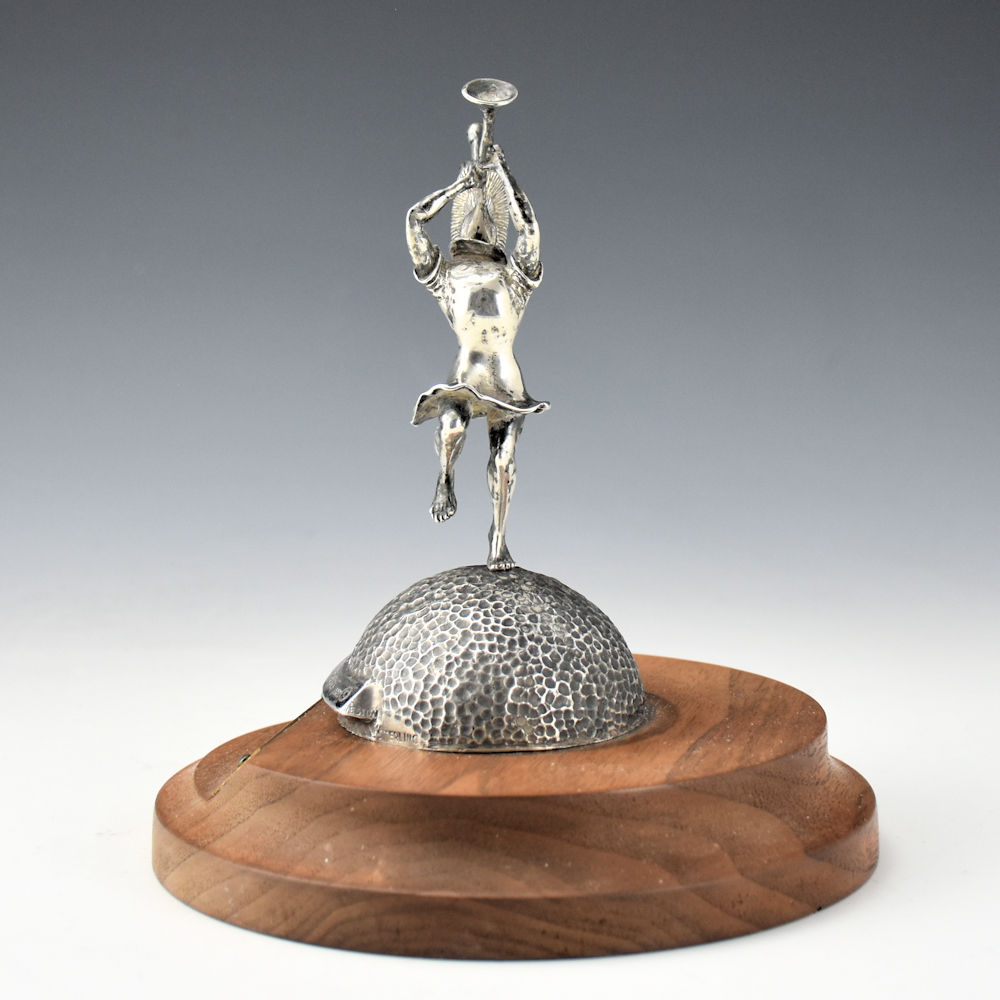
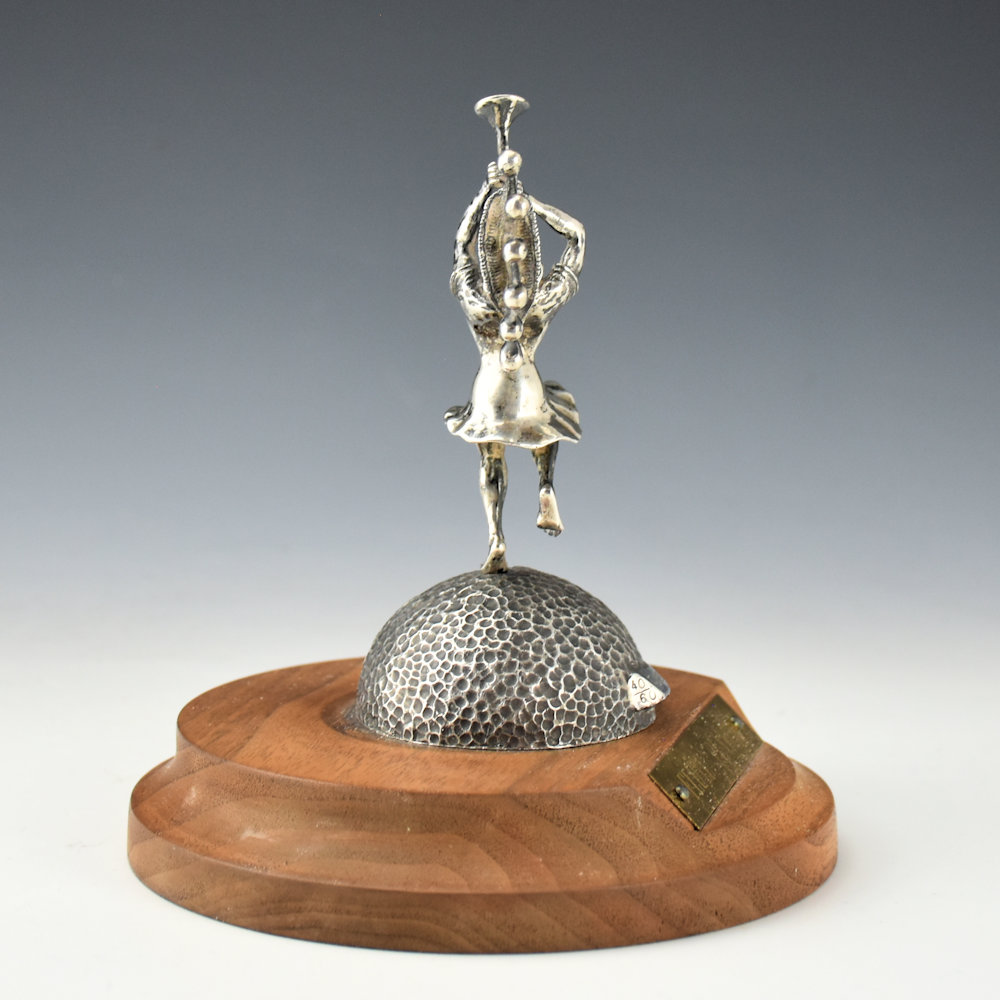
Lonewolf, Joseph – “Flute Player” Silver Casting, 40/60 (1980)
$ 2,200.00
Beginning in the early 1970’s, Joseph Lonewolf revolutionized the world of Santa Clara pottery by incorporating his sgraffito (lightly etching the surface of the clay) and incised (more deeply cut into the clay) designs. He was the first potter to begin making bronzes of his work in 1974. This piece is from 1980 and it is the last of his castings and it is from silver. It is the flute player which is often seen in his pottery. Joseph said of the flute player in his work:
“The flute player lifts his flute and calls the creatures. Encircled by the musical story coming from his flute, the flute player, symbolic of leadership, tells the animals to come forth”.
Lonewolf said of this bronze:
“Lonewolf captured the musculature of the flute player in the composition of his miniature sculpture. The well-developed muscles of the flute player – symbolic of leadership – portrays an image of a strong leader. A long-time symbol of Pueblo Indians, the flute player is very special to Lonewolf because he blesses all creates in life. Birds, fish reptiles, insects, even people. Lonewolf, who admires all creates of life and respects the clay from Mother Earth – a ‘living thing’ that provides food, plants, and animals – positioned the flute player standing on top of the world, the earth and its inhabitants, collectively, bestowing a musical blessing upon all living things.”
Interestingly, the piece was cast in “brown patina, silicon bronze, sterling silver, and white bronze. This piece is the sterling silver version. I think it was a total edition of 60 with 15 of each of the four types. The detail on the headdress and the body of the figure is exceptional. The piece is dated and the number is 40/60. It is in excellent condition.
Casting Clay: The Bronze Works of Joseph Lonewolf 1974-80
Out of stock
Beginning in the early 1970’s, Joseph Lonewolf revolutionized the world of Santa Clara pottery by incorporating his sgraffito (lightly etching the surface of the clay) and incised (more deeply cut into the clay) designs. He was the first potter to begin making bronzes of his work in 1974. This piece is from 1980 and it is the last of his castings and it is from silver. It is the flute player which is often seen in his pottery. Joseph said of the flute player in his work:
“The flute player lifts his flute and calls the creatures. Encircled by the musical story coming from his flute, the flute player, symbolic of leadership, tells the animals to come forth”.
Lonewolf said of this bronze:
“Lonewolf captured the musculature of the flute player in the composition of his miniature sculpture. The well-developed muscles of the flute player – symbolic of leadership – portrays an image of a strong leader. A long-time symbol of Pueblo Indians, the flute player is very special to Lonewolf because he blesses all creates in life. Birds, fish reptiles, insects, even people. Lonewolf, who admires all creates of life and respects the clay from Mother Earth – a ‘living thing’ that provides food, plants, and animals – positioned the flute player standing on top of the world, the earth and its inhabitants, collectively, bestowing a musical blessing upon all living things.”
Interestingly, the piece was cast in “brown patina, silicon bronze, sterling silver, and white bronze. This piece is the sterling silver version. I think it was a total edition of 60 with 15 of each of the four types. The detail on the headdress and the body of the figure is exceptional. The piece is dated and the number is 1/60. It is in excellent condition.
Brand
Lonewolf, Joseph (1932-2014)
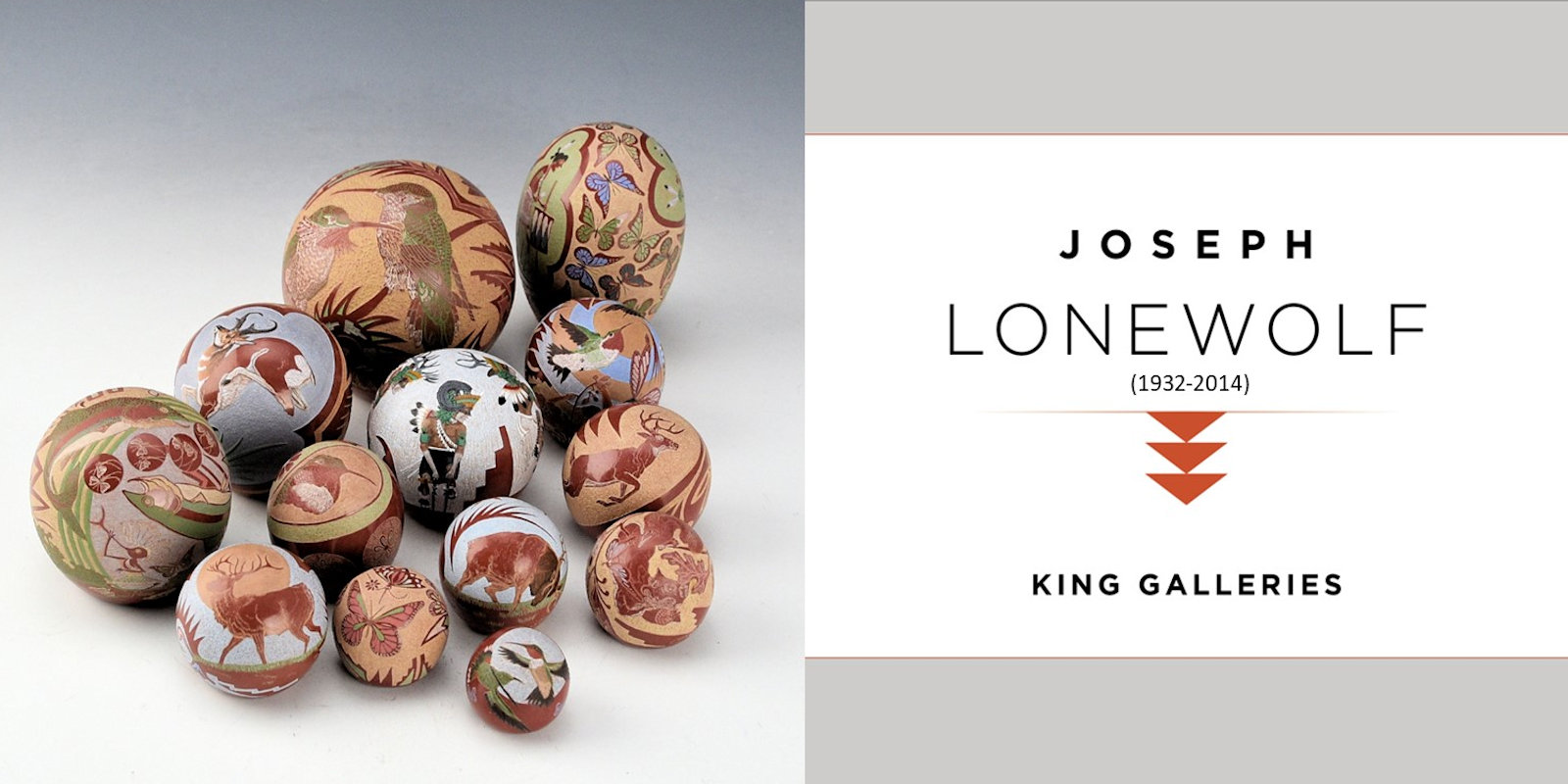
Joseph Lonewolf
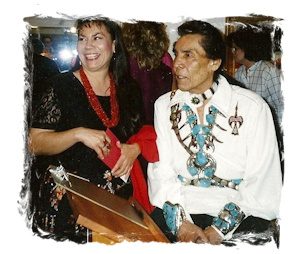 Joseph Lonewolf was a son of noted potters Camilio and Agapita Tafoya and the brother of Grace Medicine Flower. In the early 1970s, Joseph revolutionized the world of Santa Clara pottery by incorporating his sgraffito (lightly etching the surface of the clay) and incised (more deeply cut into the clay) designs in his work.
When Joseph and his family gather clay, they do it with the utmost respect. Before the clay can be taken from Mother Earth, they must say a prayer, asking to take the clay and tell the clay mother that they will take her and make her into a beautiful pot. The clay is brought home, and water is added to turn the clay into a liquid form known as slip. The slip is then strained to take out any rocks or debris, and then the clay can be dried, kneaded, and used.
Joseph was awarded numerous awards throughout his career, and his work can be found in museums worldwide. He has been featured in multiple books, including "The Art of Clay." He received the prestigious New Mexico Governor's Award for Excellence in the Arts in 2009 and the SWAIA Lifetime Achievement Award.
Joseph Lonewolf was a son of noted potters Camilio and Agapita Tafoya and the brother of Grace Medicine Flower. In the early 1970s, Joseph revolutionized the world of Santa Clara pottery by incorporating his sgraffito (lightly etching the surface of the clay) and incised (more deeply cut into the clay) designs in his work.
When Joseph and his family gather clay, they do it with the utmost respect. Before the clay can be taken from Mother Earth, they must say a prayer, asking to take the clay and tell the clay mother that they will take her and make her into a beautiful pot. The clay is brought home, and water is added to turn the clay into a liquid form known as slip. The slip is then strained to take out any rocks or debris, and then the clay can be dried, kneaded, and used.
Joseph was awarded numerous awards throughout his career, and his work can be found in museums worldwide. He has been featured in multiple books, including "The Art of Clay." He received the prestigious New Mexico Governor's Award for Excellence in the Arts in 2009 and the SWAIA Lifetime Achievement Award.